
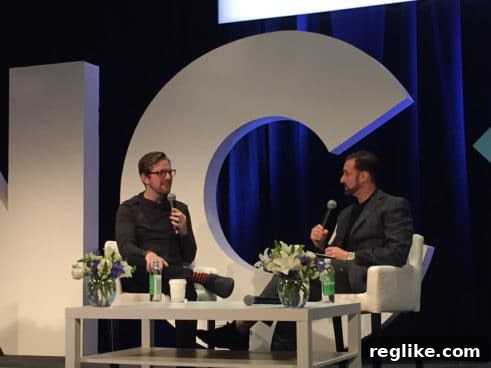
“The folks here in this room are perhaps more important than you realize.” With these profound words, Matt Mullenweg, the visionary CEO of Automattic and co-founder of WordPress, set a compelling tone for his discussion at NamesCon 2017. Held in Las Vegas, this premier event for the domain name industry served as the perfect platform for Mullenweg to articulate his enduring philosophy on the vital role of domain names in fostering an open, independent, and decentralized web.
Mullenweg’s address resonated deeply with sentiments he previously shared on Domain Name Wire Podcast #91, underscoring his consistent belief in the foundational importance of domain names. For him, these digital addresses are not merely technical identifiers but crucial pillars supporting the very freedom and vibrancy of the internet. In an era increasingly dominated by monolithic social media platforms and “walled gardens,” Mullenweg’s message served as a powerful call to action for preserving the original spirit of the web.
Embracing the Independent Web: A Call for Decentralization
The core of Mullenweg’s argument revolves around the concept of an independent web, free from the constraints and control of central entities. He passionately explained that a digital landscape where everyone defaults to profiles like “Facebook.com/” or “Twitter.com/” fundamentally undermines the openness and decentralization that fueled the internet’s initial growth and innovation. This reliance on proprietary platforms, while offering convenience, inherently centralizes control over user data, content, and online identities. Such a model, he cautioned, stifles independent thought, limits creative expression, and introduces points of vulnerability regarding censorship and data privacy.
For Mullenweg, the antidote to this centralization lies in empowering individuals and organizations with their own unique digital real estate. He famously declared that it is “integral to the freedom of the web that every man, woman, and child has a domain.” This isn’t just a technical aspiration; it’s a philosophical stance on digital self-sovereignty. Owning a domain name means owning your online identity, your content, and your data, rather than leasing it from a third-party platform. It represents a commitment to the principles of an open-source ethos, where individuals are creators and owners, not just users within someone else’s digital ecosystem. This independence is what ensures a diverse, resilient, and truly democratic internet, allowing for genuine innovation and unfiltered communication.
The Rise of .blog: Automattic’s Vision for New TLDs
Automattic, the company behind WordPress.com and the open-source WordPress project, is not just talking about an independent web; it’s actively building the infrastructure to support it. A significant part of this strategy is the investment in new generic top-level domains (gTLDs), particularly the .blog extension. Launched in November, the .blog domain name was introduced with a clear purpose: to provide a dedicated, recognizable space for bloggers, content creators, and publishers to establish their presence outside the crowded and often generic .com space.
Since its launch, the .blog TLD has seen promising early traction. Mullenweg reported that approximately 40,000 to 45,000 .blog names had been registered at the time of NamesCon 2017. A substantial portion of these registrations, around 17,000 to 18,000, were secured through WordPress.com, highlighting the symbiotic relationship between Automattic’s platforms and its new domain venture. Perhaps even more encouragingly, about half of all registered .blog domains are active, hosting unique and diverse content. This activation rate is a critical metric for new TLDs, indicating genuine usage rather than speculative registrations, and it speaks to the immediate utility and appeal of a domain explicitly tailored for blogging.
Normalizing Non-.com: The Path to Mainstream Acceptance
Mullenweg’s ambition for .blog and other new top-level domains extends beyond initial registration numbers. His ultimate goal is to elevate their prominence into the mainstream internet consciousness, transforming them from niche alternatives into widely accepted and utilized identifiers. He expressed a surprisingly “short horizon” for achieving this, believing it can be accomplished within just a few years. The primary challenge, as he candidly admitted, is to “normalize having something other than .com to the right of the dot.” This requires shifting deeply ingrained user habits and perceptions that have been shaped by decades of .com dominance.
Overcoming the .com default requires a concerted effort to educate, promote, and demonstrate the value of new TLDs. It involves showcasing their relevance, memorability, and ability to convey specific meaning or brand identity directly in the domain name. For content creators, a .blog domain instantly signals the nature of their site, potentially enhancing discoverability and brand recognition. This normalization isn’t just about awareness; it’s about building trust and demonstrating the legitimacy and professionalism that can be associated with these newer extensions.
Influencers and the Power of Early Adoption
While the initial launch showed promise, Mullenweg acknowledged that the founder’s program for .blog, designed to attract prominent figures and celebrities, didn’t entirely meet expectations. Fewer high-profile individuals than anticipated signed up, suggesting that even with a strong vision, breaking traditional domain habits takes time and persuasion. However, a significant turning point arrived with Tim Ferriss, a renowned author, entrepreneur, and podcaster, who made the strategic decision to switch his highly popular blog to Tim.blog. This move provided a powerful endorsement and a tangible example of the value proposition of the .blog TLD.
Mullenweg emphasized the importance of such “Tim-Ferriss-quality” individuals adopting .blog. The logic is simple: when influential figures, whose brands are built on credibility and innovation, embrace a new technology or platform, it significantly lowers the barrier to entry for a wider audience. Their adoption signals legitimacy, demonstrates practical application, and inspires confidence among general web users and aspiring bloggers. As more thought leaders and respected content creators migrate to .blog, it will naturally accelerate the normalization process, making it a more attractive and accepted choice for everyone.
Investing in the Future: WordPress’s $40 Million Advertising Push
Recognizing that awareness and acceptance require substantial investment, WordPress is dedicating significant resources to its advertising efforts in the coming year. Mullenweg announced an investment exceeding $40 million, a substantial sum aimed at expanding the reach and influence of both the WordPress platform and related initiatives. A portion of this significant budget is specifically earmarked for “Get.Blog,” a strategic campaign designed to promote and drive adoption of .blog domains. This targeted advertising is crucial for building widespread recognition and encouraging potential registrants.
The “Get.Blog” campaign will likely focus on highlighting the benefits of a .blog domain for various use cases, from personal blogs and professional portfolios to niche content sites and online communities. It will aim to differentiate .blog from other extensions, emphasizing its direct relevance to content creation and self-expression. By investing heavily in marketing, Automattic intends to create a compelling narrative around .blog, positioning it as the definitive choice for anyone looking to establish a credible and memorable online presence dedicated to blogging. This multi-faceted approach – combining technical infrastructure, strategic partnerships, and robust marketing – underscores Automattic’s long-term commitment to empowering the independent web and ensuring a diverse landscape of online identities.
The Broader Impact: Reshaping the Digital Landscape
Mullenweg’s vision at NamesCon 2017 was not merely about selling domain names; it was about shaping the future trajectory of the internet. By advocating for individual domain ownership and championing new TLDs like .blog, he is pushing back against the consolidation of power in the digital realm. The long-term impact of this push could be profound, fostering a more resilient internet where content creators have greater control over their intellectual property, their audience, and their revenue streams. It empowers small businesses and individual voices to compete on a more level playing field with larger entities.
The ongoing efforts by Automattic and the broader domain name community to normalize alternatives to .com represent a critical step towards realizing the full potential of the web. As more individuals embrace their own domains, the internet becomes a richer tapestry of diverse voices and independent platforms, true to its original design. Matt Mullenweg’s message at NamesCon 2017 serves as a powerful reminder that while technology evolves, the fundamental principles of openness, freedom, and decentralization remain paramount for a healthy and thriving digital ecosystem.