
The Aftermarket Domain Battle: Namecheap vs. GoDaddy in a High-Stakes Showdown
The intricate world of domain names, a crucial foundation for any online presence, is often marked by strategic alliances and fierce competition. Recently, a significant dispute has erupted between two giants in this space: Namecheap and GoDaddy. Richard Kirkendall, CEO of Namecheap, and Paul Nicks, President of Domains at GoDaddy, engaged in a public exchange that shed light on underlying tensions in the domain aftermarket. This article delves into the core of this disagreement, exploring the implications for domain investors, registrars, and the broader industry.
At the heart of the matter lies GoDaddy’s ownership of Afternic, a leading domain aftermarket platform that facilitates the sale of premium domain names. Namecheap operates as a key partner within the Afternic network, syndicating domains and sharing commissions on successful sales. This partnership, while mutually beneficial, has been strained by disagreements over pricing strategies and inventory management, leading to a public dispute that has garnered significant attention.
The Spark: Allegations of Inventory Restriction and Revenue Maximization
The conflict first came to light when Richard Kirkendall publicly asserted that GoDaddy was deliberately restricting certain Afternic inventory from being displayed on Namecheap’s platform. Kirkendall suggested that this action was a calculated move by GoDaddy to funnel more aftermarket sales through its own channels, thereby maximizing its revenue. When a domain is sold directly on GoDaddy’s platform, GoDaddy retains the full commission, whereas sales through partners like Namecheap require a commission split with Afternic.
Godaddy likes to do “tests” that censor out certain registrars because they have more sales. Their optimization involves trying to get the most sales to Godaddy themselves.
— Richard Kirkendall (@NamecheapCEO) March 31, 2022
This accusation raised questions about fair competition and the nature of partnerships in the domain industry. If a dominant player like GoDaddy can selectively control inventory distribution among its partners, it could potentially disadvantage competitors and limit choices for consumers seeking valuable digital assets.
Paul Nicks, representing GoDaddy, subsequently responded to Kirkendall’s claims, providing a counter-narrative and asserting GoDaddy’s position on the matter.
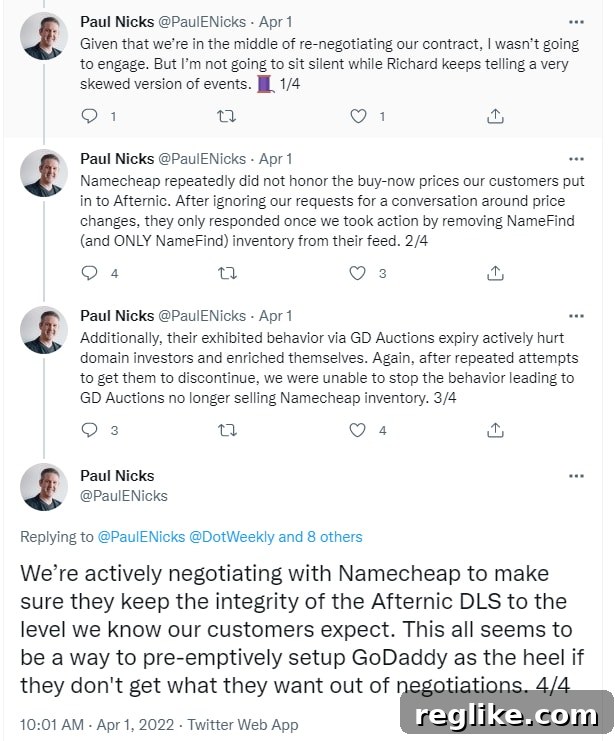
To fully understand the intricacies of this dispute, it’s essential to examine the specific points of contention raised by both parties.
The Afternic Inventory Conundrum: Markups, Discounts, and Pricing Integrity
One of the primary areas of disagreement revolves around the pricing mechanisms within the Afternic network. GoDaddy, through Afternic, typically allows its partners to apply a markup to sellers’ prices. This practice enables registrars to capture a larger commission on domain sales. In fact, reports have shown that registrars can add markups of up to 15% on Aftermarket domain names, influencing the final price paid by the buyer.
However, Namecheap chose a different approach. Instead of a markup, Namecheap introduced a slight discount of 3% on Afternic-syndicated domains. This bold move meant that Namecheap took a hit on its own commission but gained a competitive edge by offering lower prices to its customers. For domain investors and buyers consistently seeking the best deals, Namecheap’s discounted pricing became an attractive option. Many in the domain community, including this author, have directed buyers to Namecheap specifically for these savings, demonstrating the effectiveness of their strategy in attracting sales.
Apparently, this discounting strategy clashed with Afternic’s established policies. While Afternic permits partners to increase prices through markups, it reportedly does not allow for discounts. GoDaddy viewed Namecheap’s 3% discount as a breach of this policy, leading to punitive action. As a consequence, GoDaddy retaliated by removing its NameFind inventory – a portfolio of premium domains owned by GoDaddy – from being listed on Namecheap’s platform. This action directly impacted Namecheap’s available inventory and its ability to offer these desirable domains to its customer base.
From an objective standpoint, the practice of allowing markups but prohibiting discounts seems inherently imbalanced. If the goal is to provide flexibility to partners in adjusting prices, then both upward and downward adjustments should, in principle, be permitted. While GoDaddy might argue the need to maintain pricing integrity for sellers or prevent downward pressure on domain values, denying a partner the ability to offer a discount for competitive advantage, especially when markups are allowed, raises questions about fairness and equitable partnership terms. The notion that Namecheap “wouldn’t honor the buy now prices” seems less compelling when other registrars are actively increasing those prices.
The Expired Domains Dispute: Fulfillment Challenges and Marketplace Transitions
The second major point of contention centers on expired domain inventory. Historically, Namecheap partnered with GoDaddy Auctions to sell its expired domains, leveraging GoDaddy’s extensive auction platform and buyer reach. However, in November of the preceding year, Namecheap made a strategic decision to move its expired domain inventory to its own marketplace, seeking greater control and potentially better revenue capture.
This transition, however, introduced a new set of challenges. It appears that Namecheap was pulling back an unusually high number of domains late in the auction process. For buyers on GoDaddy Auctions, this phenomenon of “pullbacks” can be incredibly frustrating. When a buyer successfully bids on or purchases an expired domain, especially one registered with a partner registrar, there’s always a possibility that the original registrant might renew or transfer the domain at the last minute. While all registrars have different deadlines for these actions, encountering a renewal or transfer after a domain has been purchased through an auction, particularly in the final days of closeouts, leads to significant buyer disappointment and wasted effort.
The extent of Namecheap’s pullbacks remains unclear without precise data. However, the sentiment among buyers is that GoDaddy, as the platform facilitator, needs to do everything within its power to ensure the fulfillment of completed aftermarket purchases. High rates of pullbacks erode buyer trust in the auction process and can deter future participation, ultimately harming the entire ecosystem of expired domain sales. This aspect of the dispute highlights the critical importance of reliable transaction fulfillment in the domain aftermarket.
Escalation and Attempts at De-escalation
To provide a clearer timeline of events and Namecheap’s perspective, Richard Kirkendall offered additional details on the unfolding situation:
- Initially, GoDaddy not only removed its NameFind domains from Namecheap but Afternic also took the more severe step of pulling Namecheap’s entire portfolio from its syndication network. This meant Namecheap could no longer sell any Afternic-listed domains, not just GoDaddy’s own inventory.
- It was in response to these actions – the removal of NameFind inventory and the broader syndication pullback – that Namecheap decided to remove its expired domains from GoDaddy Auctions, shifting them to its proprietary marketplace. This suggests a reactive measure to GoDaddy’s earlier moves.
- Subsequently, in an apparent attempt to normalize the strained relationship and potentially de-escalate the conflict, Namecheap removed the 3% discount it had been offering on Afternic-syndicated names. This concession indicates Namecheap’s willingness to conform to Afternic’s pricing policies in hopes of restoring the partnership.
This sequence of events illustrates a tit-for-tat escalation, followed by Namecheap’s attempt at reconciliation through policy adjustment. The situation underscores the delicate balance of power and the strategic maneuvering involved in major domain industry partnerships.
Broader Implications for the Domain Industry
This dispute between Namecheap and GoDaddy carries significant implications for the wider domain industry:
-
Competition and Market Dominance: GoDaddy’s substantial market share and its ownership of key aftermarket platforms like Afternic give it considerable leverage. Concerns about potential anti-competitive practices or the stifling of smaller players are legitimate, especially if inventory is selectively controlled to favor GoDaddy’s own sales channels. This conflict highlights the ongoing debate about the concentration of power in the domain space.
-
Partner Relationships and Trust: The public nature of this disagreement can erode trust among partners in the Afternic network. Registrars rely on clear, consistent, and fair terms of engagement. When policies appear to be applied unevenly or in a punitive manner, it can destabilize existing partnerships and deter new ones.
-
Consumer Impact: Ultimately, these disputes affect domain buyers and sellers. Restrictions on inventory, changes in pricing models, or issues with transaction fulfillment can limit choices, increase costs, or create frustration for those looking to acquire or divest digital assets. A healthy, competitive aftermarket benefits everyone through transparency and diverse options.
-
Policy Clarity: The incident brings to light the need for explicit and unambiguous policies regarding pricing, discounts, and inventory management for syndication partners. Clear guidelines can prevent misunderstandings and foster more stable relationships.
Conclusion: Hopes for Resolution and Fair Play
The ongoing disagreement between Namecheap and GoDaddy is more than just a corporate spat; it reflects deeper tensions within the domain aftermarket regarding fair competition, partner autonomy, and consumer choice. It would be a significant loss for the domain community if Namecheap were permanently unable to sell Afternic inventory, as it would reduce competition and limit options for buyers.
While GoDaddy has a legitimate interest in managing its network and upholding its policies, the practice of allowing markups but disallowing discounts from partners deserves critical re-evaluation. Similarly, Namecheap, and indeed all registrars, bear the responsibility of ensuring reliable fulfillment in expired domain transactions to maintain buyer confidence.
One can only hope that these two influential companies can navigate their differences and arrive at a mutually agreeable resolution. A collaborative approach, prioritizing fair play and the health of the broader domain ecosystem, will ultimately serve the best interests of domain investors, businesses, and individuals seeking to establish their vital presence online.