
Canadian Appeals Court Upholds Michaels.ca Domain Transfer in Pivotal Trademark Infringement Case
In a significant ruling for brand protection and domain name integrity in the digital age, a Canadian appeals court has firmly sided with the renowned crafts store chain, Michaels (NASDAQ:MIK), in its long-standing dispute over the domain name Michaels.ca. This decision reaffirms the lower court’s judgment, mandating the transfer of the domain to the retail giant, bringing an end to a compelling saga of online identity and trademark rights.
The party at the losing end of this protracted legal battle is an individual whose surname, coincidentally, is Michaels. David Michaels, the domain registrant, found himself in a complex legal challenge against a corporate entity bearing the same name, highlighting the intricate landscape of digital branding and the potential for conflict when personal identity intersects with established commercial trademarks.
The Genesis of a Domain Name Dispute: Michaels.ca at the Heart of the Matter
The story of the Michaels.ca domain name dates back to 2001 when David Michaels initially registered it. For several years, the domain remained relatively inactive in a commercial sense. However, the trajectory of this digital asset changed significantly in 2009 when Mr. Michaels began utilizing it to operate an online retail venture. This pivotal shift from a personal registration to a commercial enterprise marked the beginning of what would evolve into a substantial legal confrontation.
Michaels Stores, Inc., a leading North American specialty retailer of arts, crafts, framing, floral, and decorative items, viewed this commercial use as a direct infringement upon its established brand identity and trademarks. The company expressed considerable concern that Mr. Michaels’ commercial operation under Michaels.ca was designed, whether intentionally or not, to capitalize on the potential confusion among internet users searching for the well-known crafts retailer. In a competitive online marketplace, such confusion can lead to diversion of traffic, loss of potential customers, and dilution of a brand’s hard-earned reputation. The image below provides a glimpse into what the Michaels.ca website looked like in May 2014, precisely one month after Michaels Stores initiated its lawsuit, offering context to the retailer’s concerns.
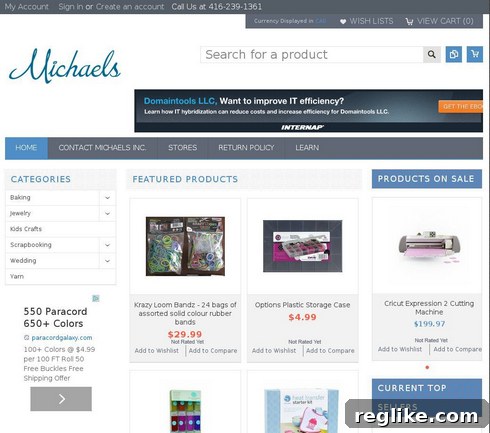
For comparison, the official website of the Michaels crafts store chain can be found at Michaels.com, allowing observers to note the distinct differences and potential areas of overlap that could lead to consumer confusion.
A Clash of Identities: The Defendant’s Perspective and Key Contentions
From David Michaels’ perspective, the narrative takes a different turn. He contended that the confusion, far from being his making, actually intensified when Michaels Arts & Crafts, the corporate entity, underwent a significant rebranding. This rebranding saw the company simplify its name to simply “Michaels” and, more importantly, adopt a new corporate logo that Mr. Michaels claimed bore a striking resemblance to his own personal signature. This assertion formed a cornerstone of his defense, suggesting that any confusion stemmed from the retailer’s actions rather than his own.
According to Mr. Michaels, the first direct communication from the retailer regarding the domain occurred in 2012. At this time, Michaels Stores allegedly contacted him with a demand for the transfer of the Michaels.ca domain name. The company reportedly offered $10,000 for the transfer, along with an assurance that no further legal claims would be pursued if he complied. This initial offer set the stage for a series of negotiations that would ultimately fail to resolve the dispute amicably.
In response to the retailer’s demands, Mr. Michaels recounted retaining legal counsel. His aim, he stated, was to challenge and potentially cancel the U.S. trademarks held by Michaels Stores, Inc., a bold counter-move designed to strengthen his position. Following this legal engagement, Mr. Michaels claimed that the retailer escalated its offer, proposing a sum of $100,000 for him to drop his efforts and transfer the domain. Despite this substantially increased offer, he declined, citing the significant traffic his website received – reportedly more than one million visitors annually – which underscored the perceived value of the Michaels.ca domain to his online business.
Adding another layer of complexity to the pre-litigation phase, Mr. Michaels also asserted that he had entered into a verbal agreement with Michaels Stores in 2012. Under the terms of this alleged agreement, if he refrained from offering custom framing services on his Michaels.ca website, the retailer would, in turn, agree not to pursue legal action against him. This purported understanding, if true, would have provided a temporary truce, but its validity and implications would later be scrutinized within the legal proceedings.
The Legal Battle Commences: Lawsuit, Default Judgment, and Appeal
Despite the alleged verbal agreement and previous negotiation attempts, Michaels Stores proceeded to file a lawsuit against Mr. Michaels’ company in Canadian court in April 2014. While the exact trigger for the lawsuit at that specific moment remains somewhat opaque, archived screenshots from the Michaels.ca website provide crucial context. These images reveal that Mr. Michaels had, at some point, adopted a logo on his site that he claimed was similar to his signature, but which likely exacerbated the potential for confusion among internet users seeking the well-known crafts retailer. Furthermore, the Michaels.ca store itself also featured and sold craft-related items, placing it in direct competition and adjacency to the core business of Michaels Stores.
The legal process took a decisive turn when Mr. Michaels failed to submit a defense within the stipulated timeframe. This procedural misstep led the judge to grant a motion for default judgment in favor of Michaels Stores. A default judgment is a binding ruling made by a court in favor of one party based on the other party’s failure to take legal action or defend their case. In this instance, the court consequently issued an order for the immediate transfer of the Michaels.ca domain name to the corporate plaintiff, a significant blow to Mr. Michaels’ online venture. The initial court order for the domain name transfer can be reviewed in detail via this PDF document.
Undeterred by the default judgment, Mr. Michaels exercised his right to appeal the decision. He took his case to the Federal Court of Appeal, seeking to overturn the lower court’s ruling and reclaim his domain. However, in a development that solidified the retailer’s victory, the Court of Appeal recently affirmed the lower court’s decision. This affirmation means the appellate court found no reversible error in the original judgment and upheld the order for the Michaels.ca domain name to be transferred to Michaels Stores, Inc., bringing the legal journey to a conclusive end. The details of the Federal Court of Appeal’s affirmation are also available in this PDF document.
Implications and Lessons from the Michaels.ca Domain Dispute
The Michaels.ca domain name dispute serves as a compelling case study with far-reaching implications for businesses, individuals, and the broader landscape of intellectual property in the digital realm. For established corporations like Michaels Stores, it underscores the critical importance of proactive brand protection, diligent trademark monitoring, and robust enforcement strategies. In an era where a company’s online presence is paramount to its commercial success, safeguarding domain names that are intrinsically linked to core brand identity is non-negotiable. The legal victory for Michaels reinforces the principle that even if a domain is registered by an individual sharing a common name, commercial use that creates consumer confusion with an established trademark can lead to a mandated transfer.
For individual domain registrants, particularly those whose personal names might coincide with prominent brands, this case offers a stark reminder of the potential pitfalls. While the right to register a domain name under one’s own name is generally recognized, the moment that domain is leveraged for commercial purposes in a manner that encroaches upon or confuses consumers with an existing, well-known trademark, the registrant enters a high-risk territory. This applies especially when the goods or services offered are similar to those of the trademark holder. The outcome of this case highlights the immense power of trademark law in protecting brand equity, often superseding claims based solely on a personal name when commercial intent and consumer confusion are present.
Moreover, the dispute sheds light on the intricacies of legal proceedings, particularly the severe consequences of failing to adhere to procedural requirements, as evidenced by the default judgment against Mr. Michaels. It also illustrates the financial and emotional toll of protracted legal battles, even for a large corporation, and certainly for an individual. The alleged negotiation attempts, including a significant six-figure offer, underscore the immense value businesses place on their digital assets and the lengths they are willing to go to protect them.
In conclusion, the Canadian court’s decision regarding Michaels.ca is a clear affirmation of trademark rights in the digital sphere. It sends a strong message to both brand owners and domain registrants about the necessity of vigilance, due diligence, and respectful coexistence in the crowded and competitive online world. As businesses continue to expand their digital footprints, understanding and navigating the complexities of domain name disputes and trademark law will remain crucial for safeguarding brand integrity and ensuring a fair online marketplace.