
Unlocking the Potential: A Deep Dive into .CN Domain Investment
In the vast and rapidly expanding digital landscape, domain names serve as crucial digital real estate. For investors and businesses looking to tap into the immense Chinese market, the .CN domain extension presents a unique and compelling opportunity. Kassey Lee examines the critical distinctions between second-level .cn domains and their third-level counterparts, offering invaluable insights for strategic investment.

Navigating the .CN Domain Landscape: Second vs. Third Level
The .cn extension stands as the second-largest country-code top-level domain (ccTLD) globally, surpassed only by the ubiquitous .com. This makes it an incredibly attractive prospect for domain investors seeking to capitalize on China’s booming internet penetration and digital economy. Investors have several choices when considering .cn domains, primarily revolving around two distinct registration levels: second-level and third-level domains.
Second-level .cn domains offer direct, concise branding opportunities, such as Amazon.cn or Godaddy.cn. These are often considered premium assets due to their brevity and immediate recognition. In contrast, third-level domains, often referred to as subdomains, are registered under a pre-existing second-level .cn domain. Examples include Apple.com.cn, SinoData.net.cn, and HydroPower.org.cn, which are subdomains of com.cn, net.cn, and org.cn respectively. Understanding the historical context and current regulatory environment surrounding these options is paramount for any serious investor.
The Evolution of .CN Domain Registration Policies
The history of .cn domain registration reveals a journey of gradual liberalization and increasing accessibility. When the Chinese extension was initially launched in 1990, direct registration of second-level .cn domains was not permitted. The Chinese government, through its regulatory bodies, opted for a more controlled and structured rollout, allowing registrations only for third-level domains under a specific set of predefined second-level domains. This initial structure aimed to categorize and manage internet resources effectively based on their nature and purpose. The following table illustrates the initial framework of available third-level domains:
| Domain | Description |
|---|---|
| Com.cn | Designated for commercial enterprises and business entities. This was, and remains, a significant category for profit-oriented organizations. |
| Net.cn | Intended for network service providers, internet infrastructure, and related technical entities. |
| Org.cn | Reserved for non-profit organizations, associations, and civic groups. |
| (adm).cn | Specifically for administrative districts and local government bodies within China, such as BJ.cn for Beijing. |
| Gov.cn | Exclusively for central government institutions and agencies. |
| Ac.cn | Dedicated to academic research institutions and scientific academies. |
| Edu.cn | Used by educational institutions, including universities, colleges, and schools. |
| Mil.cn | Strictly reserved for military organizations and defense-related entities. |
This initial, highly segmented approach ensured that different sectors of Chinese society had their dedicated online spaces. However, the burgeoning growth of the internet and increasing demand for direct, impactful online identities led to a significant policy shift. This pivotal change occurred in 2003 when the China Internet Network Information Center (CNNIC) liberalized the registration policies, finally allowing the direct registration of second-level .cn domains. This opened up a floodgate of opportunities, transforming the .cn market and making it a truly competitive and dynamic space for businesses and investors alike.
Regulatory Hurdles: The ICP License Requirement
Investing in .cn domains, particularly with the intent to operate a website in China, comes with a critical regulatory consideration: the ICP (Internet Content Provider) license. This license is a mandatory requirement imposed by the Chinese Ministry of Industry and Information Technology (MIIT) for any website hosted on a server within mainland China. It serves as a regulatory measure to control and monitor online content, ensuring compliance with Chinese laws and regulations. An example of an ICP license number can typically be found displayed prominently in the footer of websites like Amazon.cn.
The application process for an ICP license can be complex and time-consuming, often requiring applicants to have a registered entity in China or a partnership with a local entity. Furthermore, the Chinese government has become increasingly stringent in its review and approval process, especially concerning the verification of an organization’s status. In recent years, confirming non-profit organization status for entities seeking an org.cn subdomain has become particularly challenging. This increased scrutiny makes it significantly more difficult, if not impossible, for foreign investors to sell or utilize org.cn subdomains for commercial or even legitimate non-profit purposes without navigating substantial bureaucratic hurdles.
Beyond the challenges with org.cn, several other third-level domains remain highly restricted and are not viable for general investment purposes. These include (adm).cn, Gov.cn, Ac.cn, Edu.cn, and Mil.cn, all of which are reserved for specific government, academic, or military entities. Therefore, for most domain investors looking at the broader market, the viable choices for investment boil down to second-level .cn domains, or the commercial (com.cn) and network (net.cn) third-level subdomains.
Market Trends: Second-Level .CN Dominance
To provide a clear understanding of the market dynamics, I have reviewed the comprehensive “China Statistical Report on Internet Development” published annually by the China Internet Network Information Center (CNNIC) from 1997 to 2021. This invaluable resource offers a detailed historical perspective on domain registrations within China, providing empirical data to inform investment strategies. Analyzing the numbers of domains registered across different categories reveals a consistent and undeniable trend.
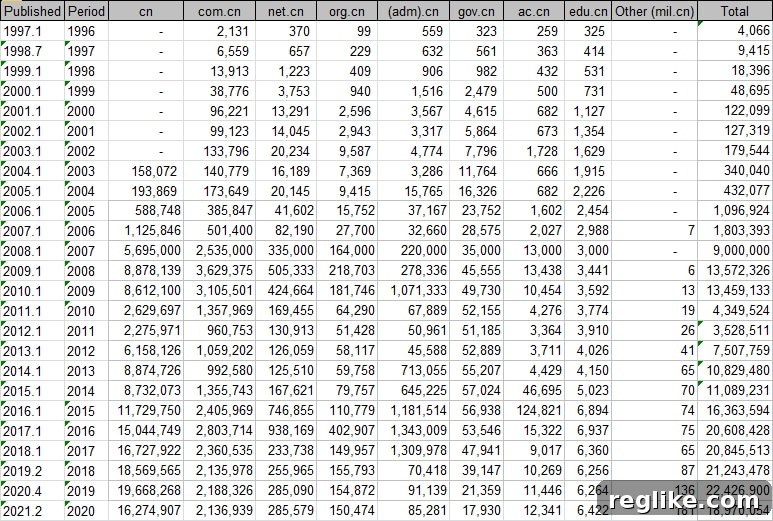
The statistical data unequivocally points towards a strong preference and accelerating growth in second-level .cn domain registrations. While com.cn and net.cn subdomains continue to hold a significant presence, their growth trajectory has been overshadowed by the rapid expansion of direct .cn registrations. This trend is driven by several factors: the desire for cleaner, more memorable branding; the perceived premium value of a direct ccTLD; and potentially, a simplified brand messaging that resonates better with modern internet users and businesses. For brands, a domain like BrandName.cn conveys a clearer and more authoritative presence than BrandName.com.cn, which can sometimes be perceived as a subsidiary or a regional extension of a .com entity.
Strategic Investment in the .CN Market
Given the regulatory landscape and the clear market trends, the strategic choice for domain investors seeking the largest pool of potential buyers and the highest return on investment becomes evident: focus primarily on second-level .cn domains. These domains offer unparalleled branding opportunities, direct appeal, and align with the current growth trajectory of the Chinese internet market. While com.cn and net.cn subdomains can still represent viable opportunities, particularly for niche markets or for those with an existing presence under these older structures, they generally do not command the same premium or broad appeal as their second-level counterparts.
When considering second-level .cn domains, investors should prioritize several key characteristics: brevity, memorability, relevance to the Chinese market (e.g., Pinyin names, common English words relevant to popular industries), and brandability. The booming e-commerce, technology, and service sectors within China continuously drive demand for strong, market-relevant domain names. Understanding local trends, emerging industries, and popular keywords will provide a significant edge in identifying high-value .cn domain assets.
Furthermore, staying informed about evolving regulatory policies from the CNNIC and MIIT is crucial. The Chinese internet landscape is dynamic, and policy changes can significantly impact domain valuation and usability. By prioritizing direct .cn domains, understanding the ICP licensing implications, and staying attuned to market shifts, investors can position themselves for substantial success in this exciting and high-growth market.
Conclusion: Seizing the .CN Opportunity
The .cn domain extension offers a formidable gateway to the world’s largest internet user base. Its evolution from a restricted, third-level-only system to a thriving market dominated by direct second-level registrations underscores the dynamism and immense potential of the Chinese digital economy. While the historical significance of com.cn and net.cn subdomains remains, the overwhelming data and market preference highlight second-level .cn domains as the prime focus for savvy investors.
Navigating the regulatory environment, particularly the nuances of the ICP license, is a critical component of any successful .cn domain strategy. By focusing on premium second-level names that resonate with the Chinese market and understanding the broader implications of local regulations, investors can unlock significant value. The clear choice for those aiming to tap into the largest pool of potential buyers and secure a robust digital presence in China is to strategically invest in second-level .cn domains, ensuring a powerful and direct brand identity in this ever-expanding digital frontier.