
Beware of Domain Renewal Scams: Protecting Your Digital Assets from Phishing Attacks
In the vast and ever-evolving landscape of the internet, owning a domain name is akin to owning prime digital real estate. It’s your online identity, your brand’s cornerstone, or the digital home for your personal projects. However, just as physical property can attract unwanted attention, domain names are constant targets for malicious actors seeking to exploit unsuspecting owners. One of the most pervasive and insidious threats comes in the form of fake domain renewal notices, meticulously crafted to steal your sensitive credit card information and compromise your digital security.
The history of internet scams is long and storied, with tactics continually adapting to bypass new security measures and user awareness. While past high-profile operations, such as the suspension of Domain Registry of America by ICANN, illustrate efforts to combat large-scale fraudulent practices, new scams emerge almost daily. These sophisticated phishing attempts leverage fear, urgency, and often a clever mimicry of legitimate entities to trick domain owners into divulging financial data.
The Anatomy of a Deceptive Domain Renewal Scam
Understanding the intricate design of these scams is the first step toward defense. Recently, a prime example came to light through the vigilance of Joseph Peterson, who shared a novel phishing attempt he encountered. This particular scam highlights how attackers personalize their approach to maximize their chances of success.
The Lure: Urgent and Personalized Notifications
Joseph received an email bearing the subject line “something.com EXPIRATION!”, where “something.com” was cleverly substituted with one of his actual domain names. This level of personalization immediately lends a veneer of authenticity. While his domain was genuinely registered and not due for expiration until the following year, the email falsely claimed an imminent expiration date, specifically October 14th. This tactic creates a sense of urgency, pressuring the recipient to act quickly without thoroughly verifying the information.
A particularly jarring detail in this specific scam was the advertised renewal price: an astonishingly low $3 for a full year. Such an offer should immediately raise a red flag for any seasoned domain owner. Legitimate domain renewals typically cost anywhere from $10 to $25 or more annually, depending on the domain extension (TLD) and the registrar. A price point significantly below wholesale value is a clear indicator that no actual service will be provided, and the primary goal is financial exploitation.
The Trap: A Sophisticated Phishing Page
Upon clicking the payment link embedded within the fraudulent email, victims are directed to a meticulously crafted phishing page. This page is designed to mimic official and authoritative bodies within the internet ecosystem, particularly ICANN (Internet Corporation for Assigned Names and Numbers). The visual deception is often striking:
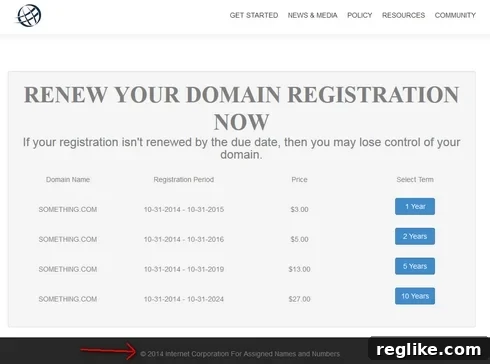
Several key elements contribute to the deception:
- ICANN Impersonation: The site prominently displays the official ICANN logo and even includes a fabricated ICANN copyright notice at the bottom of the page. This is a deliberate attempt to leverage ICANN’s authority and perceived trustworthiness.
- Fake Legitimacy: To further enhance credibility, some phishing sites go so far as to include links to genuinely recent ICANN news and media stories at the top. This gives the impression that the site is an authentic portal or information hub related to domain governance.
- Unrealistic Pricing: As mentioned, the renewal prices presented on these pages are always significantly below wholesale rates. This should be a critical warning sign. Legitimate registrars need to cover their own costs, including ICANN fees and operational expenses, making such low prices economically unviable for actual service provision. The scammer’s only intent is to harvest your payment details.
- Dynamic URL Manipulation: These scams often utilize clever URL structures to personalize the display for each victim. For instance, the URL might look something like
domaiinregistration.com/?domain=something.com&date=10-14-2014. By simply altering the parameters in the URL, the page dynamically changes the displayed domain name and expiration date, making each interaction feel tailored and legitimate to the individual target. This sophisticated use of dynamic content makes it harder for casual observers to spot the fraud.
The Scam’s Infrastructure: A Fleeting Digital Footprint
The domain used in Joseph’s example, domaiinregistration.com (note the double ‘i’ – a common typo-squatting tactic), was registered on September 18th to an individual listing an address in China, through the registrar Chengdu West Dimension Digital Technology Co., Ltd. This rapid registration of a new, subtly misspelled domain name is characteristic of phishing operations. Scammers continuously rotate through new domains to evade detection and takedown efforts. As soon as one fraudulent domain is identified and shut down by authorities or registrars, the perpetrators simply register another, upload their phishing site, and continue their email campaigns, often using publicly available WHOIS data to target new victims.
Why These Scams Are So Effective
The success of domain renewal scams lies in a combination of factors that exploit human psychology and the complexities of the internet:
- Lack of Awareness: Many domain owners, especially small business owners or individuals, are not fully conversant with the nuances of domain registration, renewal cycles, or the roles of entities like ICANN versus registrars.
- Fear and Urgency: The threat of losing a valuable domain name, combined with a false sense of immediate action required, overrides rational thought and verification processes.
- Information Overload: In a world inundated with emails, distinguishing legitimate notifications from sophisticated phishing attempts can be challenging, especially when communications mimic official sources closely.
- Complexity of the Domain Ecosystem: The multi-layered structure involving registries, registrars, and resellers can be confusing, making it easier for scammers to impersonate any of these entities.
- Sophisticated Phishing Techniques: Modern phishing emails are often grammatically correct, visually appealing, and personalized, making them much harder to identify than older, cruder attempts.
Safeguarding Your Digital Assets: Prevention and Best Practices
Protecting your domain names and personal information requires vigilance and adherence to best cybersecurity practices. Here are essential steps to identify and avoid domain renewal scams:
1. Verify the Sender and Email Authenticity
- Check the Email Address: Always examine the full sender email address, not just the display name. Look for subtle misspellings (e.g., “[email protected]” instead of a legitimate registrar’s domain).
- Hover Over Links: Before clicking any link, hover your mouse cursor over it to reveal the actual URL. If it doesn’t match your known registrar’s domain, or looks suspicious (e.g., typo-squatted domains like “domaiinregistration.com”), do not click.
- Look for Generic Greetings: While some scams are personalized, others might use generic greetings like “Dear Domain Holder.” Your legitimate registrar will usually address you by your account name or company name.
- Examine for Typos and Grammar: Although increasingly rare in sophisticated attacks, blatant grammatical errors or unusual phrasing can still be a giveaway.
2. Know Your Domain’s Status
- Use Your Registrar’s Official Portal: The most reliable way to check your domain’s expiration date and renewal status is by logging directly into your account on your accredited domain registrar’s official website. Never follow a link from an email to do this.
- Set Up Reminders: Most reputable registrars offer renewal reminder services. Ensure these are active and set to send notifications to an email address you regularly monitor.
- Utilize WHOIS Lookups (Carefully): While WHOIS databases can show domain registration and expiration dates, be aware that scammers also use this public data to target you. Ensure you use a reputable WHOIS lookup tool.
3. Be Skeptical of Unrealistic Offers
- “Too Good To Be True” Prices: As seen with the $3 renewal offer, extremely low prices for domain renewals are almost always a scam. Familiarize yourself with typical domain renewal costs for your TLDs.
- Unexpected Offers: If you receive an offer from a company you don’t recognize, especially for a domain you already own, proceed with extreme caution.
4. Enhance Your Account Security
- Enable Two-Factor Authentication (2FA): Always activate 2FA on your domain registrar account. This adds an extra layer of security, making it much harder for unauthorized individuals to access your account even if they somehow obtain your password.
- WHOIS Privacy Protection: Consider using WHOIS privacy services, if offered by your registrar. While not a foolproof solution, it can limit the exposure of your personal contact information to bulk WHOIS data scrapers.
- Strong, Unique Passwords: Use complex, unique passwords for your registrar account and never reuse passwords across different services.
5. What to Do If Targeted or Scammed
- Do NOT Engage: If you suspect an email is a scam, do not reply, click any links, or download any attachments.
- Report the Incident:
- To Your Registrar: Forward the suspicious email to your actual domain registrar’s abuse department.
- To Your Email Provider: Mark the email as spam/phishing.
- To Relevant Authorities: Report the scam to organizations like ICANN (for policy violations related to registrar accreditation), the Federal Trade Commission (FTC) in the U.S., or equivalent consumer protection agencies in your country.
- Monitor Financial Accounts: If you inadvertently entered your credit card information on a fake site, immediately contact your bank or credit card company to report the fraudulent activity and freeze or cancel the card.
- Change Passwords: If you entered any login credentials on a suspicious site, change those passwords immediately on all accounts where you might have used them.
The Broader Impact and Persistence of Online Fraud
The “whack-a-mole” nature of online fraud means that while one scam domain is shut down, another quickly surfaces. This persistence poses significant challenges for internet governance bodies, law enforcement, and cybersecurity professionals. Beyond direct financial loss, these scams can lead to identity theft, compromise of sensitive business data, and significant time and stress for victims trying to undo the damage.
For businesses, falling victim to such a scam can have severe repercussions, including loss of website control, email disruption, and potential damage to brand reputation if customers are affected. The integrity of the internet ecosystem relies on the collective vigilance of its users.
Conclusion
In the digital age, securing your online assets, especially your domain names, is paramount. Domain renewal scams are a constant threat, evolving in sophistication and targeting both seasoned internet users and newcomers. By understanding the tactics employed by these scammers, being aware of the red flags, and diligently following best security practices, you can significantly reduce your vulnerability.
Remember, your legitimate domain registrar will always provide clear, verifiable information regarding your domain’s status and renewal process, usually accessible directly through their secure portal. Trust your instincts, verify everything, and safeguard your credit card information. Your proactive approach is the strongest defense against those who seek to exploit your digital presence for illicit gain. Stay informed, stay secure, and keep your corner of the internet safe.