
Unveiling the Real Challenge: Why the New gTLD Program Misses the Mark
In the ever-evolving landscape of the internet, the importance of a strong online presence cannot be overstated. At the heart of this digital identity lies the domain name – your address in the vast digital realm. Recently, ICANN, the global governing body for domain names, released a significant report titled “Phase I Assessment of the Competitive Effects Associated with the New gTLD Program.” This report, conducted by an independent research firm, aimed to scrutinize the impact of the new generic Top-Level Domain (gTLD) program on competition and choice within the domain name market.
However, a closer examination reveals that the report, while well-intentioned, largely overlooks the fundamental premise underpinning the new gTLD program itself. The program’s core objective to enhance choice and competition in the domain space is built upon what many industry observers consider to be a misguided assumption. This article delves into why this foundational premise is flawed and explores the true dynamics at play in the highly competitive world of domain name registration.
Deconstructing the Premise: The Illusion of Scarcity Beyond .com
The central hypothesis driving ICANN’s new gTLD initiative posits that there is an acute shortage of desirable, available second-level domain names for individuals and businesses to register. This perceived scarcity is what the expansion of gTLDs, from .com and .org to hundreds of new extensions like .online, .tech, and .store, was designed to address. The idea was simple: more options mean more availability, fostering innovation and reducing the bottleneck in securing a memorable web address.
Yet, the reality on the ground paints a different picture. Far from a universal drought, there is, in fact, an abundance of excellent, impactful second-level domain names readily available across a wide spectrum of top-level domains. Consider extensions such as .io, .biz, .ws, .me, or even newer ones like .xyz or .site. These domains often host vibrant communities, innovative startups, and established businesses that have successfully built strong brands without the need for a .com. The perceived lack of “good” domain names often stems from a very specific, narrow focus, rather than a genuine industry-wide unavailability.
The misconception arises because when people express frustration over not being able to find a good domain, they are almost exclusively referring to the unavailability of a desired .com address. For many, the internet still equates to “.com.” This deeply ingrained perception is a powerful psychological barrier that colors the entire domain search experience. My own recent experience in seeking a domain for a new project highlighted this perfectly; my initial excitement for a perfect name quickly turned to disappointment as I found my top choices were already taken in the .com space. However, in almost every instance, the exact second-level domain name I desired was freely available under another gTLD. This isn’t a scarcity of domain names; it’s a scarcity of specific .com domain names.
The Undeniable Dominance: The .com Conundrum
What people are truly articulating when they lament the difficulty of finding a good domain is the severe lack of available, desirable second-level .com domain names. This distinction is crucial, as it fundamentally alters the landscape of the discussion. The new gTLD program, despite its scale and ambition, does not, and arguably cannot, alter the unique status and overwhelming demand for .com. The .com domain is a category unto itself, deeply entrenched in internet culture, business practices, and user expectations.
The historical context of .com’s dominance is critical to understanding its enduring appeal. As one of the original top-level domains, .com became synonymous with commercial enterprises and, by extension, the internet itself during its formative years. This first-mover advantage, combined with decades of brand building, advertising, and user habituation, has cemented .com as the default and most trusted extension. For many consumers and businesses, a .com domain inherently signals legitimacy, credibility, and a global presence. This ingrained trust and recognition mean that securing a .com is often seen not just as an option, but as a strategic imperative for any serious online venture.
This enduring power of .com creates unique challenges. Businesses often spend significant resources attempting to acquire a premium .com domain, even if it means altering their brand name or paying a hefty sum on the secondary market. If their ideal .com is taken, the immediate reaction is often to search for another .com variant, rather than venturing into other gTLDs. This behavior underscores that the problem isn’t a general lack of options, but a very specific struggle within the .com ecosystem. The introduction of hundreds of new gTLDs, while increasing the total pool of available domains, has not significantly diluted the demand or perception of value associated with .com, nor has it made premium .com names any more accessible.
The Critical Question: Substitution and Shifting Market Dynamics
The more profound and interesting question, therefore, is whether these new top-level domain names will, over time, begin to foster substitution for .com. Will users and businesses gradually shift their preferences, adopting new gTLDs as viable, equally reputable alternatives? This goes beyond mere availability; it delves into user behavior, brand acceptance, and the slow evolution of internet culture. For instance, if a desired domain like “AustinTexasOnline.com” is unavailable, will a user opt for “AustinTexas.online” as a direct substitute, or will they simply continue their quest for another available .com? Similarly, faced with “GlassesGuru.com” being taken, will they consider “Glasses.Expert,” “GlassesGuru.site,” or “Glasses.guru,” or will they revert to finding a different .com variation?
Understanding this substitution effect is pivotal for assessing the true impact of the new gTLD program on market competition. It’s not enough for new gTLDs to simply exist; they need to be chosen as preferred alternatives when .com isn’t an option, or even as first-choice options for new projects. This requires a significant shift in perception and behavior from both domain registrants and internet users. The research undertaken by ICANN’s firm attempted to shed light on this crucial dynamic, recognizing its importance in evaluating the success of the program’s goals. Measuring this shift, however, presents substantial analytical challenges, especially given the complexities of user decision-making processes and the myriad factors influencing domain choice.
Challenges in Data Collection and Analysis for Domain Insights
The researchers involved in ICANN’s Phase I Assessment correctly identified that truly understanding domain substitution would necessitate access to granular, transaction-level data from registrars. Such data would provide invaluable insights into user search patterns, alternative choices considered, and ultimate registration decisions. Imagine being able to track a user’s journey: seeing that they searched for five different .com domains, found them all taken, and then proceeded to register a .xyz or .online domain. This level of detail is crucial for drawing accurate conclusions about whether new gTLDs are genuinely serving as substitutes or merely expanding the periphery of the domain market.
However, acquiring such sensitive and proprietary data from a multitude of registrars presents significant logistical and privacy hurdles. Consequently, the researchers were limited to relying on macro-level data pertaining to overall domain name registrations. While this data provides a broad overview of registration trends across different TLDs, it lacks the depth required to pinpoint specific substitution behaviors. Macro data can show increases or decreases in registrations for certain TLDs, but it cannot explain the underlying reasons for those changes – whether they are due to direct substitution, new market entrants choosing non-.com TLDs from the outset, or other factors entirely unrelated to .com availability. This limitation highlights a critical gap in the current understanding of the new gTLD program’s competitive impact.
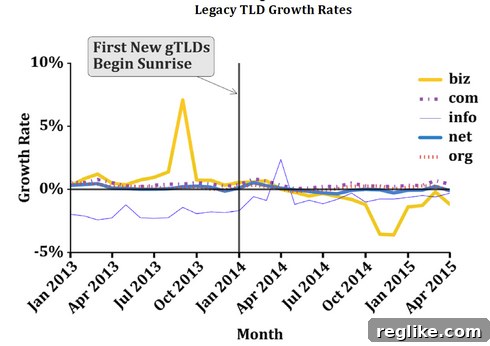
The initial analysis of this macro data offered some intriguing, albeit inconclusive, insights. The researchers observed that while there were no major changes in registration rates for most legacy TLDs like .net or .org, there was a suggestion that .biz might have been impacted by the proliferation of new gTLDs. This could be attributed to .biz’s specific niche as a commercial domain, making it a more direct competitor to many of the business-oriented new gTLDs. Nevertheless, without transaction-level data, it’s difficult to ascertain if this impact is due to direct substitution or other market dynamics. The report wisely concluded that future evaluations of renewal rates would be essential to draw more definitive conclusions, as a domain name’s long-term value is often reflected in its renewal, rather than just its initial registration.
The .XYZ Controversy: Market Strategies Under Scrutiny
Perhaps one of the most unexpected, yet telling, details within the report was a parenthetical mention: “(At least one registry that we are aware of, .xyz, has offered free registrations.)” This seemingly innocuous remark touches upon a significant, ongoing controversy within the domain industry, shedding light on aggressive market strategies employed by some new gTLD registries. The .xyz registry, a prominent player among the new gTLDs, has been embroiled in a high-profile lawsuit with Verisign, the operator of the .com and .net registries. The crux of the dispute revolves around Verisign’s accusation that .xyz orchestrated a widespread giveaway of domain registrations. Verisign alleges that .xyz manipulated its registration numbers through these free or heavily discounted offerings to artificially inflate its market position and, implicitly, to challenge the dominance of .com.
.xyz, on the other hand, vehemently denies these claims, asserting that all its registrations were paid for, even if at promotional prices, and that no actual “giveaways” occurred in the manner Verisign suggests. This legal battle highlights the intense competition and the high stakes involved in gaining market share in the domain industry. Strategies that push the boundaries of conventional registration practices can significantly skew market data, making it challenging for reports like ICANN’s to accurately assess competitive effects. Despite the heated debate surrounding .xyz’s practices, it’s noteworthy that even with potential artificial inflation of its numbers, the ICANN-commissioned research was still unable to identify any noticeable, adverse effect on .com’s market standing. This further underscores the remarkable resilience and unwavering appeal of the .com domain, even in the face of aggressive new entrants and innovative market tactics.
Conclusion: The Enduring Power of .com in a Crowded Market
In conclusion, while ICANN’s new gTLD program was launched with the laudable goal of increasing choice and competition, its foundational premise regarding a general scarcity of good domain names appears to be misdirected. The true bottleneck lies not in the overall availability of second-level domains, but in the acute scarcity of desirable second-level .com domain names. The digital landscape is indeed richer with a multitude of new gTLDs, offering diverse options for branding and online presence, from .tech for technology companies to .art for creatives. However, the report’s findings, despite their limitations, reinforce the persistent dominance of .com.
The journey towards understanding genuine substitution remains complex, requiring more granular data than currently accessible. What is clear, however, is that merely increasing the number of available domain extensions does not inherently solve the challenges faced by those seeking a prime .com address. The psychological and historical gravity of .com continues to anchor user preferences and business strategies. While new gTLDs will undoubtedly carve out their own niches and attract specific communities, the idea that they will fundamentally displace or significantly diminish the market share of .com in the near future appears largely unfounded by current evidence. The internet continues to evolve, and so too will the strategies for establishing a compelling online identity, but the reign of .com, for now, remains undisputed, proving that some questions, when answered, only highlight the wrong initial query.