
The Initial Challenge: Domain Registrars Lagging in New TLD Discoverability
The internet, a constantly evolving tapestry of information and connection, rests on the fundamental concept of domain names. These unique identifiers are more than just web addresses; they are integral to a brand’s digital identity and online presence. A pivotal moment in this evolution occurred with the introduction of hundreds of new Top-Level Domains (TLDs), promising a fresh landscape of opportunities for businesses, organizations, and individuals to secure more relevant and memorable web addresses. However, as these innovative extensions made their debut, a significant hurdle quickly became apparent: many prominent domain name registrars were ill-prepared to effectively suggest, or even readily display, these new TLDs to their customers.
On a landmark day, the initial set of Latin script new TLDs transitioned from early access programs to general availability. This marked a turning point where users could, in principle, effortlessly locate and register their desired domains at standard market prices, much like traditional extensions such as .com or .org. Yet, for pioneering registries like Donuts, which owned a substantial portfolio of these newly launched TLDs, the existing infrastructure of the domain registrar ecosystem proved to be a bottleneck. This article provides an in-depth examination of this initial struggle, dissecting how major registrars like GoDaddy, eNom, 1&1, and Hover navigated the launch, and exploring the broader implications for the future of domain name search and digital branding in an expanding internet.
The Dawn of New TLDs: Reshaping Digital Identity and Online Presence
For decades, the digital realm was largely defined by a limited selection of domain extensions. The familiar trio of .com, .org, and .net, alongside a few others, dominated the scene. While these served their purpose, the scarcity of desirable names under these extensions often led to intense competition, domain squatting, and a sense of creative constraint for digital branding. Recognizing the need for greater choice, innovation, and specificity, the Internet Corporation for Assigned Names and Numbers (ICANN) initiated an ambitious program to expand the domain name system with hundreds of new generic Top-Level Domains (gTLDs).
These new TLDs were not merely additional suffixes; they represented a fundamental paradigm shift. They offered domain seekers a chance to adopt more descriptive, niche-specific, and sometimes geographically relevant options. Imagine a local plumber effortlessly securing a domain like “yourcity.plumbing,” or a tech blogger using “experts.guru.” This expansion aimed to enhance brand clarity, improve search engine relevance, and foster a more intuitive and diverse internet landscape. Registries invested heavily in acquiring and launching these new extensions, anticipating a rapid adoption driven by the inherent value of highly relevant and memorable domain names. This initiative was poised to redefine how businesses and individuals establish their online presence, offering a granular level of identity previously unimaginable.
The Unpreparedness of Registrars: A Critical Barrier to Domain Discovery
The success of the new TLD program, despite its innovative vision, was heavily contingent upon the domain registrars. These entities serve as the crucial intermediaries, connecting users to the vast and complex domain name system. For new TLDs to thrive, they needed to be easily discoverable and prominently presented whenever a user searched for a relevant keyword or phrase. The ideal scenario envisioned registrars employing intelligent search algorithms capable of suggesting new TLDs that perfectly aligned with a user’s intent, thereby extending options beyond the traditional .com.
However, the initial rollout starkly revealed a critical disconnect between the availability of these cutting-edge extensions and the registrars’ capability to effectively present them. This deficiency wasn’t just a minor technical hiccup; it represented a fundamental flaw in the user experience, particularly for those actively seeking domain registration. When a potential registrant types “findjoesplumbing” or “austintexasguru” into a search bar, their primary objective is to secure a relevant and available domain name for their digital branding. If the registrar’s system fails to proactively suggest “findjoes.plumbing” or “austintexas.guru,” it creates a substantial barrier to adoption, diminishing the perceived value and accessibility of these very specific and often highly relevant new extensions. Let’s delve into the specific performances of some leading registrars during this critical initial phase.
GoDaddy’s Initial Lag: Missing the Mark on Relevance and Discoverability
My investigative journey into registrar readiness began with GoDaddy, undeniably one of the largest and most recognizable domain registrars globally. I initiated test searches using practical terms such as “findjoesplumbing” and “austintexasguru.” As expected, the familiar .com domain was prominently displayed and offered as a primary option, often accompanied by a multitude of related search terms, other established legacy extensions, and various premium domain suggestions. This standard practice is designed to offer a wide array of choices within the traditional domain framework.
The true litmus test, however, was the discoverability of the newly launched TLDs. For a search query like “findjoesplumbing,” one would reasonably anticipate “findjoes.plumbing” to appear as a highly relevant and immediate suggestion. Similarly, “austintexas.guru” should have been a top contender when searching for “austintexasguru.” Astoundingly, across search results often exceeding 100 options for each query, the exact matching .plumbing and .guru domains were nowhere to be found. This critical omission persisted even as I proceeded to the checkout process, where these relevant new TLDs were still not presented as alternatives or complementary purchases. This suggested a fundamental lack of integration at the core of their search mechanism.
This was far from a trivial oversight. A significant number of new TLD applicants had meticulously chosen their domain strings based on the frequency and relevance of these keywords in existing domain names, banking on registrars to recognize and intelligently promote this inherent relevance. The evidence strongly indicated that GoDaddy, during these crucial initial hours post-launch, had not yet integrated these new TLDs into its primary domain search algorithm. While acknowledging that this observation was made within a mere 30 minutes of the formal launch, it undeniably highlighted a significant state of unpreparedness. The industry, and indeed customers, had higher expectations for a market leader like GoDaddy to have its systems fully updated and ready to showcase these groundbreaking options from day one, setting a benchmark for the broader domain industry.
eNom’s Progress: A Step in the Right Direction, Yet Still Imperfect
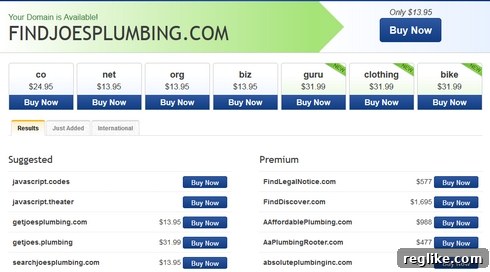
Following my analysis of GoDaddy, I shifted my focus to eNom, a registrar with a unique position, being an applicant for new TLDs itself. This status implied a potentially deeper understanding of the evolving new TLD ecosystem. Encouragingly, eNom demonstrated a noticeably better performance in handling domain searches compared to GoDaddy. For a plumbing-related search term, eNom successfully displayed the availability of the .com domain and highlighted seven alternative extensions. While three of these alternatives were indeed new TLDs from the Donuts registry, a peculiar observation was the absence of the highly relevant .plumbing TLD among these prominent top suggestions.
This particular behavior suggested that the prominently displayed alternative options might have been “hard-coded” or pre-selected without dynamic consideration for the specific search term entered by the user. This approach, while offering some new TLDs, limited their immediate and direct relevance. However, a glimmer of more intelligent integration appeared in the lower-left section of the search results page, where .plumbing domains were explicitly suggested. Intriguingly, even here, the exact match, “findjoes.plumbing,” was not offered; instead, a closely related “getjoes.plumbing” appeared as an alternative.
Further testing, specifically with “AustinPlumbing.com,” revealed that while both the .com and “Austin.Plumbing” were already taken, the search suggestions box on the left was commendably populated with various .plumbing domains. This indicated that eNom had, at minimum, partially integrated the new TLDs into its suggestion engine. Despite the primary, most prominent suggestions still being somewhat generic, eNom’s approach represented a clear step in the right direction. It demonstrated an active awareness of the necessity to surface these new options, even if its underlying search algorithm still required refinement to dynamically prioritize exact matches and highly relevant, context-specific alternatives.
1&1’s Missed Opportunity: A Disconnect Between Marketing and Functionality
My investigation into registrar functionality next brought me to 1&1, a company known for its substantial investment in promoting new TLDs. Earlier reports had indicated that 1&1 had allocated an estimated $50 million towards advertising new TLD pre-registrations. Such a significant marketing push logically led one to expect their live registration system to be at the forefront of new TLD integration, boasting seamless functionality.
I began with a straightforward and highly specific search: “findjoes.plumbing.” The expectation was a direct hit, or at the very least, prominent and accurate suggestions for this highly relevant domain. The reality, however, was in stark contrast to expectations. The search result was a complete failure, returning an error message indicating that the domain could not be found or directly registered through the provided search method. This outcome was particularly puzzling given their aggressive pre-registration campaigns.
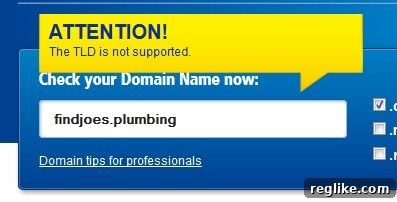
Image: 1&1’s search interface failing to find a specific new TLD.
This scenario raised serious questions about 1&1’s overarching strategy. It suggested that while the company was highly effective at capturing pre-registrations – often at premium prices and with greater control over the initial launch process – their system for regular, live registrations of these newly available TLDs was severely deficient. As one might infer from the lack of direct registration, .plumbing domains were conspicuously absent from any suggestions or alternative options within their search interface. This significant disconnect between an aggressive pre-registration marketing strategy and a demonstrably deficient live search experience presented a considerable missed opportunity, potentially alienating users who had been enticed by their advertising and expected seamless access to these new domains.
It’s also important to note that other significant players, such as Network Solutions, exhibited similar issues during this initial phase, seemingly not supporting direct, immediate registrations of new TLDs. This pattern underscored a broader, systemic challenge across a substantial portion of the domain registration industry.
Hover’s Quality Search, Yet Similar Hurdles for New TLDs
My final assessment led me to Hover, a registrar that has consistently earned praise for its clean, intuitive, and generally high-quality domain search experience. My hope was that Hover’s established reputation for robust search functionality would translate into superior discoverability for the new TLDs. Unfortunately, Hover, much like many of its competitors, struggled with proactively suggesting the new extensions as viable alternative options. While its user interface remained commendable, the new TLDs remained largely obscured unless a user knew precisely what to input.
For example, the only reliable way to find and register a .plumbing domain was to explicitly include “.plumbing” within the search field itself. This critical limitation meant that a user conducting a generic search for “joesplumbing” would not be presented with “joes.plumbing” as an option unless they were already aware of the .plumbing TLD and specifically searched for it. While this allowed for direct registration if one possessed the exact domain knowledge, it failed comprehensively on the fundamental aspect of discoverability. For a technology designed to expand choice and enhance relevance, requiring users to possess prior knowledge of specific new TLDs severely undermined its core purpose and potential for widespread adoption.
Why This Matters: The Broader Impact of Poor Discoverability on the Digital Landscape
The initial struggles of domain registrars to effectively integrate and suggest new TLDs are not merely minor technical glitches that will sort themselves out. These issues carry profound and far-reaching implications for the entire domain ecosystem, the evolution of digital branding, and the future of online presence. This situation is less about a “marathon, not a sprint” and more about running a marathon where the starting blocks are misaligned, and the path ahead is obscured.
For New TLD Registries: A Stifled Opportunity and Investment Risk
For registries, especially those like Donuts that have invested hundreds of millions into acquiring and launching these new extensions, poor discoverability represents a significant impediment to their return on investment. If potential users cannot easily find and register a highly relevant domain like “yourbusiness.plumbing” when searching for a plumbing service, the unique value proposition of such a specific TLD rapidly diminishes. Registries fundamentally rely on registrars as their primary distribution channels; if these channels are obstructed, inefficient, or simply unaware, gaining market share and achieving widespread adoption becomes an incredibly arduous, uphill battle. The challenge of competing against hundreds of other new extensions, the long-established gTLDs like .com, and countless country-code TLDs (ccTLDs) is already immense. Without prominent “shelf space” and intelligent surfacing within registrar search results, many promising new TLDs risk languishing in obscurity, failing to achieve their intended potential for niche market penetration and specialized digital branding.
For Businesses and Individuals: Missed Branding and SEO Opportunities
For businesses striving to establish a unique, memorable, and impactful online presence, new TLDs offer a compelling and often superior alternative to the increasingly scarce and expensive .com addresses. Consider a local artisan, for instance, who could benefit immensely from a domain like “localcrafts.shop” or “artisan.studio,” creating an instantly recognizable and highly relevant web address. However, if registrars consistently fail to suggest these tailored options, businesses are often forced back to generic .coms or less intuitive alternatives that dilute their brand message. This translates directly into missed opportunities for enhanced branding, clearer market positioning, and potentially improved search engine visibility through keyword-rich and highly relevant domain names. Furthermore, individual users seeking specific information also miss out on discovering more relevant and descriptive websites, leading to a less efficient and intuitive internet browsing experience.
For the Domain Industry: Slowed Evolution and Innovation
The sluggish and inadequate integration of new TLDs by registrars inadvertently contributes to the perpetuation of .com dominance, even in situations where more appropriate, descriptive, and readily available alternatives exist. This inertia slows down the natural evolution of the domain name system and stifles broader innovation within the industry. The initial wave of enthusiasm surrounding new TLDs was predicated on the vision of expanding choice, fostering creativity, and building a more diverse and functional internet ecosystem. If the very tools designed to facilitate this expansion – the registrars’ search interfaces – are not up to the task, the entire industry suffers from delayed growth, a less vibrant marketplace, and ultimately, a less user-centric internet. Registrars bear a critical responsibility not just as transactional sellers, but as key facilitators of discovery, innovation, and progress within the global domain space.
The Road Ahead: Evolving Domain Search for a Modern Internet
While the initial challenges observed were undeniably significant, they are by no means insurmountable. The “marathon, not a sprint” analogy remains pertinent, but it also accentuates the critical urgency for registrars to adapt, innovate, and significantly enhance their domain search capabilities. The very future of new TLDs, and indeed the broader trajectory of the domain industry, hinges upon a profound transformation in how users discover, select, and register their online identities.
What specific changes are needed? Firstly, registrars must transcend rudimentary keyword matching algorithms and embrace far more sophisticated, intelligent search methodologies. This necessitates the adoption of semantic search capabilities that can genuinely understand user intent, even when a specific TLD is not explicitly mentioned in the search query. Leveraging advanced artificial intelligence and machine learning could empower systems to proactively suggest the most relevant new TLDs based on complex factors such as search terms, inferred user location, industry context, and even historical browsing data. Such intelligent suggestions would dramatically improve the user experience and the discoverability of niche domains.
Secondly, seamless integration of all available TLDs into the primary search results – rather than relegating them to obscure suggestion boxes or requiring explicit TLD entry – is paramount. This demands a fundamental redesign of existing search interfaces to ensure new TLDs receive fair and prominent visibility alongside traditional extensions. Furthermore, robust educational efforts from registrars are crucial; actively informing users about the myriad benefits and diverse availability of new TLDs can significantly drive demand and encourage exploration beyond the familiar. Registrars must evolve from being mere marketplaces to becoming trusted guides in the vast domain landscape.
The essential shift must be from merely presenting “domain availability” to providing insightful, context-aware “domain suggestions.” Registrars should aspire to function as digital consultants, expertly guiding users towards the most optimal domain name for their specific needs, whether that be a classic .com for broad appeal or a highly specific .photography or .guru extension for targeted branding. The immense long-term potential of new TLDs, offering unprecedented levels of branding precision, creativity, and clarity, can only be fully unlocked when registrars decisively step up to meet the challenge of intuitive, comprehensive, and intelligent domain discovery. This proactive evolution will not only benefit registries and registrants but will also invigorate the entire domain industry.
Conclusion: A Call to Innovation in Domain Registration for the Future
The initial launch of new Top-Level Domains represented a monumental stride forward for the internet, promising a rich and diverse tapestry of online identities. However, this auspicious beginning was met with considerable friction from the very gatekeepers of the internet – the domain name registrars – whose search functionalities proved largely unprepared for the influx of these revolutionary extensions. GoDaddy’s complete omission, eNom’s partial but flawed integration, and 1&1’s stark disconnect between marketing and functionality all served to underscore a systemic issue prevalent across a significant portion of the industry.
While acknowledging that the widespread adoption of new TLDs is indeed a long-term endeavor, the initial hurdles in discoverability were far more than minor inconveniences. They actively impeded the growth and acceptance of new TLDs, frustrated potential registrants, and severely limited the immense potential for innovative and highly relevant digital branding. The mandate for domain registrars is unequivocally clear: they must rapidly evolve and modernize their domain search capabilities to match the dynamism and vastness of the new TLD landscape. By making strategic investments in smarter algorithms, designing more intuitive interfaces, and ensuring comprehensive integration, registrars can transform their role from mere resellers into true enablers of digital identity and online success. Only through such committed innovation can the full promise of new TLDs be realized, paving the way for a more diverse, descriptive, and ultimately more user-friendly internet for everyone.