
The Elusive Quest for One-Word Domain Names: A Comprehensive Guide
In the vast digital landscape, a singular, powerful domain name stands as a beacon of brand identity and memorability. For decades, the hunt for the perfect one-word domain has captivated entrepreneurs, marketers, and domain investors alike. These concise digital assets offer unparalleled branding power, ease of recall, and a distinct competitive edge. Yet, as the internet matures and digital real estate becomes increasingly scarce, securing such a domain has evolved into a formidable challenge. A recent project, OneWord.Domains, sheds crucial light on this very predicament, demonstrating just how rare and often costly these coveted names truly are, especially within the most popular top-level domains (TLDs).
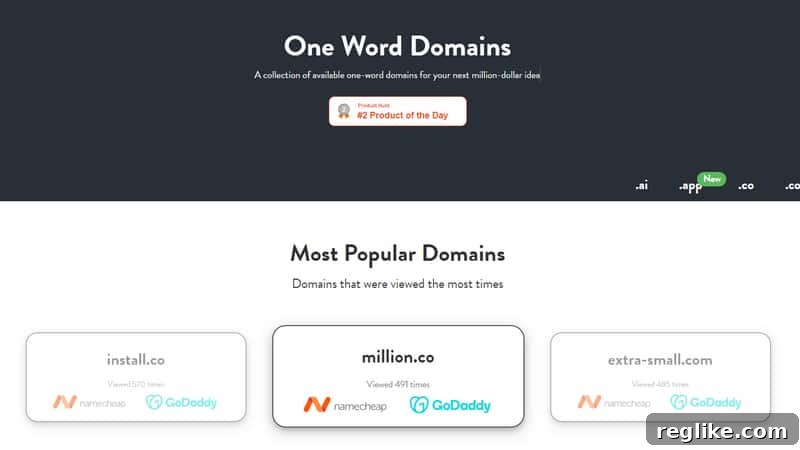
Unveiling Scarcity: Introducing OneWord.Domains
The brainchild of Steven Tey, a talented data science student at the Minerva Schools at Keck Graduate Institute, OneWord.Domains serves as an invaluable, albeit perhaps sobering, resource. Launched with the explicit goal of helping individuals discover available one-word domain names, the platform quickly illustrates the harsh reality of domain scarcity in today’s digital age. By consolidating a list of single-word domains and checking their availability across a curated selection of popular extensions, Tey’s project offers a unique perspective on the challenges faced by anyone seeking an ultra-premium domain.
Currently, the site focuses its search on a handful of highly sought-after TLDs: .ai, .app, .co, .com, and .io. These extensions were likely chosen due to their contemporary relevance, particularly within the tech, startup, and creative industries. While .com remains the undisputed king of domain extensions, others like .ai and .io have gained significant traction, especially for artificial intelligence and technology-focused ventures, while .app provides a clear signal for mobile applications, and .co offers a sleek, global appeal as an abbreviation for “company” or “corporation.”
The Undeniable Allure of Single-Word Domains
Why do one-word domains hold such immense appeal? The reasons are multifaceted and deeply rooted in effective branding and marketing principles. A single, impactful word for a domain name offers:
- Unmatched Memorability: Easy to recall, spell, and verbally communicate, minimizing potential errors.
- Potent Branding: A strong, concise identity that immediately conveys professionalism and authority. Think “Apple.com” or “Google.com.”
- Search Engine Optimization (SEO) Benefits: While direct keyword matching in domain names has diminished in SEO importance, a memorable, brandable domain still aids in direct navigation, brand recall, and overall authority building.
- Trust and Credibility: Often perceived as established and authoritative, building instant trust with users.
- Digital Real Estate Value: Like prime physical real estate, highly desirable one-word domains appreciate in value, making them significant digital assets.
For startups, a one-word domain can instantly elevate their perceived status, allowing them to punch above their weight in competitive markets. For established businesses, it reinforces their market leadership and simplifies their digital presence.
The Premium Problem: When Availability Doesn’t Mean Affordability
While OneWord.Domains successfully identifies domains that are technically “available for registration,” it quickly highlights a significant hurdle that often dampens the excitement: registry premiums. This is perhaps the most critical takeaway from the site and a common pitfall for aspiring domain owners.
Registry premiums are additional fees imposed by the domain registry (the organization that manages a TLD, like Verisign for .com or Afilias for .info) on certain high-value domain names. These names are deemed “premium” due to their brevity, commonality, or perceived market value. Unlike standard domains, which can cost anywhere from $10-$20 per year, premium domains can carry initial registration fees ranging from hundreds to tens of thousands, or even hundreds of thousands of dollars. Crucially, these high fees are often recurring, meaning the annual renewal cost will also be significantly higher than a standard domain.
A prime example provided by the original article is “Million.co.” While OneWord.Domains might show this as “available,” a quick check with a domain registrar would reveal its premium status. To add “Million.co” to your portfolio, you’d be looking at a several thousand-dollar initial investment, an amount far beyond the typical budget for most small businesses or individual projects. This stark reality can be a significant deterrent, transforming what appears to be an exciting discovery into a budgetary nightmare.
It’s important to distinguish between premium domains set by the registry and domains sold on the secondary market by private owners. While both can be expensive, registry premiums are fixed by the TLD operator for previously unregistered names, whereas secondary market prices are determined by supply, demand, and negotiation between buyer and seller.
The Dearth of Good Names: Beyond Premiums
Even when filtering out the premium options, users of OneWord.Domains will likely notice a “dearth of good names” available at regular registration rates. This scarcity extends beyond just high-priced premiums. Decades of domain registrations mean that virtually all common, desirable, short, and brandable words have long been registered, especially in the venerable .com space. What remains are often obscure words, technical jargon, or terms with limited appeal.
For TLDs like .io and .ai, which are newer and have seen a surge in popularity, the situation is slightly different. While there might be more one-word domains available at standard rates compared to .com, the “good” ones—those that are intuitive, universally understood, and strong brand candidates—are still quickly snapped up. This constant registration pressure means that even in newer TLDs, the window of opportunity for acquiring a truly excellent one-word domain at a non-premium price is rapidly closing.
OneWord.Domains: A Sobering Reminder or a Catalyst for Creativity?
The original article suggests that “rather than helping you find good domains to register, the site is another reminder of how difficult it is to find great domains to register.” While this perspective holds some truth, OneWord.Domains can also be viewed as a valuable educational tool. It provides concrete, real-time data that underscores the immense value and scarcity of one-word domains. For aspiring domain investors or startups with unrealistic expectations, it offers a necessary dose of reality, encouraging them to adapt their strategies.
The site serves as a powerful illustration of the demand for concise, memorable online identities. It highlights the premium placed on simplicity and clarity in branding, prompting users to think more creatively about their domain choices.
Navigating the Domain Landscape: Alternative Strategies
Given the challenges highlighted by OneWord.Domains, what are the practical alternatives for businesses and individuals seeking a compelling online presence?
1. Embracing Two-Word Domains
The suggestion for a “two-word domains site” in the original article is highly pertinent. Two-word domains offer an excellent balance between memorability and availability. They are significantly more abundant than one-word domains and often come without registry premiums, making them far more accessible. Examples like “QuickBooks.com,” “Salesforce.com,” or even simpler combinations like “GreenEnergy.com” demonstrate their effectiveness. When choosing a two-word domain, prioritize:
- Relevance: Words that clearly relate to your business or industry.
- Memorability: Easy to say, spell, and remember together.
- Brandability: Words that create a unique and strong brand image.
2. Exploring New Generic Top-Level Domains (gTLDs)
Beyond the TLDs covered by OneWord.Domains, hundreds of new gTLDs have been launched in recent years, such as .tech, .shop, .online, .store, .art, .xyz, and many more. These offer a broader spectrum of choices where one-word or two-word combinations might still be available at standard prices. While some might argue that newer gTLDs lack the instant credibility of .com, their specific nature can be highly advantageous for targeted branding (e.g., “YourBrand.tech” for a technology company). The key is to choose a gTLD that genuinely aligns with your brand and target audience.
3. Inventing Brandable Domains
If direct, descriptive domains are unavailable, creating a unique, invented word or a combination of words that forms a distinctive brand name is a highly effective strategy. Think of companies like “Spotify,” “Zillow,” or “Etsy.” These names were not existing dictionary words but became incredibly powerful brands. This approach requires creativity and a strong marketing effort to build brand recognition, but it offers the ultimate flexibility in securing a unique domain name.
4. Leveraging Domain Marketplaces
For those determined to acquire a specific, previously registered domain, the secondary market is an option. Domain marketplaces like Sedo, Flippa, or GoDaddy Auctions allow individuals to buy domains from current owners. While this can be costly for premium names, it’s often the only way to secure a truly desirable one-word or two-word domain that has already been registered.
5. Strategic Use of Hyphens or Numbers (with caution)
While generally advised against due to potential confusion and brand dilution, in very specific circumstances, a hyphen or a number can make a previously unavailable domain accessible (e.g., “My-Brand.com” or “Brand247.com”). However, this should be a last resort, as it can complicate memorability and lead to traffic loss to the non-hyphenated or non-numbered version.
Conclusion: Adaptability in the Digital Domain Rush
The journey to find the perfect domain name, particularly a one-word gem, is increasingly challenging. Steven Tey’s OneWord.Domains project is a stark, data-driven reminder of this scarcity and the prevalence of registry premiums. It effectively demonstrates that the low-hanging fruit of the internet’s early days has long been picked. However, this reality should not deter aspiring website owners. Instead, it should encourage a more strategic, creative, and adaptable approach to domain acquisition.
While the allure of a singular, impactful word remains strong, the future of successful domain branding lies in exploring intelligent two-word combinations, embracing relevant new gTLDs, or forging entirely new brandable names. The digital landscape continues to evolve, and with creativity and foresight, a powerful and memorable online identity is still within reach, even if it requires venturing beyond the seemingly simple one-word ideal.