
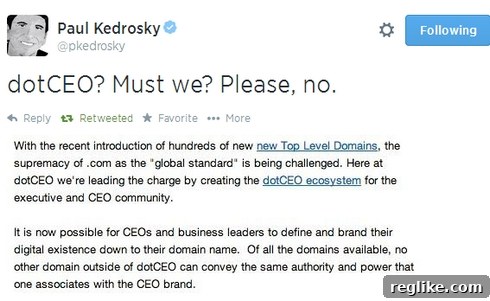
In the evolving landscape of the internet, where new generic Top-Level Domains (gTLDs) promise a plethora of choices beyond the traditional .com, some extensions capture attention for reasons other than their intended purpose. Such was the case with the .CEO domain, which recently found itself under the spotlight of prominent venture capitalist Paul Kedrosky. With a significant following of 275,000 on Twitter, Kedrosky’s observations carry considerable weight, and his thoughts on .CEO quickly ignited a lively debate across the platform.
Paul Kedrosky’s Initial Reaction and the Ripple Effect
Kedrosky, known for his incisive commentary on technology and finance, expressed his discovery of the .CEO domain, prompting an immediate surge of engagement among his followers. His tweet served as a catalyst, pulling the new gTLD into a public discussion that quickly veered towards skepticism rather than endorsement. The screenshot below captures the initial moment that sparked this widespread conversation:
The subsequent conversation that ensued was predictably swift and revealing, reflecting a shared sentiment among many internet users and industry observers. Social media platforms, with their instantaneous nature, often amplify expert opinions, especially when they touch upon nascent or contentious topics. Kedrosky’s critique wasn’t just a personal opinion; it quickly became a collective sounding board for perceptions surrounding niche, status-oriented gTLDs.
The Public’s Perspective: Arrogance or Innovation?
Among the barrage of replies, certain themes consistently emerged. One user succinctly highlighted a common concern:

Kedrosky’s concise response, “Exactly,” confirmed his alignment with the notion that the .CEO domain might project an aura of self-importance or even arrogance rather than professional distinction. This sentiment underscores a fundamental challenge for many specialized gTLDs: how to convey value and purpose without alienating potential users or appearing out of touch with broader digital etiquette.
Another commenter echoed similar reservations, suggesting that such a domain might imply an undeserved exclusivity:

To this, Kedrosky again expressed agreement, stating, “And that exact thought had already crossed my mind.” This exchange revealed a critical insight: the immediate public perception of .CEO leaned heavily towards skepticism regarding its utility and desirability. While the vision for gTLDs was to create more specific and memorable web addresses, some extensions, like .CEO, inadvertently triggered a negative connotation of elitism or even vanity.
Beyond the Negativity: A Glimmer of Support?
It’s important to note that the conversation wasn’t entirely one-sided. Amidst the prevailing criticism, there were a few differing opinions. Not every commenter was a detractor of .CEO; one person found some merit, perhaps seeing its potential for a very specific, high-level personal branding, or appreciating the novelty it brought to the domain space. However, these voices appeared to be in the minority, overshadowed by the more widespread sentiment of doubt and ridicule.
The Fundamental Challenges Facing the .CEO Domain
The criticisms levied against .CEO, particularly those highlighted by Kedrosky and his followers, point to deeper issues that have hindered its adoption. These challenges can be broadly categorized into two main areas: its perceived ‘silliness’ and the strategic missteps in its marketing.
The “Insurmountable Silliness” and Value Proposition
The phrase “insurmountable silliness” perfectly encapsulates one of the primary hurdles for the .CEO domain. In an era where digital presence is paramount, the choice of a domain name is a critical branding decision. While a .com or country-code TLD (.co.uk, .de) carries established trust and familiarity, and some new gTLDs like .app or .dev offer clear functionality, .CEO struggles to define a practical, universally accepted value proposition.
For many, using a domain like “[MyName].CEO” or “[Company].CEO” might indeed come across as overtly self-aggrandizing rather than a mark of distinction. The digital world often favors understated authority and genuine utility over explicit status symbols. Companies and individuals alike prioritize domains that are memorable, easy to share, and convey credibility without appearing pretentious. The .CEO domain, by its very nature, pushes against this prevailing cultural preference, attempting to mandate a status that is usually earned and implicitly recognized.
Moreover, the cost associated with many premium new gTLDs often factors into adoption rates. If a domain offers limited perceived value yet demands a higher price point than traditional alternatives, its uptake will naturally be limited. For a domain like .CEO, the specific target audience (actual CEOs, executives) is inherently small, and even within that group, the perceived benefit of differentiating with .CEO over a solid .com is often negligible when weighed against potential negative perceptions.
Fumbled Marketing and Missed Opportunities
Beyond the inherent challenges of its brand identity, the backers of .CEO also “fumbled the marketing right out of the gate,” a sentiment widely shared and elaborated upon in earlier reports. Effective marketing for a new gTLD requires more than just making it available; it demands a compelling narrative, clear use cases, and strong early adopter testimonials. It needs to answer the question: “Why this domain, and why now?”
A successful launch strategy for a new gTLD typically involves:
- Clear Target Audience Identification: While .CEO’s target might seem obvious, it failed to resonate with this demographic effectively.
- Strong Value Proposition: Articulating distinct benefits over existing TLDs (e.g., increased SEO relevance for a specific niche, enhanced branding for a particular industry).
- Early Adopter Programs: Engaging influential figures or organizations to demonstrate practical usage and lend credibility.
- Comprehensive Educational Campaigns: Explaining how the domain fits into the broader digital ecosystem and how it can be leveraged for business or personal branding.
The .CEO domain appears to have missed many of these crucial steps. The marketing efforts did not effectively address the potential for negative perceptions or build a convincing case for its unique utility. Without a clear and persuasive message, even a seemingly straightforward concept like “for CEOs” can fall flat.
This misstep in marketing, combined with the domain’s inherent brand perception issues, directly contributed to its remarkably low registration numbers. At the time of this scrutiny, there were only 1,430 .CEO registrations, a stark indicator of its struggle to gain market acceptance despite the ambitious vision behind new gTLDs. This figure stands in sharp contrast to the millions of registrations seen by more successful and versatile new extensions, highlighting a significant disconnect between concept and execution.
The Broader Landscape of New gTLDs and Digital Identity
The story of .CEO serves as a cautionary tale within the larger context of ICANN’s ambitious program to expand the internet’s domain name system. While the initiative has successfully introduced a vast array of new TLDs, ranging from geographic (.london, .nyc) to industry-specific (.tech, .design) and generic (.online, .xyz), the success has been uneven. For every widely adopted new gTLD, there are many others that struggle to carve out a niche and achieve significant registration volumes.
The challenges faced by .CEO underscore several critical factors for domain success in the digital age:
- Perception and Trust: Traditional TLDs like .com still command the highest level of trust and recognition. New gTLDs must actively build their reputation.
- Utility and Relevance: Domains that offer clear functional benefits or align seamlessly with specific industries or communities tend to fare better.
- Simplicity and Memorability: A good domain name is easy to recall, type, and share.
- Marketing and Brand Building: Even the most innovative gTLD requires robust marketing to educate the public and generate demand.
In conclusion, Paul Kedrosky’s initial tweet and the ensuing social media commentary served as a powerful, albeit informal, audit of the .CEO domain. It brought to light the critical intersection of public perception, effective marketing, and the inherent challenges in launching a new digital identity product. The limited adoption of .CEO, despite the grand vision for new TLDs, stands as a testament to the fact that merely creating a specialized domain is not enough; it must resonate authentically with its intended audience and offer clear, undeniable value in a crowded digital world.