
Prince.com Returns Home: A Landmark Legal Victory for Prince’s Estate
In a significant and long-awaited development for the digital legacy of one of music’s most iconic figures, the highly sought-after domain name Prince.com has officially changed hands. After navigating a complex legal landscape, the estate of the late, legendary musician Prince – celebrated globally for his unparalleled artistry and innovative spirit – has successfully secured ownership of this vital web address. This transfer marks a pivotal moment in the ongoing efforts to consolidate and protect Prince’s vast intellectual property, ensuring that his official digital presence will now be controlled by the very entity dedicated to preserving his authentic legacy.
The journey to reclaim Prince.com was far from straightforward, revealing the intricate challenges of managing a global celebrity’s brand in the digital age. The domain was previously owned by Domain Capital, a company known for its portfolio of premium domain name assets. The estate initiated legal proceedings against Domain Capital, asserting claims of cybersquatting. This accusation typically arises when a party registers, traffics in, or uses a domain name that is identical or confusingly similar to a trademark belonging to another individual or entity, with the alleged bad faith intent to profit from it.
The Legal Showdown: Unpacking Cybersquatting and Reverse Domain Name Hijacking
The dispute over Prince.com escalated into a full-fledged legal confrontation, shining a spotlight on critical issues surrounding intellectual property rights and domain ownership. Prince’s estate argued that Domain Capital’s long-standing ownership of Prince.com constituted cybersquatting, implying that the domain was held with the intent to unfairly capitalize on the musician’s immense fame and established brand without proper authorization. For such a claim to prevail, the estate would typically need to demonstrate three key elements:
- That Prince had established trademark rights in the name “Prince” for goods and services related to music and entertainment.
- That the domain name “Prince.com” is identical or confusingly similar to that recognized trademark.
- That Domain Capital registered and used the domain name in “bad faith,” meaning with intent to profit from the estate’s goodwill or to prevent the estate from using it.
However, Domain Capital was not without its own legal strategy. In a robust response to the estate’s claims, the company filed a counter-suit, alleging “reverse domain name hijacking” (RDNH). This is a less common but equally significant claim within domain name disputes. RDNH occurs when a trademark holder attempts to obtain a domain name from a legitimate registrant by making false or unsubstantiated claims of cybersquatting. Essentially, Domain Capital would have contended that they had a legitimate right to own and hold the Prince.com domain, and that the estate’s actions were an abusive attempt to seize a valuable asset without proper legal grounds.
High-stakes legal battles involving prominent celebrity names are frequently intricate, often delving deep into the specific timing of trademark registrations, the nature of a domain’s past and present use (or non-use), and the commercial intent of its owner. The intrinsic value of a premium, short, and highly recognizable domain name like Prince.com is immense, not just for branding purposes but also for its potential as a central digital hub for fans, official content, and various commercial endeavors.
The Path to Resolution: An Escrow Agreement Facilitates Transfer
Rather than proceeding to a potentially lengthy, unpredictable, and costly trial, both parties ultimately opted for a resolution outside the courtroom. The parties settled their dispute in January, a common and often preferred outcome in complex legal challenges where the risks and expenses of litigation can outweigh the potential benefits. A crucial component of this settlement was an escrow agreement. An escrow arrangement typically involves a neutral third party holding assets or funds until all specific conditions of a contract are met, providing security and trust to both sides.
In this particular context, the escrow agreement strongly suggests that Domain Capital agreed to transfer the Prince.com domain name to Prince’s estate in return for a confidential cash payment. This type of resolution is mutually beneficial, allowing both parties to avoid the uncertainties of a court judgment, mitigate further substantial legal expenses, and ultimately move forward. For Domain Capital, it provided a financial return on their investment in the domain, while for the estate, it guaranteed the acquisition of a vital digital asset essential for protecting Prince’s brand.
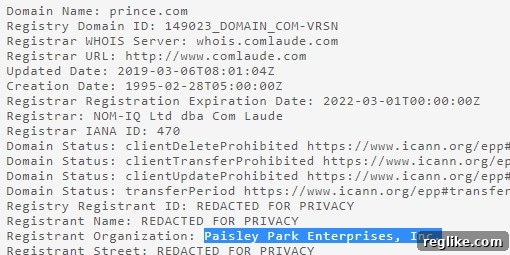
As of recent updates, the transfer is complete and fully reflected in the domain’s public Whois records. The domain name is now managed by Com Laude, a specialized registrar renowned globally for its expertise in brand protection and managing critical domain portfolios for major corporations, high-profile individuals, and celebrity estates. This strategic choice of registrar further underscores the estate’s commitment to implementing robust security measures and diligent management of Prince’s invaluable online presence.
Paisley Park Enterprises, Inc. Takes the Reins: The Future of Prince.com
The updated Whois record now definitively indicates that Paisley Park Enterprises, Inc. is the official owner of Prince.com. This detail carries profound significance, as Paisley Park is inextricably linked to Prince’s creative genius; it was his legendary studio, his sanctuary, and now stands as a revered museum and an enduring tribute to his life and artistic legacy. By placing Prince.com directly under the umbrella of Paisley Park Enterprises, the estate reinforces its commitment to centralizing all elements of Prince’s brand and legacy under one unified, authoritative, and truly authentic entity.
For millions of fans worldwide, this development brings a renewed sense of anticipation and excitement. While the domain name currently does not resolve to an active website – a common occurrence immediately following such a high-profile transfer, as new hosting arrangements are made and fresh content is meticulously developed – the possibilities for Prince.com are immense and thrilling. It could evolve into the definitive online portal for Prince’s unparalleled music catalog, rare videos, exclusive archival footage, official merchandise, information for sanctioned tribute acts, and serve as a comprehensive, interactive resource for his devoted global fanbase. Imagine a digital extension of Paisley Park itself, offering unprecedented, officially sanctioned access to his artistic universe, carefully curated to reflect his unique vision.
Controlling a premium domain like Prince.com is paramount for several compelling reasons:
- Brand Authenticity and Protection: It actively prevents unauthorized parties from creating misleading or unofficial sites that could dilute, misrepresent, or even tarnish Prince’s meticulously crafted brand and artistic message.
- Enhanced Fan Engagement: A centralized, official digital hub significantly enhances the fan experience, providing reliable, accurate information, fostering a sense of community, and delivering content directly from the source.
- Legacy Preservation: It empowers the estate to meticulously curate, present, and safeguard Prince’s vast body of work and personal story in a manner that truly reflects his artistic integrity and profound cultural impact.
- Sustainable Commercial Opportunities: It establishes a direct, official channel for legitimate merchandise sales, music streaming, licensing opportunities, and other ventures that financially support the estate and its overarching mission to honor Prince’s memory and contribute to his philanthropic causes.
The Broader Implications: Intellectual Property Protection in the Digital Age
The successful acquisition of Prince.com by Prince’s estate not only represents a victory for his legacy but also highlights a broader, ongoing challenge within the digital realm: the vital protection of intellectual property, especially for deceased celebrities. Estates of legendary figures often face an uphill battle in managing vast catalogs of music, images, and brand names, all while navigating a complex landscape populated by opportunistic domain registrants and online counterfeiting operations. This case serves as a powerful reminder of the indispensable value of securing key digital assets and proactive brand management.
Celebrity domain name disputes are far from uncommon. Many estates and even living artists have had to vigorously fight to reclaim domain names that incorporated their names, stage names, or distinctive brand identifiers. While this specific dispute was resolved through a civil lawsuit and subsequent settlement, many domain name disputes, particularly those involving clear trademark infringements, are adjudicated through ICANN’s Uniform Domain-Name Dispute-Resolution Policy (UDRP). The UDRP provides a streamlined administrative process for resolving clear cases of cybersquatting, often offering a faster and less expensive alternative to traditional court litigation.
The Prince.com settlement underscores the growing importance for individuals, corporations, and especially celebrity estates to proactively register and vigilantly defend their digital identities across various top-level domains (TLDs) and major social media platforms. In an age where an artist’s online presence is inextricably linked to their overall legacy, public perception, and commercial viability, effective control over prime digital real estate like Prince.com is not merely a preference, but an absolute necessity for long-term brand health and fan trust.
A New Chapter for Prince’s Digital Legacy and His Global Audience
The transfer of Prince.com to Paisley Park Enterprises, Inc. signifies much more than just a change in domain ownership; it represents a profound reaffirmation of Prince’s enduring legacy and the estate’s unwavering commitment to upholding his artistic integrity for generations to come. As the digital world continues to evolve at a rapid pace, having a central, authoritative, and official online home will be absolutely crucial for connecting with new generations of fans and ensuring that Prince’s revolutionary music, profound messages, and pioneering spirit continue to resonate globally, inspiring creativity and challenging conventions.
This settlement effectively closes one chapter of legal contention and triumphantly opens another – one brimming with exciting possibilities for how Prince.com will serve as a beacon for his memory and a gateway to his extraordinary universe. Fans worldwide now eagerly await what the estate will unveil, confident that this vital piece of digital real estate will henceforth be managed with the utmost reverence, vision, and dedication befitting the artist formerly known as, and forever celebrated as, Prince.