
The Hidden Cost of “Free” WHOIS Lookups: Protecting Your Privacy in the Digital Age
In an increasingly interconnected world, where digital footprints are constantly being created, the concept of “free” often comes with a hidden price. This holds true for many online services, and WHOIS data websites are no exception. While they offer invaluable insights into domain registrations, understanding their operational models and potential privacy implications is paramount for any internet user or business owner.
WHOIS lookup services provide a public record of domain registrations, offering details like the domain owner’s name, contact information, registration date, and expiration date. For years, reputable platforms such as DomainTools have served as excellent resources for accessing this information, often providing extensive additional data about a domain and its associated website. However, the accessibility of such data comes with a caveat: users must exercise extreme caution regarding which services they utilize if they truly value their privacy and data security.
Understanding the Illusion of “Free”: How WHOIS Services Monetize Your Searches
The notion that valuable services can be offered completely free of charge often masks complex business models. For non-registrar WHOIS sites, their sustainability and profitability typically stem from one or more revenue streams:
Advertising Revenue: The Visible Trade-off
Many “free” WHOIS lookup sites prominently display advertisements, which is a straightforward and transparent monetization strategy. These ads, often contextually relevant to domains, hosting, or website services, generate income based on impressions or clicks. Users, in this scenario, “pay” by being exposed to commercial messages, a common trade-off for accessing free content or services online. This model is generally well-understood and accepted by the internet community.
Subscription Fees: Access to Premium Features
Another common approach is the subscription model. While basic WHOIS lookups might be free, many providers offer premium tiers that unlock advanced features, bulk lookups, historical data, API access, and enhanced analytics. DomainTools, for instance, offers robust subscription plans that cater to professionals requiring deeper insights and more extensive data access. This model ensures a sustainable revenue stream while providing enhanced value to paying customers.
Data Collection: When You Are the Product
The most concerning and often opaque monetization strategy involves data collection. If a WHOIS service presents no visible advertising, demands no subscription fees, and yet provides a seemingly robust service, it’s crucial to remember a fundamental truth of the digital economy: if you’re not paying for the product, you are likely the product. Such services may be collecting and analyzing user search queries, IP addresses, browsing patterns, and other metadata for various purposes. This collected data can be aggregated, anonymized (or not), and then sold to third parties for market research, targeted advertising, competitive intelligence, or even more nefarious purposes like profiling potential targets for phishing or cyberattacks. This raises significant privacy concerns, as your interests and research activities become valuable commodities.
The Peril of Public Search Histories: A Major Privacy Vulnerability
Beyond the hidden data collection, some WHOIS services introduce an even more direct and immediate privacy risk: the public display of recent search queries. This practice, while perhaps intended to demonstrate site activity or foster a sense of community, can have severe consequences for user privacy and strategic information.
Case Study: BehindDomain.com’s Public Display
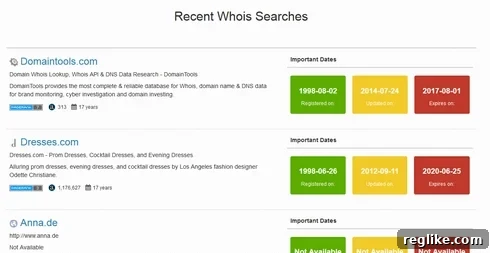
Consider the example of a WHOIS site like BehindDomain.com. While it might offer a clean and user-friendly interface for displaying WHOIS results, clearly highlighting key dates and presenting information in an uncluttered view, it possesses a critical flaw: it openly displays recent WHOIS searches directly on its homepage. This means that any domain you search for on the site becomes publicly visible to anyone visiting the homepage.
This functionality inadvertently creates a public log of user interests, which can be highly problematic. Imagine performing a WHOIS lookup for a domain you’re considering purchasing – perhaps a new business idea, a strategic acquisition, or a domain for a sensitive project. If this search instantly appears on a public homepage, it alerts competitors, squatters, or malicious actors to your intentions, potentially leading to domain sniping, inflated prices, or preemptive competitive moves. It fundamentally undermines the confidentiality often associated with preliminary research.
Why Public Searches Are a Major Concern: Specific Scenarios
- Competitive Intelligence: Competitors can monitor your WHOIS searches to infer your strategic direction, new product launches, or market entry plans.
- Domain Speculation and Sniping: If you’re researching a domain for purchase, making your interest public could prompt others to register it first or demand a premium price.
- Security Research: Security professionals or ethical hackers investigating suspicious domains or potential threats might inadvertently expose their research targets, potentially alerting adversaries.
- Personal Privacy: Individuals researching sensitive or controversial topics might inadvertently reveal their interests, leading to unwanted scrutiny or exposure.
- Brand Protection: Companies monitoring for trademark infringements or brand abuse might reveal their investigative leads.
Navigating WHOIS Lookups Safely: Best Practices for Protecting Your Privacy
Given the potential pitfalls, exercising vigilance when using WHOIS lookup services is essential. Here are some best practices to safeguard your privacy and strategic interests:
Choose Reputable Services Wisely
Opt for well-established and trusted WHOIS providers that have clear privacy policies and transparent business models. While services like DomainTools offer comprehensive data, be aware of their specific terms of service and whether you require their premium features or if a basic, privacy-focused free tool suffices for your needs.
Scrutinize Privacy Policies
Before using any WHOIS lookup service, take the time to read its privacy policy. Understand what data they collect, how it’s used, and whether it’s shared with third parties. A reputable service will be transparent about its data handling practices.
Leverage Registrar-Provided Tools
Many domain registrars offer their own WHOIS lookup tools directly through their platforms. These tools are often more privacy-focused for their existing customers and may not engage in extensive data collection or public display of searches, as their primary business is domain registration, not data monetization through lookups.
Consider Privacy-Enhancing Technologies
For highly sensitive WHOIS lookups, consider using privacy-enhancing technologies. A Virtual Private Network (VPN) can mask your IP address, making it harder for the WHOIS service to link searches back to your specific location or identity. Browsers focused on privacy, or even tools like Tor, can add additional layers of anonymity, though they might slow down your browsing experience.
Understand WHOIS Privacy Protection for Domain Owners
While this article focuses on the user performing the lookup, it’s also crucial to mention WHOIS privacy protection for domain owners. If you own a domain, utilizing WHOIS privacy services offered by your registrar can shield your personal contact information from public view, replacing it with the registrar’s details. This protects you from spam, telemarketing, and potential identity theft, underscoring the broader importance of privacy around WHOIS data.
The Evolving Landscape of WHOIS: GDPR and Beyond
The landscape of WHOIS data has significantly evolved, particularly with the advent of stringent data protection regulations like the General Data Protection Regulation (GDPR) in Europe. GDPR has had a profound impact on the accessibility of personal data within WHOIS records, particularly for individuals in the EU. Many registrars now mask or redact personal contact information for individual registrants by default, replacing it with “REDACTED FOR PRIVACY” or similar placeholders. This shift aims to balance the need for transparency in domain ownership with individuals’ fundamental right to privacy. While this makes it harder to obtain direct contact information for some domain owners, it reinforces the principle that personal data should be protected, even in public databases like WHOIS.
Conclusion: Value WHOIS, Prioritize Your Privacy
WHOIS data remains an indispensable resource for a wide range of activities, from cybersecurity investigations and brand protection to market research and general internet curiosity. However, the path to accessing this data is paved with choices that directly impact your privacy. Understanding the business models behind “free” services, particularly those that engage in data collection or, worse, public display of search histories, is critical. By choosing reputable services, reviewing privacy policies, and employing privacy-enhancing measures, users can harness the power of WHOIS data while effectively safeguarding their digital footprint and strategic interests. In the digital age, true freedom often lies in informed choices and proactive privacy management.