
Unveiling the Digital Pulse: A Deep Dive into .London and .NYC Domain Usage
The digital landscape is constantly evolving, with new top-level domains (TLDs) emerging to offer more specific and localized online identities. Among the most prominent of these are geographical TLDs, which allow businesses, organizations, and individuals to anchor their online presence directly to a specific city. Launched last year, both the .London and .NYC TLDs quickly ascended to the forefront of the new TLD leaderboards, capturing significant attention and demonstrating a robust initial uptake. While .London has garnered approximately 60,000 registrations, .NYC has surpassed this with over 75,000 domains recorded in its zone file.
At first glance, these registration figures might suggest a clear winner. Does a higher registration count mean .NYC is definitively “beating” .London? Such a simplistic comparison, however, overlooks a multitude of factors that define true domain success and real-world utility. To truly understand the vibrancy and effectiveness of these city-specific domains, a more granular analysis is essential. The story of their adoption and actual usage is far more nuanced, shaped by unique eligibility rules, local market dynamics, and the diverse ways in which registrants choose to leverage their digital assets.
Understanding the Landscape: Key Differences Between .London and .NYC
Both London and New York stand as undisputed global powerhouses, major financial centers, and cultural melting pots. Yet, the foundational policies governing their respective TLDs introduce a critical divergence in their operational dynamics. A key distinction lies in the eligibility criteria for registration. The .London domain operates under a more open policy, allowing virtually anyone to register a domain name, regardless of their physical location or connection to the city. This expansive approach aims for broad adoption and inclusivity, fostering a wide array of uses from local businesses to global entities with a London focus, and even individuals with a personal affinity for the city.
In stark contrast, the .NYC TLD enforces stricter residency requirements. Registration is typically restricted to individuals and businesses with a verifiable physical presence within New York City. This restrictive policy is designed to maintain the authenticity and integrity of the .NYC brand, ensuring that domains genuinely represent entities operating within the five boroughs. While this might lead to slower growth in raw numbers, it could potentially cultivate a higher quality of active, locally relevant websites. These differing philosophies inherently influence how these domains are perceived, registered, and ultimately utilized, making a direct numerical comparison less indicative of their individual successes.
Beyond Registrations: Metrics of Real-World Usage and Impact
To move beyond mere registration counts and gain a deeper understanding of the functional success of .London and .NYC, we partnered with Dataprovider. This authoritative source provided comprehensive data, enabling us to conduct an eye-opening, granular examination of these two popular TLDs. Dataprovider meticulously crawled a significant majority of registered .London and .NYC domains, collecting invaluable insights into how these domains are actively being used in the wild. Their findings offer a fresh perspective on what constitutes “success” for a new TLD, introducing a set of metrics that reflect engagement, activity, and genuine online presence rather than just ownership.
The following analysis delves into these fascinating findings, providing a comparative look at .London and .NYC across several critical dimensions. For clarity, in all accompanying graphical representations (which unfortunately cannot be generated here, but are referenced by the original article’s image descriptions), .London data is consistently presented on the left, while .NYC data is on the right.
Reachable: Is Your Digital Door Open?
A fundamental indicator of a domain’s utility is its reachability – whether it resolves to an active website when visited. Our analysis reveals varied outcomes for sites on these new TLDs. While a significant portion of domains under both .London and .NYC successfully resolve to live content, a notable percentage, unfortunately, remains unreachable. This can be due to various reasons, including domains being parked, held for future development, or encountering technical configuration issues.
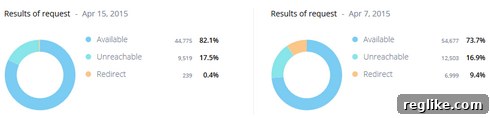
Interestingly, a good portion of .NYC domains are found to be forwarded. This suggests that many registrants of .NYC domains, possibly existing businesses, are opting to point their new city-specific domain to an already established website on another TLD (e.g., .com). While forwarding still constitutes usage, it indicates a different adoption strategy compared to building entirely new websites on the TLD. For .London, a higher percentage of directly resolving sites might imply a greater tendency to create new, dedicated online presences under the .London umbrella, or perhaps that the more open registration policy attracts speculative registrations that remain dormant.
Copyright Dates: Tracing Digital Footprints and Migrations
Dataprovider’s analysis of copyright notices on websites under these TLDs yielded a particularly intriguing result. Out of over 10,000 sites found to include a copyright notice, a surprising number displayed dates prior to 2014, the year both TLDs were launched.
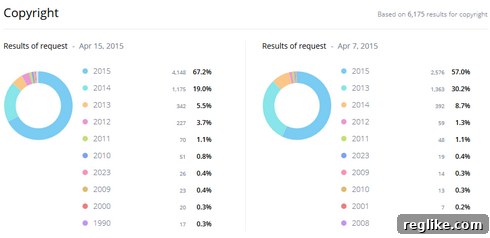
Finding copyright dates like 2013 or even 2010 on a domain that theoretically shouldn’t exist before 2014 might seem paradoxical. However, this phenomenon offers valuable insight into registrant behavior. It strongly indicates that many domain owners are not necessarily launching brand-new websites. Instead, a significant number are porting existing sites from other TLDs to their new .London or .NYC domain, often retaining their original copyright dates in the process. Another common scenario involves forwarding the new domain to an established website that already features an older copyright. This metric suggests that a substantial segment of these new TLD registrations are serving as a digital ‘rebranding’ or an additional gateway to an existing online presence, rather than acting as the primary host for entirely novel content.
Contactable: Connecting with Your Audience
For businesses, the primary purpose of a website is often to generate leads and facilitate interaction with customers. Therefore, the presence and type of contact information are crucial indicators of a domain’s business utility and user-friendliness. Dataprovider examined how many sites on .London and .NYC provide readily available contact details.
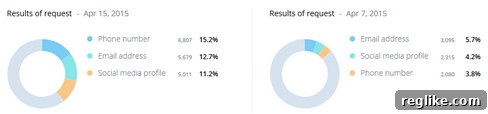
In this regard, .London appears to be demonstrating a stronger inclination towards offering comprehensive contact options. Websites under .London are more frequently found with visible contact information, including email addresses, phone numbers, and physical addresses. This could imply that a higher proportion of .London domains are being utilized for active business operations or community engagement, where direct communication is paramount. The difference might also reflect the broader eligibility of .London, attracting a more diverse range of users, including small businesses and service providers who rely heavily on direct client contact. For users, easy access to contact information enhances trust and facilitates seamless interaction, making such websites more effective in their intended purpose.
Social Media Integration: Expanding Your Digital Reach
In today’s interconnected digital world, the presence of social media accounts on a website is a strong indicator of an active and modern online strategy. It shows an effort to engage with audiences across multiple platforms and build a broader digital footprint. Dataprovider’s findings reveal interesting patterns in social media integration for these city TLDs.
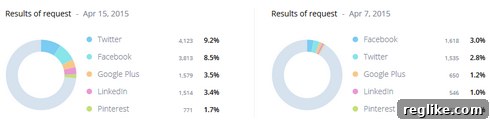
Here again, .London exhibits a stronger presence of social media links on its websites. This suggests that websites adopting the .London TLD are, on average, more actively participating in social media marketing and community building efforts. This could be due to several factors: the open registration policy might encourage more digitally-savvy individuals or marketing-focused businesses to adopt .London, or it might reflect a general trend of stronger social media integration within the broader London digital ecosystem. Regardless of the underlying cause, a higher incidence of social media links points to a greater commitment to comprehensive online engagement and brand visibility for .London domains.
Hosting Country: Geographic Anchors of Digital Presence
The physical location of a website’s hosting server can be significant for various reasons, including website speed, local SEO, and data sovereignty. For geographical TLDs like .London and .NYC, it’s particularly insightful to observe where these domains are being hosted. Unsurprisingly, the majority of .London sites are hosted by UK-based providers, and similarly, US providers host the bulk of .NYC sites, reinforcing their local affiliations.
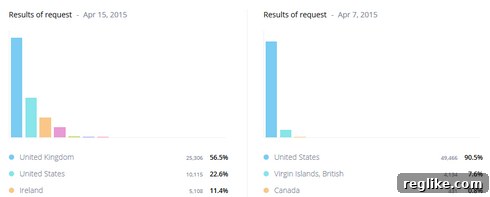
However, the data also reveals a broader geographical distribution for .London hosting, with Ireland playing a notable role alongside the U.S. This wider distribution for .London could be attributed to its more open registration policy, attracting international entities or businesses with global hosting strategies that still wish to project a London-centric identity. The presence of U.S. hosting for .London domains might also indicate larger enterprises or multinational corporations with an existing digital infrastructure in the U.S. choosing to host their .London sites there for efficiency. Conversely, the stronger concentration of hosting within the U.S. for .NYC domains aligns with its more restrictive, locally-focused registration requirements, suggesting a closer link between physical presence and digital infrastructure.
SSL Certificates and CMS Usage: Building Secure and Modern Websites
The adoption of essential web technologies such as SSL certificates and content management systems (CMS) provides a strong indication of the modernity, security, and professional intent behind websites on a new TLD. An SSL certificate (HTTPS) is crucial for securing data transmission, building user trust, and improving search engine rankings, while CMS platforms like WordPress facilitate easy website management and development.
Dataprovider’s findings show a notable difference in SSL certificate adoption: 1,152 .London sites were found with an SSL, compared to 120 .NYC sites. It’s important to remember, as noted previously, that domains might be forwarding to another site that already possesses an SSL certificate, which could skew direct comparisons for sites directly hosted on the TLD. Nevertheless, this direct count suggests a more proactive approach to website security among .London domain owners for sites directly resolving on the TLD.
Regarding CMS usage, WordPress stands out as a dominant platform. Approximately 2,650 .London sites have WordPress installed, which is a very positive sign, indicating active development and easy content management. For .NYC, about 1,630 sites utilize WordPress. This suggests a healthy adoption of a user-friendly and feature-rich CMS across both TLDs. Interestingly, a significant number of .NYC sites were also found using Sitefinity CMS. Sitefinity is often favored by larger organizations and enterprises due to its robust features and scalability, which could hint at the type of businesses gravitating towards the .NYC TLD under its restrictive registration policy – potentially established, larger entities with more complex web development needs.
Implications and Future Outlook for City-Specific TLDs
The granular data provided by Dataprovider paints a compelling picture, demonstrating that the success of a TLD extends far beyond mere registration numbers. The distinct eligibility criteria for .London and .NYC have clearly shaped their usage patterns. .London’s open policy appears to encourage a broader spectrum of active website development, characterized by higher engagement metrics such as contactability and social media presence, alongside a robust adoption of modern web technologies like WordPress. This suggests a vibrant ecosystem of both new and migrated sites actively serving a diverse audience.
Conversely, .NYC’s restricted policy, while resulting in fewer total registrations, points towards a potentially higher concentration of established businesses using the TLD, often by forwarding to existing, well-developed sites. The prevalence of enterprise-level CMS like Sitefinity further supports this, indicating that larger, more sophisticated organizations might be leveraging .NYC as a localized digital identifier for their established brands. The initial question of whether .NYC is “beating” .London thus becomes more complex: while .NYC leads in raw registrations, .London seems to exhibit a higher degree of active, front-facing website development and engagement, suggesting different definitions of success for each.
The evolution of geographical TLDs like .London and .NYC is a testament to the ongoing innovation in the domain name industry. These TLDs offer powerful branding opportunities and a clear signal of local identity, which is increasingly valuable in a globally connected yet locally focused digital economy. Understanding the subtle differences in their adoption and usage, driven by policy and market dynamics, provides invaluable insights for registries, brand managers, and domain investors alike, guiding future strategies for digital presence and online engagement.
Conclusion
In conclusion, while initial registration figures offered a snapshot of the early uptake of .London and .NYC, a deeper dive into their actual usage reveals a more intricate narrative. The qualitative metrics provided by Dataprovider — encompassing reachability, historical content, contactability, social engagement, hosting patterns, and technology adoption — offer a far more comprehensive understanding of their respective strengths and the diverse ways in which they are being utilized. Both .London and .NYC are undeniably successful in their own rights, each carving out a unique niche within the bustling domain name landscape. Their individual trajectories underscore the importance of looking beyond superficial numbers to truly grasp the vitality and long-term impact of new TLDs in shaping our online world.