
The Evolving Landscape: Retargeted Ads on Parked Domains – Opportunities and Risks
In the continually evolving world of digital advertising, how online content is monetized and consumed undergoes constant transformation. A notable and increasingly prevalent shift observed over the past 6 to 12 months is the rise of retargeted advertisements appearing on what were traditionally considered passive assets: parked domain names. This emerging trend signals a significant departure from conventional contextual advertising, introducing both compelling opportunities for increased revenue generation and substantial challenges, particularly concerning trademark infringement and user privacy.
Demystifying Retargeted Ads and Parked Domains
To fully grasp the implications of this convergence, it’s essential to first understand the fundamental concepts of retargeted advertising and parked domains.
What Exactly Are Retargeted Ads?
Retargeting, often referred to as remarketing, is a sophisticated digital marketing tactic aimed at re-engaging internet users who have previously visited a specific website but left without completing a desired action, such as making a purchase, subscribing to a newsletter, or filling out a form. The mechanism typically involves placing a small piece of code, commonly known as a cookie or pixel, in the user’s web browser when they initially visit a site. Subsequently, as that user navigates to other websites across the vast expanse of the internet – including social media platforms, news portals, blogs, and now, increasingly, parked domains – these cookies enable ad networks to display highly personalized advertisements for the site they previously visited. The core objective is to gently remind potential customers of their prior interest, nurturing them back to the original site to convert into customers.
The Traditional Role of Parked Domains
A parked domain is a registered internet domain name that does not currently host an active website or email services. Instead, it typically displays a placeholder page. Historically, these pages were monetized through contextual advertising. The idea was straightforward: if a domain name, for instance, “luxurytraveldeals.com,” was parked, its placeholder page might display advertisements related to luxury travel, cruises, or hotel bookings. Revenue was generated from user clicks on these ads. However, the relevance of these contextual ads was often generic, and their click-through rates (CTR), and consequently the generated revenue, could be quite modest, particularly for broadly named or lower-traffic domains. For many years, domain parking offered domain investors a relatively passive income stream, a method to derive some value from their undeveloped digital real estate while awaiting potential development or sale.
The Emergence: Retargeted Ads on Parked Domain Pages
The landscape of domain monetization is visibly shifting. Over the recent past, domain owners and users alike have observed a sharp increase in Google AdSense ads, among others, that are unmistakably retargeted rather than contextually relevant. Instead of seeing ads related to the generic topic suggested by the parked domain itself, users are encountering advertisements for websites they have visited in the recent past. This phenomenon underscores an evolving strategy in how ad inventory on these often-underutilized web properties is being filled.
To illustrate this trend, consider the following example of a parked page a user might encounter. The highlighted sections in the image below would represent advertisements that are not topically linked to the domain name, but are instead tailored to the individual user’s browsing history:
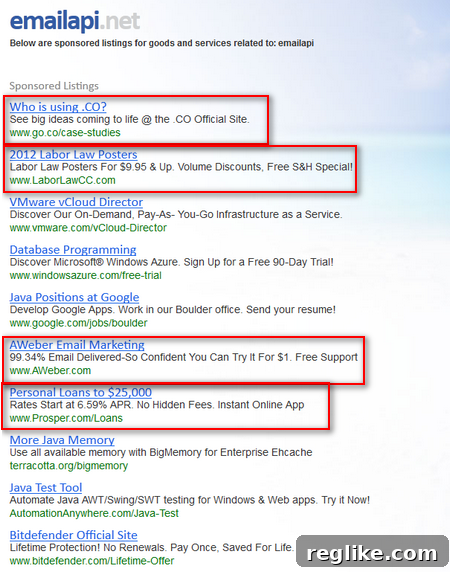
As depicted in the example, it’s common to find several ads that bear no direct relation to the underlying topic of the parked domain. These advertisements are specifically targeted to the user based on their past online interactions and sites visited. It’s worth noting that the particular domain in this illustration was previously monetized through the hosted Google AdSense for Domains program, a service that Google has since announced will be shut down. This detail further emphasizes the dynamic nature of domain monetization and the continuous need for domain owners to adapt their strategies.
The Upside: Enhanced Revenue and Greater Relevance
The integration of retargeted advertisements onto parked domains brings forth a compelling array of advantages for both domain owners and the broader advertising ecosystem. This strategy effectively addresses some of the inherent limitations that plagued traditional domain parking monetization.
Significantly Increased Revenue Potential
One of the most immediate and profound benefits is the potential for a substantial uplift in domain parking revenue. Historically, contextual ads on parked domains, especially those with generic names or modest traffic, often resulted in “penny clicks” – generating very low payouts per click. Retargeted ads fundamentally transform this economic model. By presenting advertisements that are highly relevant to a user’s recent browsing behavior and demonstrated interests, the probability of a click increases dramatically. Crucially, these clicks are typically from users who are further along in the purchase decision funnel, making them significantly more valuable to advertisers. Advertisers are invariably willing to pay a premium for clicks originating from users who have already shown a clear interest in their products or services. This willingness to pay more directly translates into higher Cost Per Click (CPC) for domain owners, leading to greater overall earnings.
This paradigm shift means that domain names that once generated negligible income can now evolve into more lucrative digital assets. Why continue to display low-value, generic advertisements when the alternative is to serve highly targeted, high-value ads that resonate deeply with the individual user’s recent online activities? This transition effectively elevates the ad inventory on parked domains from a low-yield commodity to a more valuable, highly personalized offering.
Enhanced Ad Relevance for the User Experience
While the advertisements themselves may not be contextually relevant to the specific parked domain name, they are undeniably more relevant to the *individual user* visiting that page. From a user experience perspective, encountering an advertisement for a product they recently viewed on an e-commerce site, or a service they were actively researching, is often perceived as far more useful and less intrusive than a random, loosely related ad. This heightened perceived relevance can lead to a more engaging and less frustrating user experience on a parked page, transforming it from a mere digital dead end into a momentarily useful point along their broader online journey. For advertisers, this superior relevance directly translates into higher conversion rates and a more efficient allocation of their marketing budget, as their messages are reaching genuinely interested and engaged individuals.
Broader Reach for Advertisers
For advertisers, the expansion of retargeting capabilities to include parked domains provides an even wider and more diverse network for re-engaging potential customers. It enables them to capture user attention on a vast array of domains that might otherwise be overlooked or considered inefficient in a traditional, purely contextual ad placement strategy. This expanded reach further maximizes their visibility and the overall potential for conversions.
The Downside: Significant Risks and Challenges
Despite the enticing revenue potential, the increasing prevalence of retargeted ads on parked domains introduces a series of significant challenges and risks. Domain owners must remain acutely aware of these potential pitfalls to navigate this evolving landscape responsibly and avoid costly complications.
Heightened Risk of Trademark Infringement Claims
Perhaps the most substantial and concerning risk associated with this trend is the increased vulnerability to trademark infringement complaints. Traditionally, proving trademark infringement on a parked domain often required demonstrating that the domain name itself was infringing, or that the contextual advertisements displayed were directly causing confusion or diluting a registered trademark. With the advent of retargeted ads, these legal lines become considerably blurrier and more perilous.
Trademark holders can now more easily argue that even if the parked domain name itself is not infringing, the display of ads for their specific products or services on a third-party parked domain can create a perception of confusion, imply unauthorized endorsement, or dilute the distinctiveness of their brand. The core argument is that the domain owner, by enabling or allowing retargeted advertisements, is effectively participating in the commercial use of the trademark without explicit authorization. This situation is particularly problematic because domain owners typically possess little to no direct control over *which* specific retargeted ads are ultimately shown to individual users by the automated ad networks. Despite this lack of direct editorial control, certain legal interpretations may still hold the domain owner responsible for the content displayed on their digital property, especially if it leads to consumer confusion.
For those who might doubt the tangible nature of this threat, legal precedents are already emerging. A notable and highly publicized case involved AlamoClub.com. The owner of this domain encountered significant legal challenges related to trademark infringement because retargeted advertisements for Alamo Rent A Car, a widely recognized car rental company, were appearing on their parked page. This case serves as a powerful and stark warning: what was once largely considered a passive form of domain monetization can now expose domain owners to active, complex, and potentially expensive legal disputes with powerful trademark holders. Domain owners are strongly advised to seek legal counsel and maintain extreme vigilance regarding the potential for such claims.
Pressing Privacy Concerns and Regulatory Scrutiny
The fundamental reliance on intricate user tracking and the detailed analysis of personal browsing history for retargeted advertising raises significant privacy concerns. As global privacy regulations, such as the General Data Protection Regulation (GDPR) in Europe and the California Consumer Privacy Act (CCPA) in the United States, become increasingly stringent and widely enforced, the methods employed for tracking and targeting users are under intensifying scrutiny. While major ad networks typically manage the complexities of compliance, the mere fact that a parked domain is displaying highly personalized advertisements could inadvertently draw unwanted attention to the domain owner’s practices, or at the very least, to the broader ad ecosystem they participate in. Furthermore, internet users are becoming increasingly privacy-aware, and the experience of “creepy” ads seemingly following them across disparate websites can lead to negative perceptions and a lack of trust.
Ad Quality and User Perception Issues
While generally more relevant to the individual, retargeted ads can occasionally lead to negative user experiences. For instance, seeing an ad for a product that was just purchased moments ago can be frustrating, feel intrusive, or even seem like a waste of the user’s time. Additionally, the complete absence of contextual relevance to the *parked domain* itself might feel jarring or disjointed for some users, even if the individual ads are personally relevant. This can lead to a less cohesive and potentially confusing browsing experience.
The Future of Domain Monetization: Navigating the New Landscape
The proliferation of retargeted ads on parked domains unequivocally signals a fundamental and irreversible shift within the domain parking industry. This evolution moves monetization strategies away from simplistic keyword matching and towards highly sophisticated user profiling and behavioral targeting. For domain owners, this necessitates a proactive approach to adapting to a significantly more complex and nuanced operating environment.
To successfully navigate this intricate new landscape, domain owners should meticulously consider and implement several strategic measures:
- Vigilance and Due Diligence: It is crucial to regularly monitor the types of advertisements that appear on their parked domains, paying particular attention to those domain names that could potentially be misconstrued as infringing upon existing trademarks.
- Informed Platform Selection: Domain owners must thoroughly understand the policies of their chosen ad platforms concerning ad content, user data handling, and dispute resolution mechanisms.
- Diversification of Strategies: Relying solely on parking may no longer be sufficient or prudent. Exploring alternative monetization strategies, such as developing mini-sites, creating lead generation landing pages, or effectively redirecting traffic to developed websites, is highly recommended.
- Proactive Legal Awareness: Staying continuously informed about evolving trademark laws, intellectual property rights, and stringent privacy regulations is paramount. Seeking professional legal advice is essential whenever there is even a remote doubt about potential infringement or compliance issues.
- Strategic Domain Portfolio Management: Focusing on acquiring and retaining premium domain names with unequivocally clear, non-infringing branding, or generic, high-value keywords, can potentially reduce susceptibility to trademark-related disputes.
Looking ahead, the ongoing evolution of ad targeting technologies will continue to be heavily influenced by rapid advancements in artificial intelligence (AI) and machine learning (ML), leading to even greater levels of personalization and targeting accuracy. Simultaneously, the digital advertising industry is bracing itself for monumental changes related to the eventual deprecation of third-party cookies, which currently form the fundamental backbone of traditional retargeting methods. New privacy-preserving technologies, such as Google’s Privacy Sandbox initiatives, aim to strike a delicate balance between effective ad personalization and enhanced user privacy. These impending changes will undoubtedly pose both formidable challenges and innovative opportunities for the future of retargeted advertising across all digital properties, including the vast network of parked domains.
Conclusion
The integration of retargeted advertisements into the parked domain ecosystem represents a significant double-edged sword for domain owners. On one hand, it offers a powerful and previously untapped avenue to significantly increase revenue by leveraging highly personalized and valuable ad inventory. On the other hand, this enhanced monetization potential is accompanied by the serious caveat of heightened legal exposure, particularly in the realm of trademark infringement, alongside amplified privacy concerns and regulatory scrutiny. Domain owners are now compelled to approach this rapidly evolving landscape with a comprehensive and clear understanding of both the opportunities it presents and the inherent risks it entails. Exercising extreme caution, maintaining vigilance, and proactively adapting their monetization strategies are absolutely crucial to ensure the sustainable, compliant, and ultimately successful management of their valuable digital assets. The future demands nothing less than a proactive, informed, and adaptable approach to domain management in an increasingly sophisticated and regulated online advertising world.