
A Landmark Case of Reverse Domain Name Hijacking: Unpacking a Baffling UDRP Filing

The world of domain name disputes, particularly those governed by the Uniform Domain Name Dispute Resolution Policy (UDRP), is often fraught with complex legal arguments and detailed evidence. However, every so often, a case emerges that challenges the very understanding of professional conduct and legal diligence. Such was the instance involving Anyclean Premium Limited, which recently faced a significant rebuke from a World Intellectual Property Organization (WIPO) panelist. In a decision that has left many in the intellectual property community astonished, Anyclean Premium Limited was found guilty of Reverse Domain Name Hijacking (RDNH), following what can only be described as one of the most baffling and misleading UDRP cases ever to come to light.
This particular dispute centered around the domain name Any-Clean.com. The Complainant, Anyclean Premium Limited, operates a cleaning service and maintains an online presence primarily through their website, AnyClean.co.uk. The domain in question, Any-Clean.com, was legitimately owned and actively utilized by Jethro Denahy to promote a distinct cleaning service. The clear functional similarity between the two domains and their respective businesses might, at first glance, suggest a typical UDRP battle over perceived trademark infringement. However, the subsequent claims made by Anyclean Premium Limited, and the manner in which they were presented, quickly veered into territory that defied conventional legal strategy and professional standards.
To truly grasp the perplexing nature of this case, it is crucial to understand the context of UDRP and RDNH. The UDRP is an administrative procedure established by the Internet Corporation for Assigned Names and Numbers (ICANN) for the resolution of disputes regarding the registration of domain names. It offers a faster, more cost-effective alternative to traditional litigation for trademark holders who believe their rights are being infringed by a domain name registrant. To succeed under UDRP, a Complainant must prove three elements: first, that the domain name is identical or confusingly similar to a trademark or service mark in which the Complainant has rights; second, that the Respondent has no rights or legitimate interests in respect of the domain name; and third, that the domain name has been registered and is being used in bad faith.
Reverse Domain Name Hijacking, on the other hand, is a critical safeguard within the UDRP framework. It occurs when a Complainant uses the UDRP process in bad faith to attempt to deprive a legitimate domain name holder of their domain. A finding of RDNH signifies that the Complainant knew or should have known that they could not succeed on any of the three required UDRP elements, yet still pursued the complaint with the intent to harass or unjustly acquire the domain name. Such a finding is a serious condemnation, reflecting poorly not just on the Complainant, but often on their legal counsel as well.
The Astonishing Representation: An IP-Focused Firm
Before delving into the specific and astonishing claims made by Anyclean Premium Limited, it is imperative to highlight the identity of the firm representing them. One might instinctively assume that such egregious claims would emanate from a party representing itself, perhaps driven by an overzealous but legally unsophisticated individual, or perhaps from an unscrupulous “ambulance chaser” attorney. However, the reality is far more disconcerting.
Anyclean Premium Limited was represented by Bromhead Johnson, a legal firm that explicitly focuses solely on intellectual property (IP) matters. Their very domain name, intellectual-property.uk, underscores their specialization and presumed expertise in this field. This detail is not merely incidental; it profoundly magnifies the shock and incredulity surrounding the claims presented. For a firm dedicated entirely to IP law to advance arguments so demonstrably flawed and misleading raises serious questions about their professional judgment, due diligence, and ethical standards within the UDRP process.
Deconstructing the Unfounded Allegations: A Pattern of Misinformation
The core of the WIPO panelist’s decision, and the subsequent finding of Reverse Domain Name Hijacking, lay in the series of baseless and readily disprovable claims put forth by Bromhead Johnson on behalf of their client. These allegations were not merely weak; they often appeared to be detached from reality, exhibiting either a profound misunderstanding of the facts or a deliberate attempt to misrepresent them. Let’s examine some of the most striking examples:
Allegation 1: Any-Clean.com as a Pay-Per-Click (PPC) Site Linking to Competitors
One of the central assertions made by the Complainant was that the disputed domain, Any-Clean.com, was being utilized as a pay-per-click (PPC) site, generating revenue by linking to products and services competitive with Anyclean Premium Limited. This is a common tactic deployed by cybersquatters, where a domain is parked and monetized through automated advertising links. However, in this case, the claim was unequivocally false.
Where in the world did this idea originate? A quick glance at the website hosted on Any-Clean.com would immediately reveal its true nature. The site was not a generic PPC landing page; it was a fully operational, legitimate website promoting Jethro Denahy’s cleaning service. It featured comprehensive information about his business, services offered, contact details, and other elements characteristic of a genuine commercial enterprise. The image provided in the original complaint itself, ironically, depicted exactly this:
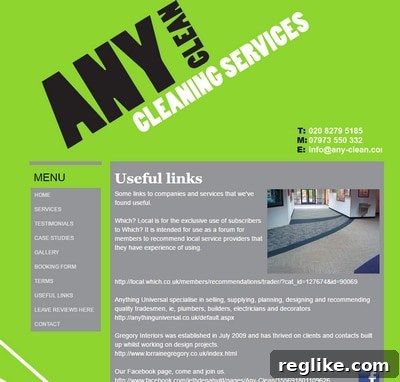
This blatant misrepresentation of the domain’s usage is a cornerstone of the panel’s RDNH finding. It suggests either a severe lack of basic factual investigation by the Complainant’s counsel or, more troublingly, a deliberate attempt to mislead the panel with false information. Claiming an active business website is merely a PPC link farm is a serious accusation and, when easily disproven, undermines the credibility of the entire complaint.
Allegation 2: The Domain Owner Lost a Previous UDRP
Another astonishing claim made by Anyclean Premium Limited was the assertion that the Respondent, Jethro Denahy, had a history of engaging in similar bad faith conduct, citing a previous UDRP loss. The Complainant specifically stated:
it is highly likely that the domain name was registered or acquired by the Respondent in order to prevent the Claimant from using its mark in a corresponding domain name. The Respondent has engaged in such conduct previously, as shown in WIPO administrative panel decision, IndusInd Bank Limited v. DomainCA (Whois Protect Service) / Yungu Jo, WIPO Case No. D2014-0811
This assertion, intended to bolster the claim of bad faith registration and use, was shockingly inaccurate. A simple review of the cited case, WIPO Case No. D2014-0811, would reveal that the respondent in that dispute was “DomainCA (Whois Protect Service) / Yungu Jo” – not Jethro Denahy. There was absolutely no connection between the respondent in the current case and the respondent in the previously cited case. The misidentification was not a minor oversight; it was a fundamental error that completely invalidated the premise of the argument. Attempting to attribute a negative legal history to a party with whom they have no connection borders on reckless endangerment of reputation and demonstrates a profound lack of due diligence in legal research. How an IP-specialized firm could make such a basic, verifiable error is truly bewildering.
Allegation 3: Baffling Claims About “Searched Through the Homepage”
The complaint also included a particularly bizarre and difficult-to-understand claim regarding search results obtained “through the homepage” of the Respondent’s website. The Panelist himself struggled to comprehend the Complainant’s meaning, noting:
The Panel notes the Complainant also relies upon various results it has obtained when various terms (“anyclean”, “ANYCLEAN”, “any-clean” and ANY-CLEAN”) are (according to the Complainant) “searched through the homepage [of the Respondent’s Website]”. The Panel does not understand what the Complainant means when it says “searched through the homepage”. The results in question, which the Complainant has placed in evidence, are not a search of the content of the Respondent’s Website and appear to the Panel to simply be the results of a Google search for the relevant term, albeit presumably one that was launched when viewing the Respondent’s Website.
This paragraph from the panelist’s decision succinctly captures the essence of the confusion. The Complainant seemed to be attempting to suggest that searches performed *on* the Respondent’s website yielded results indicative of bad faith or confusion. However, the panel’s analysis indicated that these were, in all likelihood, merely standard Google search results that might have been performed while viewing the Respondent’s site, not a function of the site itself. This claim highlights either a fundamental misunderstanding of how websites and search engines operate or a convoluted attempt to twist simple observations into evidence of wrongdoing. It further underscores the lack of clarity and factual basis underpinning the complaint.
Allegation 4: Domain Acquired Specifically to Sell to the Complainant
Finally, the Complainant alleged that Jethro Denahy acquired the Any-Clean.com domain name specifically with the intent to sell it to Anyclean Premium Limited at an inflated price. This is a common form of “cybersquatting,” where a domain name is registered purely for speculative resale to the rightful trademark holder.
Again, this claim was readily contradicted by the observable facts. As previously established, Any-Clean.com was not parked, nor was it being held dormant. It was actively being used to promote Jethro Denahy’s legitimate cleaning service, a business that directly competed with the Complainant. The very fact that the Respondent was operating a competing business under the domain name fundamentally undermines any argument that the domain was acquired solely for passive resale. The active use for a bona fide offering of goods or services is a strong indicator of legitimate interest and directly counters claims of bad faith registration for the purpose of selling to the Complainant. The Complainant’s insistence on this point, despite overwhelming evidence to the contrary, further cemented the panelist’s conclusion regarding their lack of good faith in pursuing the UDRP.
The Panelist’s Verdict: A Clear Finding of RDNH
Given the litany of unsubstantiated and demonstrably false claims, the WIPO panelist had little difficulty in finding that Anyclean Premium Limited had failed to establish any of the three elements required under the UDRP. More significantly, the panel concluded that the Complainant had engaged in Reverse Domain Name Hijacking. This finding was not merely a dismissal of the complaint; it was a strong condemnation of the Complainant’s conduct and, by extension, their legal representation.
The panel’s decision articulated that the Complainant’s allegations were so weak, so easily refuted by publicly available information, and so lacking in factual basis that they could only have been brought in bad faith. The Complainant, advised by an IP-specialized firm, should have known that its claims were untenable. Their pursuit of the UDRP, despite this, constituted an abusive attempt to seize a legitimate domain name from its rightful owner.
Broader Implications for the UDRP Process and Legal Professionalism
This case serves as a stark reminder of the importance of diligent and ethical conduct within the UDRP framework. For domain owners, it highlights the vulnerability to frivolous complaints, even from seemingly sophisticated parties, but also reinforces the UDRP’s built-in protections against such abuse. The finding of RDNH sends a crucial message that the UDRP is not a tool for corporate bullying or for acquiring domains simply because they are similar to one’s own.
For legal professionals, especially those specializing in intellectual property, this case is particularly concerning. It challenges the integrity of the profession when an IP-focused firm engages in such shoddy factual investigation and makes claims that are so easily disproven. Such actions waste the resources of the UDRP process, burden innocent domain owners with unnecessary legal defense costs, and can ultimately undermine public trust in the dispute resolution system itself. One cannot help but ponder whether this was a case of “cut-and-paste lawyering” gone horribly awry, or if there was a deeper, more troubling rationale behind the egregious assertions. Regardless, the outcome is a cautionary tale for all involved in domain name disputes.
In conclusion, the Anyclean Premium Limited UDRP case stands as a significant example of Reverse Domain Name Hijacking. Its baffling claims, presented by an IP-focused law firm, underscore the critical need for meticulous factual accuracy and ethical responsibility in all legal proceedings, particularly those as specialized as domain name disputes. The WIPO panelist’s clear and unambiguous finding of RDNH in this instance serves as an important precedent, reaffirming the principle that the UDRP process is designed to resolve legitimate disputes, not to facilitate opportunistic domain seizures through misinformation and baseless allegations.