
A landmark ruling by a World Intellectual Property Organization (WIPO) panel has brought to light a disturbing case of alleged evidence fabrication, leading to a rare finding of Reverse Domain Name Hijacking (RDNH). The panel unequivocally stated its belief that the complaint contained false statements and evidence specifically designed to mislead the adjudicating body. This particular case, centered around the domain name CheapStuff.com, serves as a stark reminder of the critical importance of integrity in domain name disputes and the severe consequences of attempting to subvert justice through deception.
In the realm of domain name disputes, the Uniform Domain-Name Dispute-Resolution Policy (UDRP) provides a streamlined process for resolving conflicts over domain names registered in bad faith. While often an effective mechanism against cybersquatting, the UDRP is not immune to abuse. One such abuse, known as Reverse Domain Name Hijacking (RDNH), occurs when a complainant attempts to wrongly obtain a domain name from a legitimate owner by filing a UDRP complaint in bad faith. Findings of RDNH are relatively uncommon, underscoring the severity of such a determination when it is made by a WIPO panelist.
The dispute over CheapStuff.com stands out as a particularly egregious example. A WIPO panelist has found compelling evidence of reverse domain name hijacking, shining a spotlight on allegations that the Complainant submitted falsified documents to the panel. What makes this case even more alarming is the assertion by the Respondent’s counsel—an assertion that the Complainant’s counsel ultimately did not refute—that these documents were intentionally misleading.
The Complainant in this intricate case was CheapStuff, Inc. However, communications surrounding the dispute, and the legal representation for the Complainant, were associated with AdMedia. This linkage adds a layer of complexity to understanding the true interests driving the complaint.
At the heart of the Complainant’s case lay a seemingly straightforward claim: they alleged that the domain CheapStuff.com was unjustly removed from their control, despite their diligent payment of the domain’s renewal fee. They further contended that after the domain was acquired by a new owner—who purchased it through an expired domain auction—this new owner demanded an exorbitant sum of $150,000 for its return. On the surface, such allegations might evoke sympathy, painting a picture of a legitimate business falling victim to a predatory domain speculator. However, a meticulous examination of the presented evidence and the established timeline quickly brought these assertions into serious question.
The initial red flag emerged concerning the Complainant’s claimed renewal. The Complainant submitted an invoice and a corresponding receipt for renewing the domain name, both purportedly dated April 22, 2020. This date, upon closer inspection, proved to be highly problematic. Critical records showed that the domain had already expired more than a month prior to this alleged renewal date, and the current Respondent had already legitimately acquired the domain through the NameJet auction platform. The presentation of an invoice for a domain renewal that occurred well after the domain had changed hands raised immediate and profound doubts about the veracity of the Complainant’s entire narrative.
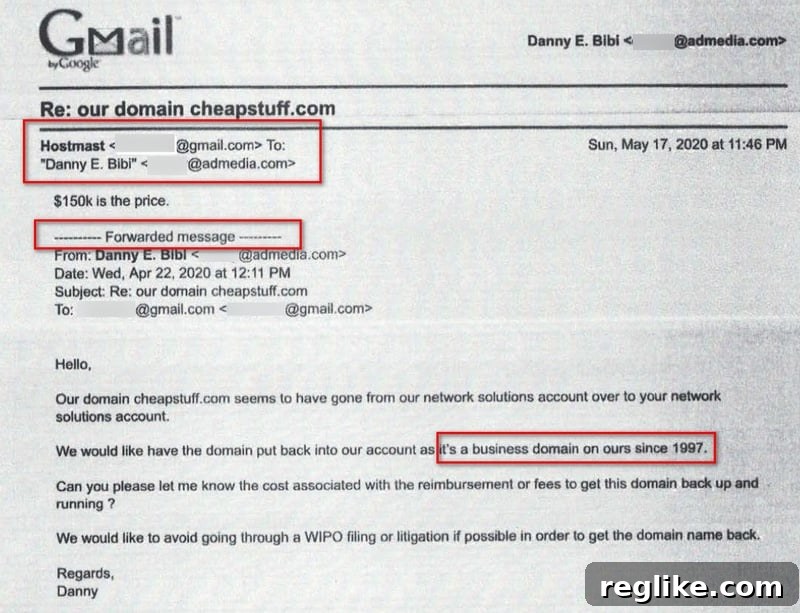
Further undermining the Complainant’s credibility was the evidence related to the alleged $150,000 ransom demand. The Complainant presented an email which they claimed was from the new domain owner, demanding this substantial sum for the domain’s return. However, the Respondent vehemently denied sending any such email. The Respondent’s astute attorney, John Berryhill, a seasoned expert in domain name disputes, meticulously dissected the email exhibit, pointing out several glaring anomalies that strongly suggested fabrication. Berryhill’s detailed observations were critical:
Secondly, on inspection of Complainant’s Annex 6, the Panel will note the notation “forwarded message” in what purports to be a reply, and a curious non-carriage-returned alignment of the “To:” field in Complainant’s exhibit. The auto-text “forwarded message” is not added to quoted text in an ordinary email reply, as any email user knows. The Respondent denies sending the email claimed in Complainant’s Annex 6, and it appears the Complainant forwarded its own sent message to itself and wrote in the “reply”.
Berryhill’s analysis highlighted fundamental inconsistencies with how standard email replies function. The presence of “forwarded message” in a purported reply, along with the misaligned “To:” field, were tell-tale signs of an email that had been manipulated rather than being a genuine direct reply. This suggested a deliberate attempt by the Complainant to construct an artificial conversation, framing it as an interaction with the Respondent. Moreover, Berryhill also pointed out a statement within the sender’s text claiming ownership of the domain since 1997, which he asserted was demonstrably false, adding another layer to the pattern of misrepresentation.
The image below visually corroborates these critical observations, depicting the email exhibit attached to the Complainant’s submission as Annex 6. It highlights the peculiar “forwarded message” notation and the unusual alignment in the “To:” field, as well as the unsubstantiated claim of long-term ownership. These visual discrepancies served as powerful physical evidence supporting the Respondent’s claims of fabrication.
In his authoritative finding of reverse domain name hijacking, WIPO panelist John Swinson did not mince words. His decision underscored the profound breach of trust and the severity of the Complainant’s actions:
…The Complaint was in the Panel’s view of the evidence submitted brought with disregard for the truth, and contains false statements and evidence designed to mislead the Panel.
For example, the Complainant says that the Complainant paid all renewal registration fees to the Registrar, including the recent renewal fee, but through some fault of the Registrar the Disputed Domain Name was not renewed. As part of the Complaint, the Complainant provides a purported invoice to show the payment of the renewal fees to the Registrar. The purported invoice is dated after the Respondent acquired the Disputed Domain Name at auction and after the Disputed Domain Name expired.
The Panel’s jurisdiction ends with this Decision, but the Respondent may have reason to report Complainant’s representative who certified the Complaint to the appropriate (e.g., bar association or otherwise) authorities.
Panelist Swinson explicitly highlighted the core discrepancies, particularly the post-expiration dating of the renewal invoice, as irrefutable proof of the Complainant’s “disregard for the truth.” The panel’s decision is not merely a rejection of the complaint; it is a condemnation of the Complainant’s conduct. Furthermore, the recommendation that the Respondent consider reporting the Complainant’s representative to relevant authorities, such as a bar association, elevates this case beyond a mere domain dispute into a serious ethical and professional matter. This recommendation underscores the panel’s belief that the counsel involved may have violated professional conduct rules by submitting what appeared to be falsified evidence.
The Complainant was represented by Robert Bass, AdMedia’s in-house counsel. When approached for comment regarding these grave allegations, Bass offered a brief and unyielding response:
The decision was simply wrong on these issues. Unfortunately, the way the process works, there is no ability to refute these erroneous conclusions. Thank you.
Bass’s statement, while asserting the decision was “wrong,” conspicuously failed to address the specific, detailed allegations of doctored exhibits—the post-expiration invoice and the manipulated email—which formed the crux of the panel’s finding of bad faith. This silence on the specifics is particularly notable given the opportunity for clarification. It’s worth remembering that the Complainant had made supplemental filings during the case, yet neither of these apparently provided any substantive response to the Respondent’s precise allegations of fabricated evidence. This missed opportunity to directly address the evidence questions further weakened the Complainant’s position and reinforced the panel’s conclusions.
In an effort to provide a balanced perspective and allow the Complainant a final public rebuttal, I followed up with Bass, explicitly detailing the areas that required clarification:
I’d like to give you the opportunity to refute them publicly because it wasn’t done in any of the additional submissions. So if you’d like to explain the Network Solutions renewal invoice from after the domain expired, or the issues with the email, please let me know.
Despite this direct invitation to address the specific evidence discrepancies, Bass reiterated his previous stance, declining to elaborate further:
Mr. Allemann: I have nothing further to add and stand by what I wrote. Thank you.
This final refusal to address the specific allegations of falsified evidence leaves a lasting impression regarding the Complainant’s case. The CheapStuff.com UDRP decision stands as a crucial precedent, not only for its clear finding of Reverse Domain Name Hijacking but also for its emphatic condemnation of efforts to mislead UDRP panels. It reinforces the principle that integrity and adherence to truth are paramount in all legal proceedings, and that attempts to deceive will be met with severe consequences, potentially extending beyond the immediate dispute to professional accountability for legal representatives.