
The High-Stakes Saga of SarahPalin.com: A Deep Dive into Political Domain Ownership and UDRP Implications
The world of domain names often mirrors the headlines of mainstream news, especially when high-profile political figures are involved. The digital real estate associated with public personalities, particularly politicians, becomes a valuable asset, ripe for strategic acquisition, speculation, or even controversy. Such was the case with SarahPalin.com, a domain that unexpectedly appeared on the aftermarket, sparking an auction and raising significant questions about ownership, legal rights, and the intricacies of online branding.
An Auction Ignites, Then Extinguishes on Afternic
The initial buzz began when an auction for the coveted SarahPalin.com domain name went live on Afternic.com, one of the internet’s leading domain name aftermarket platforms. The auction, set to conclude on November 7th, quickly garnered attention, with the bid reaching $501 after just three submissions. For many in the domain investing community, this represented a fascinating opportunity, given the domain’s direct association with a prominent political figure who had recently been in the national spotlight.
Afternic, a reputable marketplace, facilitates millions of domain transactions annually, connecting sellers with interested buyers looking to acquire premium digital assets. The platform provides a streamlined process for listing, bidding, and transferring domain ownership, aiming for transparency and security in each transaction. However, the very nature of an open marketplace means that listings are often initiated by individuals, and the onus of verifying complex ownership claims can sometimes lead to complications, as this particular case dramatically illustrated.
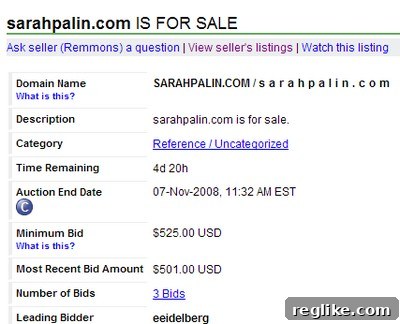
The excitement, however, was short-lived. A crucial detail emerged early in the process: the authenticity of the listing could not be immediately verified. This introduced a significant caveat, turning what seemed like a straightforward auction into a cautionary tale. The integrity of domain marketplaces relies heavily on sellers genuinely owning the assets they list. When doubts about ownership surface, it can undermine buyer confidence and force platforms to intervene. Ultimately, Afternic quickly deleted the auction, confirming that the domain had not been listed by its legitimate owner, a stark reminder of the due diligence required in the domain aftermarket.
Unraveling the Mystery: The Critical Importance of Domain Ownership Verification
In the digital realm, establishing clear ownership is paramount for any transaction, especially for valuable domain names. The SarahPalin.com auction brought this point into sharp focus. Journalists and potential buyers immediately faced a significant hurdle: the domain’s WHOIS record, which typically provides information about a domain’s registrant, was set to private. This privacy setting, while common for individuals wishing to shield their personal information from public view, complicates the verification process for prospective purchasers and makes it challenging to ascertain the true seller’s legitimacy.
Despite the private WHOIS, historical records and nameserver data offered clues, pointing towards Peter Torkelson of Advanced Design, an Alaskan design firm, as the likely owner. Investigative efforts were made to reach Mr. Torkelson, including calls to his residence and emails, but these attempts initially yielded no direct response. This lack of immediate confirmation from the supposed owner was a red flag, indicating a potential mismatch between the party listing the domain on Afternic and the actual registrant. The incident underscores a fundamental principle in domain investing: never proceed with a purchase without unequivocal proof of ownership. A private WHOIS record isn’t necessarily a deal-breaker, but it necessitates extra steps for verification, often involving escrow services or direct communication channels.
Afternic’s decision to delete the auction after discovering the listing was not initiated by the owner highlights the platform’s commitment to protecting buyers and maintaining a trustworthy marketplace. Such swift action prevents fraudulent transactions and reinforces the necessity for sellers to adhere to strict verification protocols. For buyers, this case serves as a powerful reminder that “caveat emptor” (buyer beware) holds significant weight in the domain aftermarket, especially for domains with political or personal branding significance where legal challenges are more probable.
Historical Context: What SarahPalin.com Represented Before the Auction
Understanding a domain’s history is crucial for evaluating its value, potential uses, and legal vulnerabilities. A retrospective look at SarahPalin.com through historical screenshots revealed a fascinating past, distinct from the typical placeholder page. The domain had been used to host various polls concerning Sarah Palin and broader election-related topics. This historical usage is highly significant because it demonstrates an active engagement with the political discourse surrounding the individual whose name the domain bears. Such usage could be interpreted in multiple ways: as a platform for public opinion, a fan site, an opposition site, or simply a domain maintained with an eye toward future value.
Furthermore, these historical pages also contained a notice indicating that the domain name was available for sale or lease. This public declaration of intent to sell or monetize the domain is a critical piece of evidence, especially in the context of domain disputes. It suggests that the registrant was aware of the domain’s commercial value and was actively seeking to capitalize on it, rather than merely holding it for personal use or disinterest. For political figures or celebrities, such commercial intent by a third party often forms a key argument in legal battles over domain names, as it can be used to demonstrate “bad faith” registration and use.
The historical content also sheds light on the types of risks a potential buyer might inherit. Acquiring a domain with a pre-existing political slant or one that has been used for public commentary might expose the new owner to legal scrutiny or public backlash, depending on how they choose to utilize it. The legacy of a domain name, therefore, is not just about its technical age but also its content history, which can profoundly impact its future viability and legal standing.
The Shadow of UDRP: Why SarahPalin.com Was a Legal Minefield
The acquisition of a domain name like SarahPalin.com carries a substantial amount of inherent risk, primarily due to the Uniform Domain-Name Dispute-Resolution Policy (UDRP). UDRP is an international arbitration process established by the Internet Corporation for Assigned Names and Numbers (ICANN) to resolve disputes over the registration of domain names. It provides a relatively quick and cost-effective mechanism for trademark holders, including individuals whose names are protected by common law or statutory rights, to reclaim domain names that are registered and used in bad faith.
For Sarah Palin, a prominent public figure, her name would likely qualify as a common law trademark, giving her a strong basis for a UDRP complaint. To win a UDRP case, a complainant must typically prove three elements:
- The domain name is identical or confusingly similar to a trademark or service mark in which the complainant has rights.
- The registrant (domain holder) has no rights or legitimate interests in respect of the domain name.
- The domain name has been registered and is being used in bad faith.
Applying these criteria to SarahPalin.com reveals why it was a legal minefield. Firstly, the domain name is “identical” to Sarah Palin’s name, satisfying the first element. Secondly, it would be challenging for a third-party registrant like Peter Torkelson to demonstrate “rights or legitimate interests.” Unless he could prove that his name was Sarah Palin, or that he was using the domain in a non-commercial way to comment on her, or that he was commonly known by that name, proving legitimate interest would be difficult. Running political polls, while seemingly neutral, still leverages the notoriety of her name for traffic or attention, which could undermine claims of legitimate interest.
Most critically, the fact that the domain had been openly listed for sale, and its historical use for political commentary, provides compelling evidence of “bad faith” registration and use. UDRP panels often interpret offering a domain name for sale to the complainant (or third parties) at an exorbitant price, or registering it primarily to disrupt a competitor’s business, as indicators of bad faith. In this scenario, the listing on Afternic explicitly demonstrated an intent to profit from Sarah Palin’s name. This action significantly strengthens a potential UDRP case, as it directly illustrates the registrant’s commercial intent in holding a domain name identical to a public figure’s identity without apparent legitimate reasons. It’s surprising that a UDRP had not been filed earlier, as the evidence for winning the domain through arbitration seemed robust.
Navigating the Domain Aftermarket: Lessons from SarahPalin.com
The SarahPalin.com incident offers valuable lessons for all participants in the domain aftermarket – buyers, sellers, and platform providers alike. For aspiring domain investors or individuals seeking to acquire a valuable digital asset, the primary takeaway is the absolute necessity of rigorous due diligence. Never assume the legitimacy of a listing, especially for politically sensitive or celebrity-related domain names. Always verify ownership, scrutinize historical usage, and assess potential legal risks, particularly those related to UDRP. Engaging with reputable domain brokers or escrow services that conduct ownership verification can mitigate significant risks. Furthermore, understanding trademark law and common law rights is essential when dealing with personal names or well-known brands.
For domain sellers, transparency and legitimate ownership are paramount. Attempting to sell a domain without clear title, or one that is susceptible to a UDRP complaint, not only wastes time but can also damage reputation and lead to sanctions from marketplace platforms. Sellers must ensure their listings accurately represent their ownership status and that they have the legal right to transfer the domain. This includes maintaining accurate WHOIS records or being prepared to provide immediate proof of ownership when required.
Domain marketplaces like Afternic also play a critical role. While they serve as facilitators, their responsibility extends to implementing robust verification mechanisms to detect and remove fraudulent or legally problematic listings swiftly. The prompt action taken by Afternic in this case prevented a potentially costly and legally complicated situation for an unwitting buyer, reinforcing the importance of platform integrity in fostering a safe trading environment for digital assets. The broader domain market benefits when such high standards are maintained, ensuring trust and predictability in transactions.
The Enduring Value of Digital Identity in Politics
The saga of SarahPalin.com, though brief in its auction life, serves as a powerful microcosm of the ongoing battle for digital identity and the strategic importance of domain names in the modern political landscape. For public figures, securing and controlling their digital presence – including domain names, social media handles, and online content – is no longer an option but a critical imperative for reputation management, campaign messaging, and direct communication with constituents.
The value of a domain name like SarahPalin.com extends far beyond its nominal resale price. It represents a vital piece of digital real estate that can be leveraged for political campaigns, informational portals, advocacy efforts, or even as a critical defensive asset to prevent misuse by opponents. The continuous struggle over such domains underscores the increasing convergence of traditional political strategy with digital asset management. As our world becomes ever more digitally integrated, the importance of owning and protecting one’s online identity will only continue to grow, making cases like SarahPalin.com enduring lessons in the complex interplay of technology, law, and public life.