
A new contender has entered the arena of domain appraisal, promising to reshape how we perceive and negotiate the value of digital assets. The highly anticipated automated appraisal tool from prominent domain brokerage Saw.com has officially launched, offering a fresh perspective on a notoriously complex challenge: determining a domain name’s true market worth. In an industry where valuation can often feel like an educated guess, Saw.com aims to provide clarity and empower both domain investors and end-users with more reliable data.
The Intricacies of Domain Valuation: Why Automation Struggles
The world of domain name valuation is often described as more art than science, a sentiment shared by both seasoned domain investors and industry newcomers. There are numerous complaints and valid critiques leveled against automated domain appraisal systems. The fundamental challenge lies in the multifaceted nature of domain value. Unlike tangible assets, a domain’s worth is influenced by a blend of objective metrics and subjective factors: search volume, keyword relevance, brandability, length, memorability, TLD (Top-Level Domain) popularity, industry trends, and perhaps most importantly, potential end-user demand. Even with multiple human experts weighing in, arriving at a consensus can be difficult, highlighting the inherent complexity. Relying solely on a machine to accurately quantify all these dynamic elements, especially intangible qualities like brand potential or emotional resonance, makes the task even harder.
Automated tools typically rely on algorithms that analyze various data points, including comparable sales (comps), keyword popularity, domain length, and extension. However, these algorithms can struggle with unique or highly subjective domains where direct comparable sales are scarce, or where the value lies heavily in brand perception rather than generic keyword strength. This inherent limitation has led many to view automated appraisals with a degree of skepticism, often using them as a starting point rather than a definitive statement of value.
Despite these well-known difficulties, the reputable domain brokerage Saw.com is boldly stepping into this space. They launched their innovative appraisal tool today, aiming to provide a valuable resource that can cut through some of the valuation ambiguity. This move signifies Saw.com’s commitment to enhancing transparency and accessibility in the domain market, even while acknowledging the inherent limitations of any automated system. Their goal is not to replace human expertise, but to augment it with a powerful, data-driven perspective.
Understanding Saw.com’s Appraisal Tool: Designed for the End-User
Saw.com’s new appraisal system appears to be strategically built more for end-users—individuals or businesses looking to acquire a domain for development or branding—rather than seasoned domainers who often rely on a combination of tools, deep market knowledge, and intuition gleaned from years of experience. This focus on the end-user is evident in several key features and design choices:
- Limited Searches: Users are restricted to six appraisal searches per day. This limitation serves multiple purposes. It encourages thoughtful use, prevents misuse by automated bots or those looking to rapidly churn through lists of domains without genuine interest, and ensures system resources are allocated efficiently. It suggests the tool is intended for targeted inquiries—perhaps for a business owner evaluating a handful of potential brand names—rather than for bulk portfolio analysis by professional domain investors.
- Integrated Lead Form: Crucially, the appraisal results page includes a prominent lead form. This feature is designed to connect individuals interested in buying or selling the domains they’ve just appraised directly with Saw.com’s expert brokerage services. This seamless integration transforms a simple valuation query into a direct pathway for potential transactions, creating a highly efficient business model. For Saw.com, the appraisal tool isn’t just a free service; it’s a sophisticated client acquisition funnel, leveraging their expertise to facilitate actual domain sales and acquisitions.
For domainers, however, this new entrant is poised to be incredibly beneficial, albeit in a slightly different capacity than a primary research tool. The advent of another reputable automated appraisal option can serve as a powerful asset in negotiation strategies. In the competitive world of domain sales, buyers often try to leverage low automated appraisals to justify a lower offer. The next time a potential buyer attempts to lowball an offer, armed with a conservative automated appraisal from another source, domainers now have an additional, potentially more favorable, valuation tool at their disposal to counter their claims. It adds another layer of data and credibility to the negotiation table, empowering sellers with more leverage and fostering more balanced discussions.
Comparing Appraisal Titans: Saw.com vs. GoDaddy vs. Estibot
Initial observations and testing suggest that Saw.com’s tool exhibits a distinct methodology, particularly when valuing higher-tier domains. It appears to be generally more generous—and potentially more accurate in reflecting market realities—on premium, higher-value domains compared to established tools like GoDaddy’s appraisal service. This is a significant differentiator in the competitive landscape of domain valuation. While GoDaddy’s tool is widely used, it is often perceived as conservative, especially for domains with substantial market potential. Its appraisals frequently come in at figures significantly lower than actual market sale prices for highly desirable assets, possibly due to a cautious algorithm designed to minimize risk or cater to a broader, less experienced user base.
Estibot, another veteran in the space, typically provides robust data-driven valuations, often falling somewhere between GoDaddy’s conservative estimates and Saw.com’s potentially more aggressive (and often more realistic) figures. Estibot’s strength lies in its extensive database of comparable sales and its sophisticated algorithms that consider a multitude of factors, making it a go-to for many domain professionals.
However, like most automated systems, Saw.com’s tool, too, struggles at the low end of the market. Valuing domains in the sub-$1,000 range presents unique challenges due to a lack of significant public sales data for comparable assets, the sheer volume of similar-quality names, and the highly subjective nature of their appeal. Many such domains have little to no liquid market value and their sales depend entirely on finding a very specific end-user with a niche need. This phenomenon is common across almost all automated appraisal platforms, indicating a fundamental hurdle in algorithmic valuation where clear market benchmarks are scarce and “value” is often highly individualistic.
To put Saw.com’s capabilities to the test, I ran a selection of six diverse domains through its system, comparing the results with valuations from GoDaddy and Estibot. Here’s a detailed breakdown of the findings, offering insights into each tool’s strengths and weaknesses:
Case Study 1: Bobber.com
- Saw.com: $356,000
- GoDaddy: $18,808
- Estibot: $256,000
Analysis: Bobber.com is a prime example of a valuable, short, brandable, and generic single-word .com domain. It carries strong visual appeal and is easily pronounceable, making it ideal for a variety of industries, from fishing and marine equipment to mechanics or even a playful brand name. Interestingly, this domain was publicly sold for $250,000 just last month by NameExperts. The proximity of Saw.com’s ($356,000) and Estibot’s ($256,000) valuations to this recent public sale strongly suggests that these tools likely incorporated this real-world transaction into their algorithms, contributing to their impressive accuracy for a premium asset. GoDaddy’s valuation, in stark contrast, appears remarkably low for a domain of this caliber, underscoring the potential for significant discrepancies between automated systems and highlighting its conservative nature, especially for high-value generic terms.
Case Study 2: Gems.com
- Saw.com: $2.4 million
- GoDaddy: More than $25,000 (often displayed as $25k+ or a broad range for high-value assets)
- Estibot: $1.538 million
Analysis: Gems.com is an unequivocally premium digital asset. As a short, generic, and highly descriptive word combined with the coveted .com extension, it holds immense value for businesses in the jewelry, luxury goods, mining, or even gaming sectors. This domain also recently changed hands in a private sale for an impressive $1.5 million. While GoDaddy’s appraisal of “more than $25,000” is technically accurate (as $1.5 million is indeed more than $25,000), it is practically useless for anyone seeking a realistic valuation of such a high-end domain. This broad, non-committal estimate exemplifies GoDaddy’s cautious approach for domains exceeding a certain internal threshold. In this scenario, Saw.com and Estibot provide far more actionable insights, correctly identifying Gems.com as a definitive seven-figure domain. Their ability to contextualize and estimate such high values, likely drawing from a broader pool of premium sales data, is a testament to their more sophisticated valuation models for top-tier digital assets.
Case Study 3: Shortbread.com
- Saw.com: $97,000
- GoDaddy: $10,648
- Estibot: $70,000
Analysis: Shortbread.com represents a niche, brandable domain with clear commercial appeal, particularly within the food and beverage industry, or for a blog or business specializing in baking. The wide disparity between the tools here highlights the challenges of valuing domains that are highly brandable but perhaps not generic-keyword powerhouses with millions of exact-match searches. GoDaddy’s valuation of just over $10,000 is considerably less than what I personally paid for this domain as an investor, indicating that its algorithm likely struggles with recognizing the full brand potential and the specific end-user appeal of such names. In contrast, both Saw.com and Estibot offer significantly higher valuations, which are much closer to what one would expect an end-user to pay for a high-quality, memorable domain like this for their business. This suggests their algorithms are better attuned to the nuances of brand equity, specific market demand, and the intrinsic value of a well-matched .com for a commercial entity.
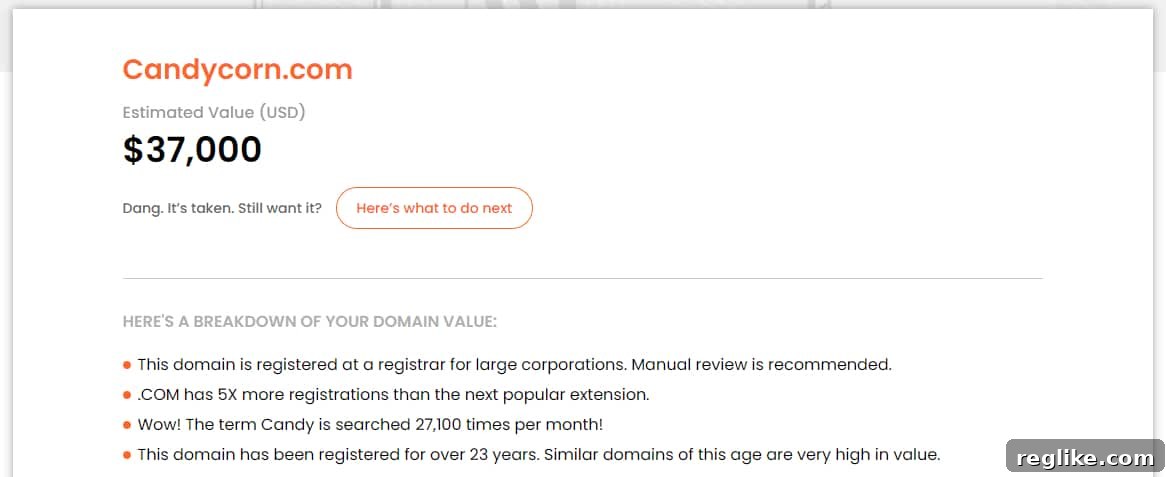
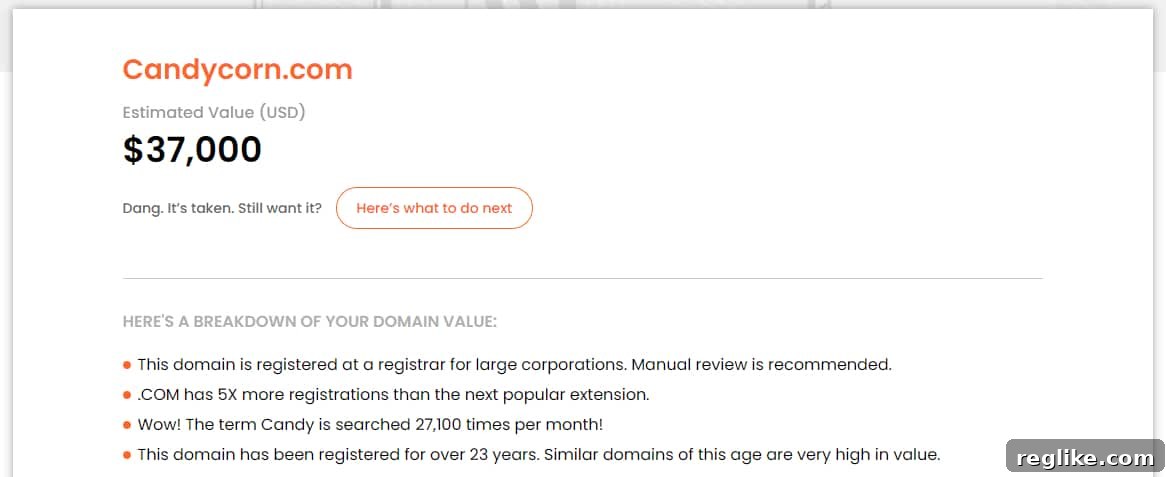
Case Study 4: CandyCorn.com
- Saw.com: $37,000
- GoDaddy: $6,520
- Estibot: $28,000
Analysis: CandyCorn.com is a classic example of a seasonal or niche-specific brandable domain. Its value is tied to a well-known product, particularly around holidays like Halloween, giving it significant potential for e-commerce, event planning, or themed content. I acquired this domain through an off-market transaction, meaning its sale price is not publicly recorded or easily accessible to automated systems. Therefore, the automated tools cannot directly reference a public comparable sale. Despite this lack of direct data, both Saw.com ($37,000) and Estibot ($28,000) provided valuations that fall comfortably within the neighborhood of my current asking price. This indicates their algorithms can accurately assess value even without immediate public sale data, relying instead on broader market trends, keyword analysis, brand recognition, and similar transactions within the relevant niche. GoDaddy, once again, offered a comparatively low figure, demonstrating a recurring pattern for brandable domains.
Case Study 5: LuckyKennels.com
- Saw.com: < $700
- GoDaddy: $1,580
- Estibot: $30
Analysis: LuckyKennels.com perfectly illustrates the difficulty automated systems face when evaluating longer, multi-word, niche-specific domains. These types of domains are often described as “throwing darts at a board” due to their unpredictable market performance and the high variability in perceived value. This particular domain actually sold for $6,000 on Sedo, a price point that none of the tools accurately predicted, with valuations ranging wildly from a mere $30 (Estibot) to a somewhat more optimistic $1,580 (GoDaddy). Saw.com placed it in the sub-$700 category. The wide discrepancy here underscores a fundamental truth: for less generic, longer, or highly specific names, automated appraisals can only offer a very rough estimate. The actual market value is heavily dependent on finding that one specific end-user who perceives immense value in the name for their business, making human brokerage, targeted marketing, and skilled negotiation crucial for realizing its true potential.
Case Study 6: Hearing360.com
- Saw.com: < $700
- GoDaddy: $2,639
- Estibot: $0
Analysis: Similar to LuckyKennels.com, Hearing360.com falls into the category of challenging domains for automated appraisal. It’s a brandable, two-word numeric combination that targets a specific industry (hearing aids, audiology, health technology). This domain sold for $5,100 on Sedo, again demonstrating the significant gap between automated estimates and actual market sales for such names. Estibot’s $0 valuation is particularly striking, suggesting its algorithm found no comparable data or perceived no inherent value, possibly due to the numeric component or the specific niche. Saw.com and GoDaddy offered modest estimates, but none came close to the final sale price achieved through a marketplace like Sedo, which connects domains with actively seeking buyers. This reinforces the notion that names like Hearing360.com, while potentially valuable to the right end-user, are extremely difficult for algorithms to accurately assess due to their unique characteristics and the lack of robust, directly comparable public sales data. Human expertise, understanding of specific industries, and targeted outreach often become indispensable in these situations to unlock true value.
Leveraging Automated Appraisals: A Smarter Approach for Domainers and End-Users
The introduction of Saw.com’s appraisal tool adds another valuable data point to the complex landscape of domain valuation. For domainers, it provides an additional, often more generous, perspective that can be strategically employed during negotiations. In a typical scenario where a buyer might present a low automated appraisal to justify a meager offer, you can now confidently run the domain through Saw.com’s tool. If it yields a higher, more representative number, you now have credible ammunition to share with the prospective buyer, strengthening your negotiating position and potentially securing a fairer price for your digital assets. It offers a counter-narrative, presenting a more optimistic but potentially more accurate market outlook.
For end-users, Saw.com’s tool offers a quick and accessible way to get an initial understanding of a domain’s potential value, helping them budget and strategize their acquisition efforts. While automated tools should never be the sole determinant of a domain’s worth, using multiple sources, including Saw.com, GoDaddy, and Estibot, provides a more comprehensive picture. Combining these algorithmic insights with human expertise, thorough market research, an understanding of current industry trends, and an appreciation for specific business needs remains the most robust and intelligent approach to domain valuation. Saw.com’s entry is a positive development for the entire domain industry, fostering greater transparency, providing more sophisticated tools, and ultimately helping all participants navigate the intricate world of digital asset valuation more effectively.