
Revolutionizing Domain Management: Sedo’s Auto-Categorization Tool Unlocks Greater Sales Potential
In the dynamic world of domain name investing and sales, efficiency and precision are paramount. For years, one of the most tedious yet critical tasks for domain sellers has been the accurate categorization of their portfolio. This painstaking process, often overlooked due to its labor-intensive nature, directly impacts a domain’s visibility and, consequently, its likelihood of sale. Recognizing this persistent challenge, leading domain marketplace Sedo recently unveiled an innovative solution: its new auto-categorization tool. This cutting-edge feature promises to transform how sellers manage their inventories, saving invaluable time and significantly increasing the odds of connecting with the right buyers.
The Undeniable Importance of Domain Categorization for Sales Success
Before delving into Sedo’s breakthrough, it’s crucial to understand why categorization holds such weight in the domain aftermarket. Imagine a vast library with millions of books, but without any organizational system. Finding a specific genre or topic would be an insurmountable task. The domain marketplace operates on a similar principle. Buyers typically search for domains within specific niches, industries, or categories. A domain incorrectly or poorly categorized is akin to a needle in a haystack – it might be a perfect match for a buyer, but they’ll never find it.
Effective categorization serves several vital functions:
- Enhanced Discoverability: Properly categorized domains appear in relevant search results, placing them directly in front of interested buyers.
- Targeted Audience Reach: It ensures that your domain is presented to buyers actively looking for assets within that specific industry or use case.
- Improved Buyer Experience: A well-organized marketplace makes it easier for buyers to navigate, leading to higher engagement and satisfaction.
- Increased Perceived Value: A domain that fits neatly into a recognized category often appears more professional and purposeful, potentially commanding a higher price.
- Reduced Time to Sale: By connecting the right domain with the right buyer more quickly, categorization accelerates the sales cycle.
Previously, whether on Sedo, Afternic, or other platforms, the onus was entirely on the seller to manually assign categories. With marketplaces expanding to encompass thousands of categories – Sedo now boasts over 2,000 – this task became increasingly complex and time-consuming. While the expansion to such a vast number of categories allows for incredibly targeted searches, it simultaneously created a significant headache for sellers trying to accurately place each domain without the aid of sophisticated tools.
Sedo’s Game-Changing Auto-Categorization Feature: A Deep Dive
Sedo’s new auto-categorization tool is designed to address this very pain point head-on. By leveraging advanced algorithms and potentially machine learning, the tool automatically suggests the most appropriate categories for domains as they are submitted. This technological leap means that sellers no longer have to painstakingly browse through an extensive list of 2,000+ categories for each and every domain. The system intelligently analyzes the domain name itself, often considering common uses, keywords, and linguistic patterns, to propose a suitable classification.
Navigating 2,000+ Categories with Unprecedented Ease
The transition from a few hundred broad categories to over two thousand highly specific ones represents a significant evolution in domain search capabilities. For buyers, this means more granular and precise results, allowing them to pinpoint exactly what they’re looking for without sifting through irrelevant listings. For sellers, however, this sophistication initially presented a challenge: how to accurately map their diverse domain portfolios to such a detailed taxonomy? Sedo’s auto-categorization tool elegantly solves this dilemma. Instead of becoming overwhelmed by choice, sellers are now presented with intelligent suggestions, drastically reducing the cognitive load and time spent on administrative tasks.
This automated process is not just about convenience; it’s about optimizing the selling strategy. By ensuring domains are correctly categorized from the outset, sellers maximize their exposure to genuinely interested parties. It transforms what was once a bottleneck into a streamlined, efficient step in the domain submission process, ultimately contributing to a more active and successful marketplace for everyone involved.
Hands-On Review: Testing Sedo’s Auto-Categorization Accuracy
To truly appreciate the efficacy of this new tool, a practical test is invaluable. I decided to put Sedo’s auto-categorization feature through its paces by submitting a small, diverse batch of four domain names to my Sedo account. The selection aimed to cover different types of domains – from descriptive to geographic to brandable – to gauge the tool’s versatility and accuracy across various scenarios.
The Test Subjects: A Diverse Domain Portfolio
Here are the four domain names I chose for this experiment, along with a brief rationale for their potential categorization:
- GalleryAlbum.com: This name strongly suggests an online platform for displaying images, artwork, or photographs. It could be suitable for art galleries, photographers’ portfolios, or personal photo albums.
- MarbleLake.com: A specific geographic name, referencing an 800-acre lake in Michigan. This domain clearly points towards recreational activities, travel, or real estate related to that specific location.
- TinDoll.com: This domain evokes images of collectible items, specifically vintage toys. It’s quite niche and points towards hobbies, collecting, or potentially even antique shops.
- TrueAudience.com: A highly brandable and generic name with a broad range of potential applications. It could relate to audience measurement, social networking, marketing analytics, public speaking, or even entertainment. This domain presents a significant challenge for automated categorization due to its abstract nature.
I submitted all four domains using Sedo’s auto-categorization tool, eager to see how well it performed with such varied inputs. The results provided a fascinating insight into the tool’s capabilities and limitations.
Detailed Analysis of Categorization Results
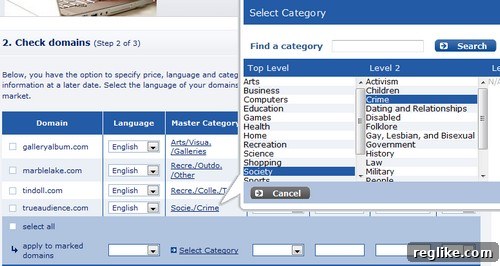
Here are the categorizations proposed by Sedo’s tool for each domain:
- GalleryAlbum.com – Arts > Visual Arts > Galleries
This categorization is remarkably accurate and perfectly aligned with the most intuitive uses of the domain. “Arts,” “Visual Arts,” and “Galleries” precisely capture the essence of a platform designed for visual presentation. This result demonstrates the tool’s ability to interpret descriptive domain names effectively and place them within highly relevant sub-categories.
- MarbleLake.com – Recreation > Outdoors > Other
For a specific geographic location known for its natural features, “Recreation” and “Outdoors” are excellent top-level classifications. The “Other” sub-category, while somewhat generic, is understandable given the specificity of “Marble Lake.” The tool correctly identified the broader recreational context, even if it couldn’t pinpoint a more precise sub-category like “Lakes” or “Boating” if such granular options exist. This still ensures the domain appears in relevant outdoor recreation searches, which is highly beneficial.
- TinDoll.com – Recreation > Collecting > Toys
This categorization is spot on. The combination of “Recreation,” “Collecting,” and “Toys” perfectly encapsulates the domain’s likely use case. It accurately identifies the hobbyist nature and the specific type of item (toys) that would be collected. This demonstrates the tool’s capability to understand niche keywords and assign them to highly relevant, multi-tiered categories.
- TrueAudience.com – Society > Crime
Here, we encounter the most interesting and challenging result. While the other three domains received highly appropriate categorizations, “TrueAudience.com” was placed under “Society > Crime.” This outcome highlights the inherent difficulty in automatically categorizing highly brandable, generic, or abstract domain names. “True Audience” could imply authenticity in viewership, a loyal following, or even accurate demographic data. Its connection to “Crime” is not immediately obvious and likely stems from an algorithmic interpretation that might be trying to link “True” with “true crime” or “audience” in a judicial context (e.g., courtroom audience, audience with a judge regarding a crime). This specific miscategorization underscores a common challenge for AI in understanding nuanced human intent behind brandable names.
Overall, the tool performed admirably, especially for descriptive and niche domains. The miscategorization of “TrueAudience.com” serves as a valuable reminder that while automation is powerful, human oversight and the ability to refine are still crucial, particularly for highly conceptual or ambiguous names.
Empowering Sellers: Overriding and Refining Categories
The beauty of Sedo’s new auto-categorization tool is not just its ability to make initial suggestions, but also its flexibility. Recognizing that no automated system can be 100% perfect, especially with the subjective nature of some domain names, Sedo has ensured that sellers retain full control over their classifications. If you’re not satisfied with any of the categories the tool picks for you, changing them is incredibly straightforward and user-friendly.
The Intuitive Category Picker
The process of adjusting a category is designed for maximum ease. By simply clicking on the suggested category, users are presented with an intuitive “picker table.” This interface allows sellers to browse the extensive list of 2,000+ categories and sub-categories, much like navigating a structured directory. This gives sellers the power to fine-tune the classification, ensuring that every domain in their portfolio is positioned optimally for sale. For a domain like “TrueAudience.com,” for instance, a seller could easily navigate to categories like “Marketing > Advertising,” “Business > Consulting,” or “Internet > Social Media” to find a more suitable fit. This combination of intelligent automation and user-friendly manual override creates a robust system that truly empowers domain sellers.
Maximizing Your Domain Sales Potential with Smart Categorization
The introduction of Sedo’s auto-categorization tool is more than just a convenience; it’s a strategic enhancement for anyone serious about selling domain names. By streamlining the categorization process, sellers can redirect their valuable time and energy towards other critical aspects of domain investing, such as market research, portfolio acquisition, or direct outreach.
Increased Visibility and Targeted Buyers
The core benefit remains increased visibility. In a crowded marketplace, standing out means being easily found by the right people. Correct categorization ensures that your domains don’t get lost in the shuffle but are prominently displayed to buyers whose search criteria align perfectly with your asset. This targeted exposure is invaluable, as it significantly reduces the effort required from buyers to find what they need, leading to quicker decisions and more successful transactions.
Saving Time, Boosting Efficiency
For domain investors managing hundreds or even thousands of names, the time savings offered by this tool are monumental. What once took hours of meticulous research and manual entry can now be completed in a fraction of the time, allowing portfolios to be listed and optimized much faster. This efficiency gain translates directly into a more agile and profitable selling operation.
The Future of Domain Management: AI-Powered Efficiency
Sedo’s auto-categorization tool is a clear indicator of the increasing role of artificial intelligence and machine learning in the domain industry. As domain marketplaces continue to grow in complexity and volume, intelligent automation will become indispensable for managing large portfolios efficiently. This innovation positions Sedo at the forefront of domain management technology, offering a superior experience for both buyers and sellers.
For sellers, embracing such tools means staying competitive. It’s no longer enough to simply list a domain; optimizing its presentation and discoverability is key. Tools like Sedo’s auto-categorization empower sellers to do just that, ensuring their valuable assets are given the best possible chance to sell.
Final Thoughts and Recommendations
Based on the tests, Sedo’s auto-categorization tool is a highly valuable addition for any domain seller. While it performs exceptionally well for descriptive and niche domains, sellers should still review the suggested categories for brandable or abstract names, utilizing the easy-to-use manual override when necessary. This hybrid approach – leveraging AI for efficiency and applying human intelligence for nuanced refinement – represents the optimal strategy for maximizing domain sales potential in today’s evolving market. If you haven’t yet experimented with this feature, now is the time to experience how much time it can save and how effectively it can position your domains for their next owner.