
The Alarming Truth: Small Businesses and the Escalating Threat of Website Hacking
In the rapidly evolving digital landscape, a company’s website is often its most vital asset, serving as a storefront, communication hub, and revenue generator. Yet, for countless small businesses, this critical asset is under constant threat. Unsurprisingly, the incidence of website hacking among very small businesses is not just prevalent; it’s staggeringly high. Recent data from industry giant GoDaddy sheds a stark light on this pressing issue, revealing that small enterprises are frequently targeted, often with devastating consequences.
GoDaddy recently released new data underscoring the widespread nature of hacking incidents affecting very small businesses, including direct attacks on their websites. While the numbers are undeniably high, for those of us who have navigated the intricacies of the internet for years, the revelations may not come as a complete shock. As someone who has managed WordPress websites since as early as 2005, experiencing the unfortunate reality of a hacked site has been an unwelcome, albeit educational, part of the journey.
GoDaddy’s Insights: A Deep Dive into Small Business Cybersecurity Risks
GoDaddy, with its immense footprint in the web hosting and domain registration sectors, possesses a unique vantage point to analyze the prevalence and patterns of cyberattacks. The company’s comprehensive analysis of 65,477 requests for help with hacked sites over a single year offers an unparalleled glimpse into the scale of the problem. What they found paints a concerning picture for small business owners worldwide.
A significant portion of these attacks targeted WordPress sites, a popular choice for small businesses due to its flexibility and user-friendliness. The report highlighted a critical vulnerability: over half of the WordPress site hacks involved websites running outdated versions of the software. This statistic alone underscores a fundamental cybersecurity principle: staying updated is not merely a recommendation; it’s a non-negotiable imperative for digital survival. While WordPress sites are frequently targeted due to their popularity, it’s crucial to remember that no platform is immune to security threats. Any website, regardless of its underlying technology, can become a target if proper security protocols are neglected.
Understanding Hacker Tactics: Backdoors and SEO Spam
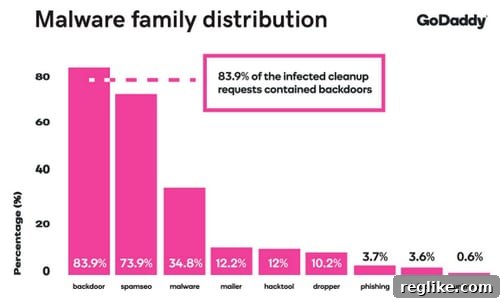
The GoDaddy report also delved into the common methods and objectives of cybercriminals. A particularly alarming finding was that in 83% of cases, hackers didn’t just compromise a site; they actively installed “backdoors.” A backdoor is a surreptitious method for gaining access to a computer, program, or system, bypassing normal authentication. In the context of a website, it allows attackers to regain entry even after the initial malicious files have been identified and supposedly cleaned. This sophisticated tactic ensures persistent access, turning a one-time breach into an ongoing vulnerability if not completely eradicated by an expert.
As for the primary motivation behind these attacks, the report indicates that adding spammy or SEO-manipulative pages is the most common goal. This tactic, often referred to as “SEO spam” or “pharma hacks,” involves injecting hidden links, keywords, and pages onto a legitimate website. The objective is multifold:
- Search Engine Manipulation: Hackers leverage the compromised site’s domain authority to boost the rankings of their own illicit websites or clients’ sites, often for illegal products or services.
- Malware Distribution: Injected content can redirect visitors to malicious sites or trigger drive-by downloads of malware onto their devices.
- Phishing Schemes: Some hacked pages are designed to mimic legitimate login screens or banking sites, tricking users into revealing sensitive information.
- Ad Revenue Generation: In some cases, the injected content serves to display unwanted ads, generating revenue for the attackers.
While less common for these types of attacks, other hacker motivations can include data theft, website defacement, or even demanding ransomware.
The Devastating Impact: Financial and Reputational Costs
The aftermath of a website hack can be catastrophic for a small business. The GoDaddy report offered a glimpse into the scale of cleanup required, with the average intervention involving the sanitization of 110 files. However, in extreme cases, a single hack necessitated the cleanup of an astonishing 35,057 files. Imagine the time, effort, and technical expertise required to identify and disinfect tens of thousands of files – a task far beyond the capabilities of most small business owners.
The impact extends far beyond file cleanup:
- Financial Loss: This includes direct costs for professional malware removal, potential loss of sales due to downtime, and diverted employee time from core business activities.
- Reputational Damage: Customers lose trust in businesses that fail to protect their online presence. A hacked site can deter new customers and alienate existing ones, leading to long-term brand erosion. Search engines like Google may also blacklist compromised sites, further harming visibility and credibility.
- Operational Disruption: A hacked site can bring business operations to a standstill, affecting lead generation, e-commerce, and customer service.
- Legal and Compliance Issues: If customer data (even simple contact forms) is compromised, businesses could face legal liabilities, fines, and mandatory disclosure requirements.
Proactive Strategies: Fortifying Your Small Business Website Security
Given the pervasive threat, small businesses must adopt a proactive and robust approach to website security. Waiting until a hack occurs is a recipe for disaster. Here are essential cybersecurity best practices:
- Keep All Software Updated: This cannot be stressed enough. Regularly update your CMS (e.g., WordPress core), themes, and plugins. Developers frequently release patches for newly discovered vulnerabilities. Automate updates where possible, but always test them in a staging environment first.
- Implement Strong Passwords and Two-Factor Authentication (2FA): Use unique, complex passwords for your hosting control panel, WordPress admin area, database, and all user accounts. Enable 2FA wherever available for an extra layer of security.
- Choose a Reputable Web Host: A quality web host provides robust infrastructure security, regular backups, and sometimes even built-in firewalls and malware scanning. Consider managed WordPress hosting for specialized security.
- Regular Backups: Implement a comprehensive backup strategy. Store backups off-site and ensure they are recent, complete, and restorable. Test your restoration process periodically to avoid unpleasant surprises during an actual emergency.
- Use Security Plugins and Tools: For WordPress sites, plugins like Wordfence, Sucuri, or iThemes Security can provide firewalls, malware scanning, login security, and intrusion detection.
- Install an SSL Certificate: An SSL certificate encrypts data transmitted between your website and visitors, protecting sensitive information and building trust. It’s also a minor SEO ranking factor.
- Limit User Permissions: Follow the principle of least privilege. Grant users only the access they need to perform their jobs. Avoid giving administrator access to everyone.
- Implement a Web Application Firewall (WAF): A WAF acts as a shield between your website and the internet, filtering out malicious traffic and blocking common attack vectors. Many hosting providers offer this, or you can use cloud-based services like Cloudflare.
- Monitor Your Website: Use tools for continuous monitoring for suspicious activity, file changes, and uptime. Early detection is key to minimizing damage.
- Regular Security Audits: Periodically engage with security professionals to conduct audits and penetration testing to identify and rectify vulnerabilities before they are exploited.
Responding to a Website Hack: Time is of the Essence
Despite all preventive measures, sometimes a hack can still occur. When it does, swift and decisive action is paramount. As the GoDaddy report vividly illustrates with its average cleanup involving 110 files and extreme cases reaching over 35,000, having a technical expert available to quickly fix a hacked site is absolutely critical. Attempting a DIY cleanup without specialized knowledge can not only be frustrating and time-consuming but can also leave hidden backdoors, leading to reinfection.
Professional services, such as GoDaddy’s own hack cleanup and malware removal offerings, are designed to handle these complex situations. These services typically involve:
- Thorough scanning to identify all malicious files and database entries.
- Removal of malware, viruses, and hidden backdoors.
- Restoration of the site from a clean backup (if available).
- Implementation of security enhancements to prevent future attacks.
Personally, I maintain a close relationship with a trusted web developer who is on call to address any such issues immediately. When your business website is compromised, every second of downtime can translate into lost revenue, damaged reputation, and eroded customer trust. The speed and expertise a professional brings to the table are invaluable in mitigating the fallout and restoring your online operations efficiently.
The Indispensable Value of Expertise
The takeaway from GoDaddy’s data and the broader landscape of cybersecurity threats is clear: website security is not a luxury; it’s a fundamental necessity for any small business operating online. The investment in robust security measures and, crucially, in access to expert technical support, pays dividends by safeguarding your digital assets, your reputation, and your bottom line. Whether through dedicated in-house staff, trusted external consultants, or reputable service providers like GoDaddy, ensuring your website is secure and recoverable is an ongoing commitment that no small business can afford to overlook in today’s interconnected world.