
The Shifting Landscape of Domain Sales: Leveraging Trust in Unsolicited Offers
In the vast and ever-evolving digital landscape, owning a domain name is akin to securing a prime piece of real estate. For many businesses and individuals, a domain serves as the fundamental gateway to their online presence, a critical digital asset that defines their brand identity. Consequently, the domain name market is a bustling ecosystem, driven by both legitimate transactions and often, unsolicited approaches from eager sellers or brokers. If you’ve owned a domain for any length of time, you’re likely familiar with the incessant stream of emails attempting to sell you a “similar” or “complementary” domain. These solicitations often land directly in spam folders, unread and unacknowledged, yet they represent a persistent and often creative facet of online commerce.
While most of these emails follow a predictable pattern, occasionally one emerges that introduces a novel twist, designed to circumvent the usual skepticism and capture a recipient’s attention. This article delves into such a creative approach, examining how a seemingly standard domain name solicitation cleverly leverages the established reputation and perceived security of a major platform like GoDaddy to build trust and encourage a purchase. This tactic highlights an interesting evolution in how domain sellers attempt to bridge the critical gap of trust in online transactions, particularly when dealing with unsolicited offers for digital assets.
The Commonplace Domain Solicitation: A Familiar Yet Annoying Influx
For individuals and entities managing an online presence, the inbox often becomes a battleground against a barrage of unsolicited communications. Among these, emails pertaining to domain names are remarkably common. Many Domain Name Wire readers, seasoned veterans of the digital realm, can instantly recognize the standard template:
“Dear [Domain Owner], I noticed you own example.com. I happen to be selling domainsomewhatsimilartoexample.com. If this is of interest to you, please reply to this email or visit the domain directly to fill out a contact form and express your interest.”
These messages typically arrive with varying degrees of professionalism, sometimes from genuine domain owners looking to offload an asset, and at other times from opportunistic individuals attempting to “front-run” an expired domain auction. The latter often involves registering a recently expired domain that might still carry some residual traffic or SEO value, hoping to flip it quickly to the original owner or a related party. While the intent behind these emails can differ, their common thread is the direct, often informal, approach to a potential buyer.
The vast majority of these emails end up in the spam folder, an automatic testament to their unsolicited nature and often, their questionable legitimacy. It takes a particularly intriguing or unique approach for one of these solicitations to break through the digital noise and warrant a closer look from a discerning recipient. This is precisely where the recent twist in domain sales strategy comes into play, demonstrating an evolving understanding of buyer psychology and online trust mechanisms.
An Ingenious Twist: Leveraging GoDaddy for Enhanced Trust
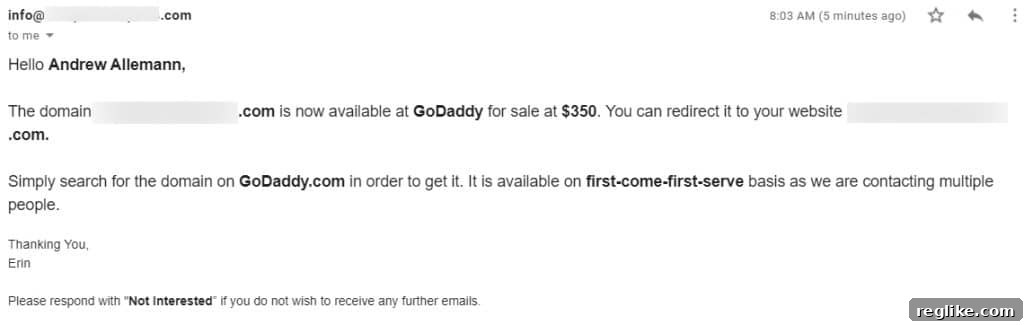
After a considerable period of ignoring or simply deleting the usual domain name solicitations, a recent email landed in my inbox that presented a noteworthy departure from the norm. This particular communication didn’t just offer a domain; it offered a purchase path designed to instill confidence and mitigate typical buyer apprehension. The email explicitly stated that the domain in question could be acquired through GoDaddy, a globally recognized and highly trusted domain registrar, for a fixed price of $350. The domain itself was quite new, having been registered only a few days prior to the email’s dispatch, indicating a proactive and somewhat calculated selling strategy by the owner.
Crucially, the email provided a straightforward instruction: “Simply search for the domain on GoDaddy.com in order to get it.” There was no direct, embedded link to a specific GoDaddy page or a pre-filled search query. This subtle omission is significant. In an era where phishing scams and malicious links are rampant, directing a user to independently navigate to a trusted platform and perform a search adds a crucial layer of perceived security. It removes the immediate suspicion associated with clicking an unfamiliar link in an unsolicited email, thereby increasing the likelihood of the recipient engaging with the offer.
Building Buyer Confidence: The Power of Reputable Platforms
This approach speaks volumes about the seller’s understanding of online transaction psychology. In the digital realm, trust is currency. When dealing with an unknown seller, especially one located in a different geographical region (in this case, India, as later determined), the inherent risks associated with direct payment methods like PayPal are substantial. Concerns about fraud, non-delivery, or disputes can deter even genuinely interested buyers.
GoDaddy, on the other hand, stands as a behemoth in the domain registration and hosting industry. Its brand recognition is immense, and its platform is widely regarded as a secure and reliable environment for managing digital assets. By funneling the transaction through GoDaddy, the seller effectively transfers a significant portion of the trust burden from themselves to a globally respected third party. Buyers are inherently more comfortable completing a transaction on a platform they know and trust, rather than sending money directly to an anonymous individual. This strategy cleverly sidesteps the primary barrier of trust that plagues most direct, unsolicited domain sales pitches.
GoDaddy’s Role as a Trusted Marketplace for Digital Assets
GoDaddy’s established position in the market is not just about brand recognition; it’s about the infrastructure and perceived security it offers. As one of the world’s largest domain registrars, GoDaddy provides a comprehensive marketplace where domains can be bought, sold, and managed. When a domain is listed for sale on GoDaddy, either directly by its owner or through an auction, it typically implies a certain level of verification and a structured process for transfer. This institutional framework offers a sense of protection to the buyer:
- Verified Ownership: Buyers can generally assume that domains listed on GoDaddy’s platform have verifiable ownership, reducing the risk of purchasing a domain from someone who doesn’t legitimately own it.
- Secure Transactions: GoDaddy’s payment processing systems are robust and secure, protecting sensitive financial information.
- Defined Transfer Processes: The transfer of domain ownership through GoDaddy is a standardized process, minimizing potential complications or disputes after purchase.
- Customer Support: Access to GoDaddy’s customer support can provide an additional layer of reassurance for buyers if issues arise.
Therefore, when an unsolicited email suggests purchasing a domain via GoDaddy, it implicitly leverages all these factors, making the offer seem less like a risky gamble and more like a legitimate business opportunity facilitated by a trusted intermediary.
The Ingenuity of the Seller’s Approach: Psychological and Practical Benefits
The ingenuity of this particular seller’s approach cannot be overstated. By directing potential buyers to search for the domain directly on GoDaddy.com, they achieve several critical objectives:
- Bypassing Spam Filters and Suspicion: While the initial email might still hit a spam folder, the absence of a direct link reduces one common trigger for email filters and alleviates immediate user suspicion regarding phishing attempts.
- Leveraging Brand Authority: They tap into GoDaddy’s immense brand authority and reputation for security and reliability. The transaction, from the buyer’s perspective, becomes a GoDaddy transaction rather than a direct dealing with an unknown foreign seller.
- Simplifying the Buyer’s Journey: Instead of complicated instructions for direct payment or manual domain transfer, the process is streamlined to a familiar and intuitive “search and buy” model within a well-known interface.
- Overcoming Trust Barriers: The most significant hurdle in unsolicited sales – establishing trust – is largely overcome. A buyer might hesitate to send $350 via PayPal to an individual in India, but they are far more likely to complete a $350 transaction on GoDaddy, knowing the platform’s security protocols are in place.
This strategy demonstrates a sophisticated understanding of consumer behavior in the digital marketplace. It’s a testament to how creative sellers are adapting their tactics to overcome the inherent skepticism associated with unsolicited offers for digital assets.
Navigating Unsolicited Domain Offers: Best Practices and Due Diligence
While the GoDaddy-centric approach adds a layer of comfort, it doesn’t entirely negate the need for caution and due diligence on the part of the potential buyer. Even with a trusted intermediary, buyers must remain vigilant and conduct thorough research before committing to any purchase. Here are some essential best practices:
1. Evaluate the Domain’s Value
Is the asking price of $350 fair for this particular domain? A newly registered domain, especially one without any established history or significant keywords, might not inherently command such a price. Factors to consider include:
- Keywords: Does the domain contain valuable or highly searched keywords relevant to your business or niche?
- Length and Memorability: Is it short, easy to remember, and pronounce?
- Extension: Is it a popular TLD like .com, or a less common one?
- Branding Potential: Does it have strong branding potential for future use?
- Comparable Sales: Research what similar domains have sold for. Tools like NameBio can provide insights into historical domain sales data.
2. Investigate Domain History
Even if newly registered, a quick check of the domain’s history (if any) can be insightful. While a few days old means limited history, for older domains, tools like the Wayback Machine (archive.org) can reveal past uses, which might indicate potential issues such as association with spam, illicit content, or simply a history of neglect.
3. Verify Ownership and Listing Details
When you search for the domain on GoDaddy, carefully verify that the listing details match what was communicated in the email. Ensure the seller is indeed listing it for the stated price and through the official GoDaddy marketplace or domain listing service. Discrepancies should raise immediate red flags.
4. Be Wary of Pressure Tactics
Any attempt to create undue urgency or pressure to buy should be viewed with skepticism. Legitimate offers, even if unsolicited, should allow for reasonable time for due diligence. Don’t let the convenience of using GoDaddy override your critical thinking.
5. Consider Alternatives
Before committing to an unsolicited offer, consider if a better, more relevant, or more affordable domain could be found through traditional search and registration. Sometimes, the “perfect” domain is simply the one you can acquire without unnecessary complexity or inflated pricing.
The Evolving Landscape of Digital Asset Acquisition
This particular domain solicitation serves as a fascinating case study in the evolving world of digital asset acquisition. It underscores that while the core act of buying and selling domain names remains constant, the strategies employed by sellers are becoming increasingly sophisticated. They are learning to navigate buyer psychology, leveraging established platforms to build confidence and streamline transactions. For domain owners and potential buyers alike, this means a continuous need for awareness, critical thinking, and a robust understanding of market dynamics.
The digital marketplace is dynamic, and creativity in sales approaches is always pushing boundaries. This clever use of GoDaddy as a trust anchor is a prime example of how sellers are innovating. It reminds us that while technology simplifies many aspects of online commerce, the human element of trust and vigilance remains paramount. Always approach unsolicited offers with a blend of curiosity and caution, ensuring that your digital investments are sound and secure.