
The Hidden Cost of .us Domains: Unmasking the Urgent Need for Whois Privacy Reform
In an increasingly privacy-conscious digital world, the registration of a .us domain name has become an untenable proposition for many consumers and businesses alike. The core issue? Fully-public Whois information, a relic of a bygone internet era, continues to expose registrants to relentless spam and unsolicited communications, transforming what should be a straightforward process into a privacy nightmare.
The Persistent Privacy Problem with .us Domains
For many years, the publicly accessible Whois database served as a crucial directory for domain ownership, intended to facilitate accountability and assist in technical and legal matters. However, this transparency was swiftly exploited by malicious actors. Spamming and cold-calling operations thrived on this readily available data. Whenever a new domain was registered, these entities would relentlessly contact the new registrants, attempting to sell them services, phish for information, or even perpetrate scams.
The landscape of online privacy underwent a monumental shift with the introduction of the General Data Protection Regulation (GDPR) in 2018. This landmark legislation, enacted in the European Union, compelled most domain registrars worldwide to redact or mask Whois information for a vast majority of top-level domains (TLDs), including popular choices like .com, .net, and .org. The aim was to protect individuals’ personal data from indiscriminate public exposure, a move largely welcomed by the global internet community.
GDPR’s Impact and the .us Exception
With their primary source of easily accessible personal data largely cut off, spammers and scammers faced a new challenge. Their solution? They simply doubled down on the dwindling handful of domains where contact information remains stubbornly public. One of these critical exceptions, unfortunately, is the .us domain. To this day, the U.S. government, through its policies regarding the .us country code top-level domain (ccTLD), has explicitly forbidden registrars from providing Whois privacy services for .us domain names. This policy effectively designates .us registrants as prime targets, making them uniquely vulnerable in an ecosystem where privacy is increasingly the norm.
This stark reality means that if you register a .us domain, you must prepare for an immediate and potentially overwhelming onslaught of unsolicited communications. Your personal details—name, address, email, and phone number—are laid bare for anyone with an internet connection to see, download, and exploit.
Real-World Consequences: A Flood of Unwanted Communications
The impact of this lack of .us domain privacy is not theoretical; it’s a harsh daily reality for many registrants. Numerous individuals have shared their distressing experiences across various online forums and communities, painting a clear picture of the significant downside to choosing a .us domain.
Bocamj’s Harrowing Experience
User “bocamj” eloquently captured the consumer predicament in a detailed account on Reddit, which quickly resonated with many:
…Since .com, .net, and .org were taken for the domain I wanted, I chose .us.
Within about 48 hours of purchasing the domain, I was slaughtered with texts and voice mails.
I was told that privacy laws (WHOIS privacy services?) do not mask registrant information on .us domains. In fact, there are a lot of domains in which your information is not masked.
I did not know this. The businesses reaching out are not legit. The voice mails say, “this call is for promotional services”. I get many blank voice mails.
When I contacted Namecheap, they informed me about the privacy stuff and said to change my contact info, so now everyone (going forward) will be emailing Scooby Doo, but the damage is done; Russia and China already have me on speed dial.
The only thing I can really do to combat this is add the numbers as contacts and block them. I couldn’t find any free robo call killer apps. I’ve blocked roughly 180 numbers.
Anyway, if you’re looking to get a domain or open a business, you should probably do your due diligence so you don’t get hammered like me.
Bocamj’s experience highlights several critical points. First, the immediacy of the spam—within 48 hours—underscores how actively these lists are scraped and utilized. Second, the nature of the calls and texts (“promotional services,” blank voicemails) points directly to automated systems designed to cast a wide net, regardless of legitimacy. Third, the advice from Namecheap to change contact information to something fictitious like “Scooby Doo” is a desperate measure, acknowledging the problem while offering no true retrospective solution. Once personal data is publicly exposed, it’s virtually impossible to fully retract it from the myriad databases of spammers and scammers globally. The “damage is done,” as bocamj poignantly notes, is a stark reminder of the irreversible nature of data breaches. Having to manually block 180 numbers is not a sustainable or scalable solution for any user.
Domain Registrars: Caught Between Regulations and User Frustration
Domain registrars often find themselves dealing with the direct fallout of this policy, as Namecheap did in the example above. They are obligated to comply with the rules set forth by the relevant authorities for each TLD. For .us domains, this means they cannot offer the Whois privacy services that are standard for most other domains. This leaves them in a challenging position: they must process registrations while knowing full well the privacy implications for their customers.
PorkBun’s Proactive Warning
Recognizing the potential for user dissatisfaction and the ethical responsibility to inform, many reputable registrars go to great lengths to warn customers before they proceed with a .us domain registration. Porkbun, for instance, provides a clear and unambiguous notice:
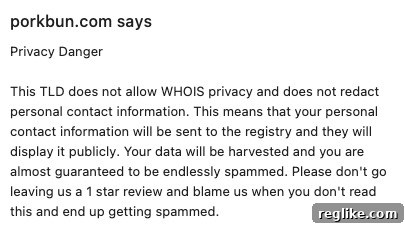
Such warnings, while helpful, do not alleviate the core problem. They simply shift the burden of awareness onto the consumer, who might still proceed due to a lack of available alternatives or an urgent need for the .us identifier. The fact that registrars feel compelled to issue such strong disclaimers speaks volumes about the severity of the privacy issues associated with these domains.
The Debate: Transparency vs. Consumer Privacy
The original justification for fully public Whois data revolved around transparency, accountability, and the ability to contact domain owners for technical, administrative, or legal issues, such as intellectual property disputes or combating cybercrime. However, in the age of ubiquitous data harvesting and sophisticated spam operations, the balance has drastically shifted. The benefits of public Whois data for legitimate purposes are increasingly outweighed by the enormous detriment to individual privacy and security. Spammers don’t need to know your physical address to send you an email, nor do they need your personal phone number to make a cold call—they simply exploit the availability of this information for their own illicit gain.
The U.S. government’s stance on .us domain privacy places it at odds with global privacy trends and the practices adopted by the vast majority of other TLD registries. This has led to a growing call for reconsideration of the policy.
Towards a Solution: Government’s Role and Future Outlook
There have been indications that the government is aware of these issues and is considering policy changes. The Department of Commerce, which oversees the .us ccTLD, has most recently in 2023, explored options for obscuring some Whois data for .us domains. This proposal included methods for legitimate parties to access the information easily, even if it would no longer be made publicly available in the Whois database.
Such a move would be a welcome step forward. At a minimum, the government should prioritize obscuring highly sensitive personal identifiers such as phone numbers and email addresses. These are the primary vectors for the unwanted communications that plague .us domain registrants. Implementing a system where these details are masked by default, similar to the GDPR model, while still providing a verified mechanism for legitimate inquiries (e.g., through an anonymized contact form or a court order process), would strike a much-needed balance between transparency and consumer protection.
As one of the last remaining significant sources of public Whois data, .us domains are easy fodder for spammers and scammers. Without policy reform, the attractiveness and utility of .us domains will continue to diminish for the general public, relegating them to a niche where privacy concerns are either non-existent or secondary to other considerations.
Protecting Yourself: Strategies for .us Domain Registrants
While awaiting much-needed policy reform, what can individuals and small businesses do if they feel they must register a .us domain? Here are a few pragmatic, albeit imperfect, strategies:
- Use a Dedicated or Disposable Email Address: Instead of your primary personal or business email, use an email address specifically set up for your .us domain registration. Be prepared for this email to receive a high volume of spam.
- Employ a Virtual Phone Number or Spam-Trap Line: If a phone number is required, consider using a virtual phone number service or a secondary phone line that you rarely use. This can help isolate unwanted calls from your main communication channels.
- Business Address Over Personal: If you are registering a .us domain for a business, use a business address rather than your residential address. For individuals, if possible, use a P.O. Box or a virtual office address service to protect your home address.
- Be Prepared to Block: As bocamj’s experience shows, you will likely need to proactively block a significant number of unwanted callers and texters.
- Perform Due Diligence: Before committing to a .us domain, carefully weigh the benefits against the significant privacy risks. Explore alternative TLDs if possible, or ensure your privacy strategy is robust if you proceed.
These strategies are merely defensive tactics against a systemic problem. They highlight the urgent need for a fundamental shift in the U.S. government’s approach to .us domain Whois policy.
Conclusion: A Call for Modernized Digital Privacy
The current policy regarding .us domain Whois data is a glaring anachronism in today’s digital landscape. It unnecessarily exposes American citizens and businesses to a torrent of spam, scams, and privacy invasions, undermining trust and deterring legitimate use. The experiences of users like bocamj are not isolated incidents but symptomatic of a broader issue that demands immediate attention.
As the internet continues to evolve and digital privacy becomes an increasingly critical concern globally, the U.S. government has an opportunity—and indeed, a responsibility—to modernize its policies. By adopting a privacy-by-default approach for .us domain registrations, while maintaining mechanisms for legitimate access, it can bring the .us domain into alignment with contemporary privacy standards. This change would not only protect registrants from incessant unsolicited communications but also enhance the credibility and desirability of the .us domain space, fostering a safer and more trustworthy online environment for everyone.