
Maximizing Domain Sales with Live Chat: Best Practices for Enhanced Customer Engagement
In the fast-paced world of e-commerce, customer engagement is paramount. Businesses are constantly seeking innovative ways to connect with potential buyers, answer their questions in real-time, and guide them through the purchasing journey. Among the most effective tools for achieving these goals is live chat support. It has become an indispensable component for online retailers, proven to significantly reduce cart abandonment and propel sales by offering immediate assistance and personalized interaction.
Imagine browsing an e-commerce site, perhaps for a unique product or a high-value digital asset, when a friendly window unobtrusively pops up, asking if you require any help. This proactive approach can make all the difference, transforming a hesitant browser into a confident buyer. In the niche but lucrative domain name industry, where assets can range from a few dollars to millions, the potential for live chat to influence purchase decisions is even greater. Successfully integrating this form of direct communication can demystify the buying process, address specific concerns, and ultimately, facilitate more successful domain transactions.
The Transformative Power of Live Chat in Modern E-commerce
Live chat has evolved from a simple helpdesk feature into a strategic sales tool. Its immediate nature resonates deeply with today’s consumers who expect instant gratification and personalized service. Unlike email, which can involve significant delays, or phone calls, which can be inconvenient, live chat offers a frictionless channel for communication right within the browsing experience.
The benefits extend beyond mere convenience. Studies consistently show that customers who engage with live chat are more likely to make a purchase. This is attributed to several factors: immediate query resolution builds confidence, personalized interactions foster trust, and the ability to address objections or clarify details on the spot prevents potential buyers from navigating away to competitors. For high-value items, where buyers often have specific questions or require detailed information before committing, live chat becomes even more critical. It bridges the information gap, provides reassurance, and creates a more human connection in an otherwise digital transaction.
Why Live Chat is Crucial for High-Value Digital Assets Like Domain Names
Domain names are not just digital assets; they are often the foundation of a business’s online identity, a key marketing tool, or a valuable investment. The decision to purchase a domain, especially a premium one, often involves significant consideration. Buyers may have questions about transfer processes, intellectual property, valuation, future potential, or specific terms of sale. These are not simple queries that a generic FAQ page can fully satisfy.
In this context, live chat acts as a virtual sales assistant, capable of guiding a prospective buyer through complex information, highlighting key benefits, and even providing negotiation insights (where applicable). It can alleviate common anxieties associated with online purchases, such as payment security or the technical aspects of domain management. Furthermore, the domain market is dynamic; a desirable domain might be snatched up quickly. Live chat can instill a sense of urgency and provide immediate assistance to expedite the purchasing process, preventing potential buyers from delaying and missing out on an ideal domain.
Sedo’s Initiative: A Step in the Right Direction
It was with great interest that I recently observed a leading domain marketplace, Sedo, implementing live chat on their domain listing pages. While browsing a particular domain listing on Sedo.com, after a short period of engagement, a friendly chat window gracefully appeared, featuring a representative ready to assist. This proactive engagement immediately signaled a commitment to customer support and a clear understanding of the need to push potential buyers forward in their decision-making process.
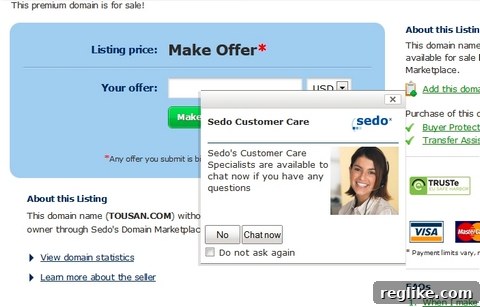
The initial impression was undeniably positive. Such an approach demonstrates a recognition that potential buyers often have questions that, if left unanswered, could lead to hesitation and ultimately, cart abandonment. By offering immediate assistance, Sedo positioned itself to clarify doubts, address concerns, and guide users toward a successful purchase. This proactive strategy holds immense potential for boosting domain sales and enhancing the overall user experience.
Unpacking Sedo’s Live Chat: Opportunities for Refinement
While the intent behind Sedo’s live chat implementation is commendable, a deeper dive into its execution reveals several areas where refinement could significantly enhance its effectiveness as a sales tool. The current setup, while offering support, appears to prioritize general assistance over targeted sales enablement, leading to a less optimized buyer journey.
Challenge 1: General Support vs. Targeted Sales Assistance
Upon clicking the chat button, instead of being immediately connected with a sales-oriented representative or presented with context-specific options, users are first prompted to provide their name and email, followed by a request to select a general support topic from a predefined list. While collecting contact information is standard practice for follow-up and CRM integration, the subsequent topic selection process introduces friction.
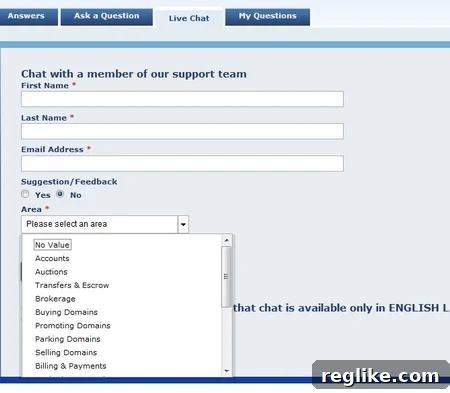
Critically, the option for “Buying Domains” is positioned far down the list. For a user who has just seen a proactive pop-up specifically related to a domain listing, having to sift through generic support categories like “General Questions,” “Seller Support,” or “Account Management” can be confusing. A typical non-Sedo user, or someone new to the platform, might not instinctively know which option directly pertains to their interest in purchasing the domain they are currently viewing. This disconnect can lead to frustration and diminish the immediate sales opportunity.
Challenge 2: Limited Availability and Time Zone Mismatch
Another significant hurdle to the chat’s global utility is its operational hours: it’s only available from 9 AM to 5 PM Central European Time (CET). While Sedo is a global company with a substantial European client base, limiting English-language chat support to these hours creates a considerable inconvenience for potential buyers in other major markets. For instance, by the time business hours begin on the West Coast of the United States (California, for example), Sedo’s chat support has already closed for the day. This geographical and temporal misalignment severely restricts its accessibility and responsiveness for a significant portion of the international market, especially in English-speaking regions.
Challenge 3: Lack of Contextual Awareness
Perhaps the most critical flaw in the current implementation, from a sales perspective, is the support agent’s lack of contextual awareness. When I initiated a chat and asked a direct question like “Is this domain available?”, the immediate response was a follow-up question: “Which domain?”. This exchange highlights a fundamental breakdown in efficiency. The chat was initiated directly from a specific domain listing page, implying a clear interest from the user in that particular asset. Expecting the user to re-state the domain name not only adds an unnecessary step but also signals that the chat system is not integrated with the browsing context. This lack of pre-populated information or contextual intelligence forces the customer to repeat information, diminishing the “live” and “supportive” aspects of the interaction and significantly slowing down the sales inquiry process.
Strategic Recommendations for Optimizing Live Chat in Domain Sales
To transform live chat from a general support channel into a powerful sales engine for domain names, a strategic overhaul focusing on user experience, agent capabilities, and technical integration is necessary. Here are key recommendations:
1. Implement Context-Aware Chat
The most impactful improvement would be to make the chat system context-aware. When a user initiates a chat from a specific domain listing page, the chat window should automatically pre-populate with the domain name they are viewing. This information should be passed directly to the support agent, enabling them to greet the customer with “Hello, how can I assist you with [DomainName.com]?” This simple integration instantly enhances efficiency and provides a superior customer experience. Furthermore, chat routing could be intelligent, directing users from domain listing pages directly to a specialized ‘Domain Sales’ team rather than a general support queue.
2. Ensure Global, Multi-Lingual Availability
For a global marketplace like Sedo, 24/7 chat support is a strategic imperative. This can be achieved through a distributed team across different time zones, or a hybrid model incorporating AI-powered chatbots for initial queries outside of human operational hours. If 24/7 human support isn’t feasible, a robust “leave a message” system should be in place, promising a prompt follow-up during operational hours. Additionally, expanding language support beyond English, or at least strategically aligning English support hours with peak usage in key English-speaking markets worldwide, would significantly broaden reach and improve conversion rates.
3. Streamline the User Experience (UX)
The initial chat form should be as minimalist as possible, asking only for essential information. More importantly, the options presented to the user should be highly relevant to their immediate context. If the chat is triggered on a domain listing page, the primary option should be “Inquire about this domain” or “Purchase assistance.” Other support topics could be secondary options or accessible through a different entry point. Proactive chat triggers should also be smarter; for instance, if a user spends a prolonged period on a listing, revisits the same listing multiple times, or attempts to add a domain to a cart but doesn’t proceed, these actions could trigger a more targeted chat invitation.
4. Empower Sales-Focused Support Agents
The success of live chat ultimately hinges on the quality of the human interaction. Agents handling domain sales inquiries need specialized training. This includes deep knowledge of the domain market, common buyer concerns, pricing structures, transfer processes, and effective sales techniques. They should also have access to comprehensive CRM tools that provide a history of the customer’s interactions and preferences. The goal is to move beyond mere “support” to proactive “sales assistance,” where agents are empowered to guide, educate, and close deals efficiently.
5. Leverage AI and Automation Wisely
AI-powered chatbots can handle frequently asked questions, qualify leads, and gather initial information before seamlessly handing over to a human agent. For example, a chatbot could ask “Are you interested in purchasing this domain for personal use or business?” or “What’s your budget range?” This allows human agents to focus on complex queries and high-value sales, increasing overall efficiency and response times. The key is a smooth transition between AI and human interaction, ensuring the customer never feels stuck or frustrated by automated responses.
The Broader Impact: A Call to Action for the Domain Industry
Sedo’s foray into live chat on domain listing pages is a commendable initial step that highlights a significant opportunity for the entire domain industry. Many other domain registrars, marketplaces, and brokers could greatly benefit from adopting and refining similar strategies. The sale of high-value digital assets requires a nuanced approach to customer service, moving beyond transactional interactions to building relationships and trust. Companies that invest in well-executed live chat solutions will differentiate themselves by offering superior customer experiences, leading to higher conversion rates, increased customer satisfaction, and stronger brand loyalty.
As the digital landscape continues to evolve, so too must customer engagement strategies. Live chat, particularly when tailored to the specific needs of domain buyers, represents a powerful tool for accelerating sales cycles and fostering a more responsive and user-friendly marketplace. Those who recognize and act on this potential will be best positioned for success in the competitive domain aftermarket.
Conclusion: Elevating the Domain Buying Experience
The presence of live support chat on Sedo’s domain listing pages is a testament to the recognized need for real-time customer assistance in the domain marketplace. While the current implementation presents opportunities for improvement, particularly concerning its focus, availability, and contextual intelligence, the foundational concept is sound. By addressing these areas through context-aware design, expanded availability, streamlined UX, empowered agents, and smart AI integration, Sedo and other domain platforms can unlock the full potential of live chat.
Ultimately, a finely tuned live chat system can transform the domain buying experience from a potentially daunting task into a seamless, informed, and highly successful transaction, benefiting both buyers and sellers alike. The goal should be to provide not just support, but proactive, intelligent sales assistance that guides customers effortlessly to their desired domain name.