
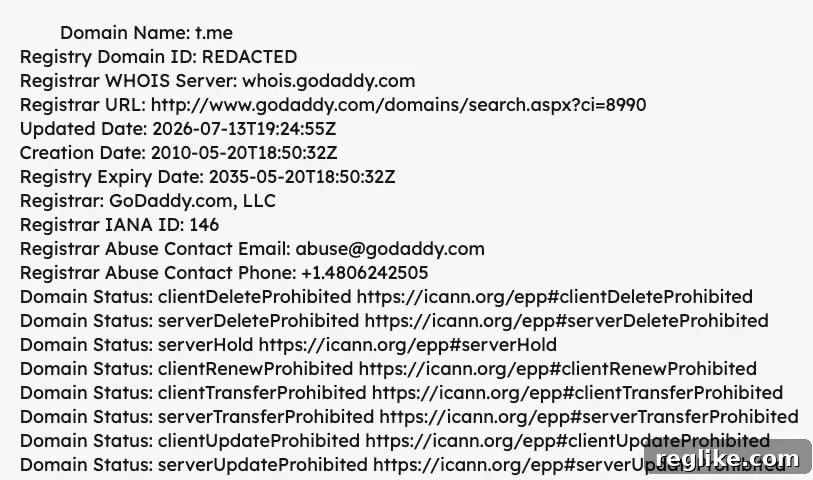
T.me shows a Server Hold status.
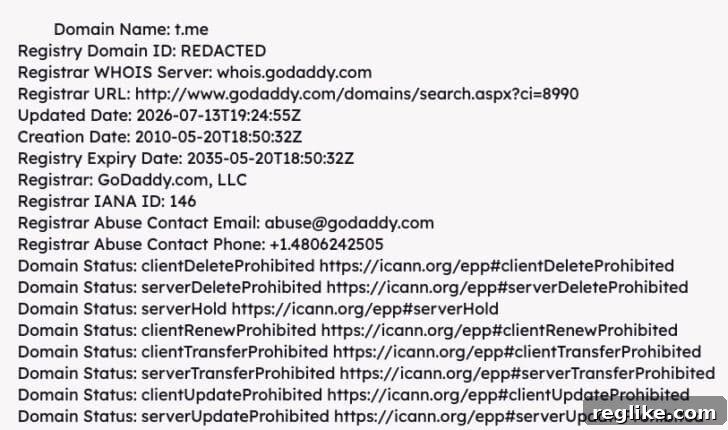
[Update: t.me is back online. The .me registry said it was on hold “due to OFAC compliance”, referring to the U.S. Office of Foreign Assets. Since t.me is a URL shortener, one of the URLs on the server led to a company on the OFAC list.]
A key domain used by the messaging service Telegram, t.me, was recently marked as being in a Server Hold state by the registry. That status prevents the domain from resolving, effectively making the shortlink service unavailable while the hold remains in place.
When a domain is placed on Server Hold it is an action taken at the registry level rather than the registrar level. In practical terms this means the registry has suspended the domain, so DNS records are not published and the domain name will not direct users to the expected destination. Because registry-level actions take effect above the registrar, they can produce immediate and wide-reaching outages for a domain that is otherwise active.
The .me top-level domain is the country code for Montenegro, but it has been widely commercialized because of the appealing “.me” meaning in English and other languages. The registry backend for .me is operated by Identity Digital, while the business and official registry responsibilities are managed by an organization in Montenegro. This split between backend operator and local registry is common among country-code domains that pursue broader commercial use.
Telegram relies on t.me as its canonical shortlink domain. The t.me/username format is the convenient shorthand for user profiles, and t.me/channelname is the familiar way to link to public channels and groups. Because the domain functions as a URL shortener and a lookup mechanism for in-app content, any interruption to t.me can impact how easily users discover profiles, channels, and shared content that rely on those short links.
There has been public attention on the relationship between Telegram and the .me registry; that relationship played a role in t.me becoming the primary shortlink domain for the app. The existence of a formal partnership or commercial agreement helped standardize t.me as the shortlink of record for Telegram, which in turn increased the domain’s visibility and importance.
At the time of the Server Hold, no definitive public explanation was available beyond the registry’s posted status. Server holds can be applied for a variety of reasons, including legal compliance, security incidents, or requests from authorities, but the registry had not provided additional context immediately after the suspension was noted.
Because t.me is used to point to a wide variety of destinations, including links that redirect outside Telegram’s own services, a registry action that targets the shortlink domain can affect many unrelated resources. If a single short URL links to content or an entity that triggers compliance checks or sanctions screening, that can sometimes lead to broader actions that temporarily take the whole domain offline while the issue is reviewed and resolved.
Service disruptions of a central shortlink domain like t.me underscore the operational risks of relying on a single domain for large-scale link resolution and identity mapping. While shortlink domains make sharing and discovery simpler, they also create a single point of failure when the domain is suspended or otherwise disabled at the registry level. Organizations and users that depend on such domains may experience broken links, failed lookups, or reduced functionality until service is restored.
As noted in the update at the top of this article, t.me was subsequently returned to service after the registry indicated the hold was related to OFAC compliance. That follow-up suggests the registry acted to investigate and address a compliance concern tied to a URL on the service, and the issue was resolved quickly enough for the domain to come back online. For now, t.me continues to serve as Telegram’s shortlink domain and remains an important component of the app’s linking and discovery system.