
Navigating the .COM Domain Market: Why Registrar Profits Remain Flat Amidst Verisign Price Hikes
The landscape of the .com domain name market presents a fascinating paradox. While Verisign, the sole wholesale provider of .com domains, continues to gain regulatory approval for price increases, the profitability of individual domain registrars remains surprisingly constrained. Despite the essential nature of .com domains for establishing an online presence and brand identity in the digital economy, the fierce competition among registrars significantly limits their margins. This article delves into the intricate dynamics of the .com domain industry, exploring how market forces shape registrar profitability, even as wholesale costs steadily climb.
Understanding the economics of domain registration is crucial for businesses, entrepreneurs, and anyone involved in the internet infrastructure. For years, the U.S. Government has granted Verisign (NASDAQ: VRSN) the authority to incrementally raise prices on .com domain names, a decision typically requiring approval from the Internet Corporation for Assigned Names and Numbers (ICANN). These price adjustments directly impact the operational costs for every domain registrar globally. However, the subsequent journey of these increased costs from wholesale to retail reveals a stark disparity between a monopolistic wholesaler and a highly competitive retail market.
The Unchallenged Dominance of Verisign in the .COM Ecosystem
Verisign holds a unique and powerful position in the domain name industry. As the exclusive registry operator for .com, it acts as the singular wholesaler for what is arguably the most coveted and widely used Top-Level Domain (TLD) on the internet. This monopolistic control means that every single penny of a price increase for a .com domain name directly contributes to Verisign’s robust bottom line. There is no alternative wholesaler for .com, eliminating competitive pressure at the registry level and allowing Verisign significant leverage in its pricing strategies, subject to governmental and ICANN oversight.
This structural advantage provides Verisign with a predictable revenue stream and the ability to dictate a fundamental component of the domain market’s cost structure. The argument often made for allowing Verisign this pricing flexibility centers on the notion that it manages critical internet infrastructure, requiring substantial investment in security, stability, and resilience. However, the ripple effect of these price hikes is not evenly distributed across the value chain, leading to significant implications for the companies that directly serve the end-users.
The Fiercely Competitive Landscape for Domain Registrars
In stark contrast to Verisign’s monopolistic position, domain registrars operate within an intensely competitive market. Hundreds of accredited registrars globally vie for customer attention, offering domain registration services alongside a suite of related products like web hosting, email, and website builders. This competitive environment is a double-edged sword: it benefits consumers by keeping prices relatively low and fostering innovation, but it severely limits the profit margins for registrars, particularly on high-volume, foundational products like .com domains.
While registrars technically possess the autonomy to set their own retail prices for .com domains, market forces act as a powerful governor. Should a registrar attempt to significantly mark up the price of a .com domain beyond what competitors charge, customers are likely to simply take their business elsewhere. This elasticity in demand, combined with the low barrier to switching registrars, means that any wholesale price increase from Verisign is largely passed directly onto the consumer, with registrars absorbing little to none of the additional cost into their profit margins. This dynamic often leaves registrars feeling squeezed between rising wholesale prices and unyielding retail competition.
A Deep Dive into Registrar Profitability: The Tucows Case Study
To truly understand the impact of these market forces, a closer look at a major player like Tucows (NASDAQ: TCX) provides invaluable insight. Tucows, a long-standing and prominent domain registrar, has consistently highlighted the challenges of maintaining profitability in the .com market through its investor communications. Their third-quarter investor Q&A, for instance, offered a compelling illustration of this struggle.
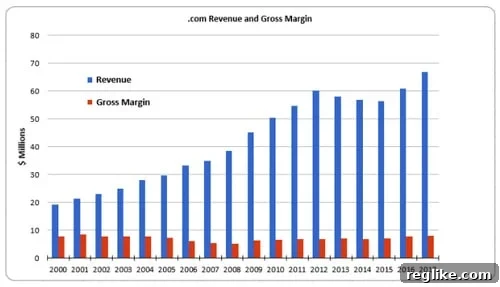
The chart above visually represents Tucows’ revenue generated from .com sales over the years, juxtaposed with its gross margin from these sales. What it strikingly demonstrates is an undeniable trend: while Tucows consistently registers an increasing volume of .com domains, driving higher overall revenue, its gross margin in dollar terms from these sales remains remarkably stagnant. This means that as the company sells more domains, its per-unit profitability diminishes significantly, with the increased revenue primarily covering the rising wholesale costs without translating into proportionally higher profits.
Elliot Noss’s Insightful Perspective on .COM’s “Strange Place”
Elliot Noss, CEO of Tucows, articulated this predicament eloquently, describing .com’s “strange place” within their business model, a sentiment likely shared by many registrars. In his own words, Noss elaborated:
… .com has a strange place for us, and I suspect most registrars. It is still by far the largest top level domain. It is still by far the one that end users want as first priority. It still dominates our discussions with resellers. And over time it has become less and less impactful to our gross margin dollars. The data, going back to the launch of OpenSRS in 2000 speaks volumes. The unit volume of .com sold goes up every year. The amount of money we pay to Verisign goes up commensurately. And the amount of money that the competitive registrar market allows us to generate stays flat. Like the prairies. Amazingly flat over now 18 years. And on a % basis it has gone from us making 40% of the .com revenue generated in 2000, all the way down to 12% in 2018. We make a little under $8 million per year on .com. That was true in both 2000 and 2018. They made roughly $19 million from our .com sales in 2000. In 2017 that number was nearly $67 million. This price increase only exacerbates that trend. And of course we believe that registrars do, by far, the lion’s share of the work to generate that revenue.
Noss’s statement is a powerful indictment of the current market structure. He highlights several critical points: Firstly, .com’s enduring popularity and market dominance – it remains the default choice for individuals and businesses seeking a robust online presence. Secondly, despite this undeniable demand, its impact on registrar gross margin dollars has steadily eroded. Over nearly two decades, from 2000 to 2018, Tucows’ unit volume of .com domains sold increased annually, yet their absolute gross margin in dollar terms remained constant, hovering around $8 million per year. This meant their percentage-based margin plummeted from a healthy 40% in 2000 to a mere 12% by 2018.
During the same period, the money Verisign earned from Tucows’ .com sales skyrocketed from approximately $19 million to nearly $67 million. This dramatic shift underscores the transfer of value from registrars to the registry operator. Noss’s conclusion, that registrars perform the “lion’s share of the work” in generating this revenue, brings to light an often-overlooked aspect of the domain industry: the extensive efforts involved in marketing, customer support, technical integration, and value-added services provided by registrars, which ultimately drive the growth and adoption of .com domains.
The Unseen Labor: Who Drives .COM Growth?
Elliot Noss’s assertion that registrars do most of the work to promote .com’s growth is a crucial point often missing from discussions about domain pricing. While Verisign maintains the technical infrastructure and database, registrars are on the front lines, engaging directly with millions of customers worldwide. They invest heavily in marketing campaigns, provide essential customer service, offer intuitive domain management interfaces, integrate domain services with other vital digital economy tools, and educate users about the value of an effective brand identity online.
These efforts are instrumental in bringing new users into the .com ecosystem and ensuring existing ones renew their domains. Without the competitive sales and support infrastructure provided by registrars, the growth of .com would undoubtedly stagnate. Registrars bear the costs associated with fraud prevention, regulatory compliance, and the constant development of user-friendly platforms, all while operating under the intense pressure of price competition. Yet, their compensation for these vital services, particularly for .com, is increasingly constrained.
Future Implications of Continued .COM Price Increases
Looking ahead, if .com prices continue their upward trajectory in the coming years, the existing trends are likely to intensify. Registrars, faced with unyielding market competition, will have little choice but to directly pass these elevated wholesale costs on to their customers. For a company like Tucows, this might mean that while their gross margin in absolute dollar terms from .com sales remains around the $8 million mark annually, this fixed margin will be generated on an even larger revenue base. In other words, they would be processing more money and more registrations, but for the same dollar profit, further diminishing their percentage-based margin.
This scenario highlights a fundamental challenge: Registrars are becoming increasingly reliant on other value-added services (like hosting, SSL certificates, email services, or premium domains) to drive significant profit growth. While .com domains remain a crucial “foot in the door” product that attracts customers, the core business of simply registering a .com name offers diminishing returns. This shifts the strategic focus for registrars towards upselling and cross-selling, potentially leading to more complex pricing structures for consumers who simply want a straightforward domain registration.
The Fundamental Disparity: Monopoly vs. Competition
The core of this debate rests on a fundamental disparity: Verisign operates as a de facto monopoly, whereas domain registrars function within a highly competitive market. Arguments suggesting that Verisign should have “price flexibility” because registrars also have “complete price flexibility” fundamentally misunderstand these market structures. Verisign’s price flexibility stems from its unique position as the sole provider, with no direct substitutes. Registrars’ theoretical price flexibility is immediately curtailed by the presence of hundreds of direct competitors offering the exact same product.
This difference is not merely academic; it has tangible economic consequences. Verisign’s pricing decisions impact the entire internet infrastructure, flowing through registrars to millions of end-users. Without the tempering effect of competition at the registry level, the potential for continuous price hikes exists, placing an increasing burden on the competitive retail sector and, ultimately, on the businesses and individuals who rely on .com domains for their digital economy participation. Understanding this unique market structure is key to appreciating the challenges faced by domain registrar profitability and the broader implications for internet accessibility and growth.
In conclusion, the .com domain market is a complex ecosystem where the unyielding forces of competition at the retail level clash with monopolistic control at the wholesale level. While Verisign continues to see its revenues from .com sales soar with approved price increases, domain registrars like Tucows find their margins constrained and flat, despite doing the significant work of driving adoption and providing essential domain registration services. This ongoing dynamic underscores the need for a balanced approach to wholesale domain prices and a recognition of the vital role registrars play in the health and expansion of the internet’s most crucial TLD. For businesses and consumers, these domain market competition trends mean careful consideration of where value is truly being added in the domain industry trends, and how sustainable registrar margins can be maintained in an ever-evolving digital landscape.