
The Criticality of Domain Names: When a Competitor Seizes Your Brand’s Digital Foundation
In the digital age, a company’s domain name is far more than just an address on the internet; it is a cornerstone of its brand identity, a primary touchpoint for customers, and a crucial asset for market recognition and competitive positioning. The choice of a domain name directly impacts ease of recall, search engine visibility, and overall brand perception. This makes the acquisition and ongoing management of a company’s digital real estate a strategic imperative. Ignoring the power of a potent, concise domain can lead to severe challenges, particularly when a competitor recognizes and capitalizes on that oversight. The case of Workforce Software and Workforce.com serves as a stark illustration of these profound implications, highlighting the perils of not securing the optimal domain for your enterprise.
The Workforce Software vs. Workforce.com Saga: A Battle for Digital Identity
For many years, two distinct entities coexisted with domains that, to the casual observer, might seem related but served different purposes. On one side, we had Workforce Software, a company dedicated to providing comprehensive workforce management software solutions to businesses globally. Their digital presence was anchored by the domain WorkforceSoftware.com.
On the other side stood Workforce Magazine, a long-standing and respected publication focused on human resources news and insights. This magazine utilized the shorter, more direct, and arguably more memorable domain: Workforce.com. For decades, there was a clear delineation; one was a software provider, the other a news outlet, and their respective domain choices reflected their core business activities without significant overlap or confusion.
The Game-Changing Acquisition and Rebranding
The landscape dramatically shifted when a direct competitor to Workforce Software orchestrated a strategic move that sent ripples throughout the industry. This competitor acquired the publisher of Workforce Magazine, and with it, the coveted Workforce.com domain. The subsequent action was equally strategic and audacious: the competitor promptly repurposed Workforce.com, transforming it from a human resources news portal into the official online home for its own suite of workforce management software. This product was then rebranded to align directly with the newly acquired domain, simply as Workforce.com. This move was a masterclass in leveraging a premium domain to gain a competitive edge, directly challenging an established player in the market.
The Immediate Aftermath: Unraveling Confusion and Competitive Disadvantage
The implications for Workforce Software were immediate and severe. Suddenly, they found themselves confronting a significant and unexpected problem: widespread brand confusion. They no longer held the most intuitive and succinct domain for their business, and, critically, this prime digital real estate was now actively being used by a direct rival. This wasn’t merely an inconvenience; it represented a fundamental challenge to their market position and brand clarity. Potential customers searching for “workforce software” or simply “workforce” might inadvertently land on the competitor’s site, creating misdirected traffic, diluted brand recognition, and a significant hurdle in their sales funnel.
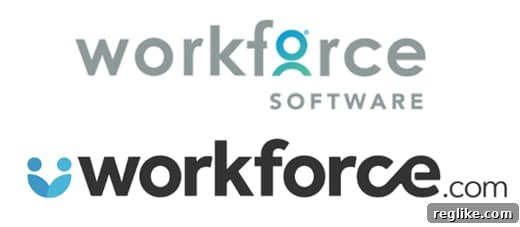
The visual branding further exacerbated this confusion. As depicted in the accompanying image, both companies adopted similar aesthetic choices for their logos. Both feature lowercase lettering, incorporating a blue icon. While the icons themselves are distinct, they share a stylistic resemblance, appearing almost as mirror images. This visual congruity, combined with the identical core domain name, served to intensify the likelihood of confusion in the minds of consumers and industry professionals alike.
The UDRP Challenge and Its Outcome
In response to this perceived threat and palpable confusion, Workforce Software pursued legal recourse, filing a cybersquatting complaint under the Uniform Domain-Name Dispute-Resolution Policy (UDRP) against Workforce.com. The UDRP is an administrative procedure designed to resolve disputes concerning abusive registration of domain names, particularly those registered in bad faith. However, in a significant setback for Workforce Software, they lost their case.
This outcome underscores a crucial distinction in domain law. UDRP cases typically hinge on three core elements: the disputed domain name being identical or confusingly similar to a trademark in which the complainant has rights; the respondent having no legitimate rights or legitimate interests in respect of the domain name; and the domain name having been registered and being used in bad faith. In the Workforce.com scenario, while the first element (confusing similarity) was undeniably present, the case likely faltered on the “no legitimate interest” and “bad faith” criteria. The original registrant (Workforce Magazine) had a legitimate interest in the domain for its publication. The subsequent acquisition by the competitor, while strategically aggressive, was a legitimate business transaction. It was not a registration made by the competitor *in bad faith* specifically to target Workforce Software at the initial point of registration, but rather a legitimate purchase of an existing, legitimately used domain that was then repurposed. The UDRP focuses on the original registrant’s intent and whether the domain was registered in bad faith *against the complainant’s trademark*. This was a case of a legitimate sale and subsequent repurposing, not initial cybersquatting.
The Broader Implications: Lessons in Domain Strategy and Brand Vulnerability
This incident is not merely an isolated legal battle; it serves as a powerful cautionary tale for any business operating in the digital landscape. It highlights a fundamental truth: neglecting to secure the best possible domain for your company can have far-reaching and detrimental consequences, potentially coming back to haunt you in unforeseen ways.
The Imperative of Owning the “Best Domain”
A “best domain” is typically short, memorable, easy to type, and directly reflective of a company’s brand or primary offering. Such domains offer a multitude of advantages: enhanced brand recall, direct navigation (users typing the name directly), improved search engine optimization (SEO) by clearly signaling relevance, and a strong sense of authority and professionalism. Workforce.com, being the concise and generic version of “workforce,” inherently possessed these qualities, making it a highly desirable digital asset. Companies often underestimate the long-term value of investing in these premium domains, choosing instead to settle for longer, hyphenated, or less intuitive alternatives.
The Risks of Settling for “Second-Best”
My usual advice to businesses contemplating domain choices is that if the absolute best domain is already in use in a non-confusing, non-infringing way, registering a “second-best” domain might be acceptable. For instance, if “example.com” is a long-standing, unrelated business, then “exampleSoftware.com” could be a viable alternative. However, I always urge extreme caution when the best domain is merely a parked page, unused, or seemingly abandoned, as it could be acquired and repurposed at any moment. The Workforce.com case, however, introduces an even more complex layer: even if a superior domain is actively used in a non-infringing manner, it is still a marketable asset. Its sale and subsequent re-direction can occur, drastically altering the competitive landscape and introducing significant brand confusion, even without any initial malicious intent from the domain owner.
The Unforeseen Consequences: Beyond Direct Competition
The potential for confusion extends beyond direct competitive threats. I recall a similar, albeit more embarrassing, situation faced by a friend. He had registered a domain following the “exampleSoftware.com” pattern for his legitimate software business. Unbeknownst to him, someone else later acquired the shorter, more generic “example.com” domain and began marketing a sex toy line. My friend quickly started receiving calls from confused acquaintances and clients, jokingly asking if he had diversified into an entirely different, highly suggestive industry. This anecdote, while humorous in retrospect, underscores the genuine brand damage and reputational risk that can arise when a seemingly unrelated domain choice by another party inadvertently creates an association you desperately want to avoid.
Beyond UDRP: The Nuances of Trademark Law
While the UDRP case for cybersquatting was unsuccessful for Workforce Software, the question remains whether further legal action, specifically under trademark law, could yield a different outcome. Trademark infringement claims typically center on the likelihood of confusion between two marks in the marketplace. However, this path presents its own set of unique challenges.
The most significant hurdle lies in the generic nature of the word “Workforce” itself. Trademark law generally provides stronger protection for marks that are arbitrary, fanciful, or suggestive (e.g., “Apple” for computers, “Kodak” for cameras). Marks that are descriptive of the goods or services they represent, such as “Workforce” for workforce management software, are inherently weaker. They often require proof of “secondary meaning” – meaning that consumers have come to associate the descriptive term primarily with the complainant’s goods or services, rather than with the generic term itself. Proving that “Workforce” solely identifies Workforce Software, despite the existence of numerous other companies and products related to workforce management, would be an arduous task.
Even if Workforce Software could demonstrate some level of secondary meaning for its own extended mark (Workforce Software), proving a likelihood of confusion with the new Workforce.com under trademark law would still be an uphill battle, especially considering the UDRP panel’s decision. Such litigation would be costly, time-consuming, and the outcome far from guaranteed, further emphasizing the foundational importance of a robust, proactive domain strategy from the outset.
Strategic Domain Management: A Proactive Imperative
The Workforce Software case serves as a critical reminder that a company’s digital identity is a precious and vulnerable asset. To mitigate such risks, businesses must adopt a proactive and comprehensive domain management strategy that includes:
- Prioritizing Premium Domains: Whenever possible, secure the shortest, most intuitive, and most brand-aligned domain names. Treat them as essential investments, not mere expenditures.
- Defensive Registrations: Consider registering common misspellings, plural forms, hyphenated versions, and relevant country-code top-level domains (ccTLDs) to prevent others from using them in a confusing or malicious manner.
- Continuous Monitoring: Regularly monitor new domain registrations that might be similar to your brand, allowing for early intervention against potential cybersquatting or trademark infringement.
- Trademark Protection: Invest in registering your brand name as a trademark. While “Workforce” might be challenging, unique brand elements or more distinctive brand names should be protected rigorously.
- Clear Branding Guidelines: Develop strong and distinctive branding guidelines, including logos and visual identity, to minimize confusion, even if domain names are similar.
In conclusion, the saga of Workforce Software and Workforce.com is a powerful testament to the ever-evolving complexities of online branding and competitive dynamics. It underscores that while legal avenues exist, the most effective defense against domain-related challenges is a proactive and strategic approach to securing and managing a company’s digital identity. In today’s interconnected world, a strong domain strategy is not just about having an address online; it’s about safeguarding your brand, ensuring customer clarity, and preserving your competitive edge.