
Exploring the Competitive Landscape: The .NET Domain in China’s Digital Arena
In our ongoing exploration of the intricate and rapidly evolving Chinese domain market, we’ve previously delved into the overarching trends, the national pride embodied by .cn, and the undeniable dominance of .com. Today, our focus shifts to a domain extension that faces significant headwinds in this dynamic environment: .net. This in-depth analysis is meticulously constructed using comprehensive data collected from China Internet Network Information Center (CNNIC) reports, spanning an impressive historical period since their initial publications in 1997. Our aim is to provide a clear, concise, and SEO-friendly overview of .net’s position, its challenges, and any glimmer of hope in one of the world’s most competitive digital landscapes.
The Chinese domain market is a colossal entity, driven by a massive internet user base and an ever-expanding digital economy. Understanding the distribution of Top-Level Domains (TLDs) within this market offers crucial insights into user preferences, corporate strategies, and regulatory influences. While some extensions thrive, others find themselves relegated to niche roles or struggling to gain traction amidst fierce competition. It is within this context that we examine the story of .net.
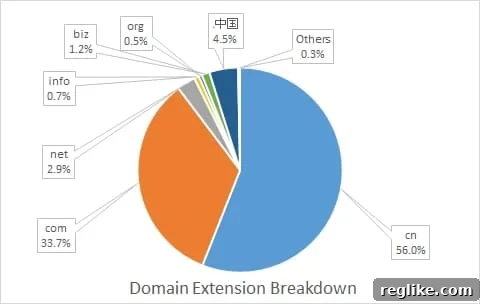
A snapshot of domain registrations in China as of December 2018 reveals a stark reality for the .net extension. As vividly illustrated in the accompanying pie chart, .net commands a mere 2.9% of the total market share, translating to approximately 1.1 million registered domains. This figure pales in comparison to the juggernauts like .cn and .com, which collectively dominate the landscape and are widely regarded as the primary choices for corporate entities, startups, and individual users across China. For the majority of Chinese businesses, particularly those with aspirations for broad market appeal or national recognition, .cn and .com are considered the default, mainstream extensions. In contrast, .net is frequently perceived as a secondary or niche option, often chosen when the preferred .com or .cn variants are unavailable, or for specific technical or network-related services. This perception significantly impacts its growth trajectory and overall adoption rate within the Chinese digital ecosystem.
The reasons behind this entrenched preference are multi-faceted. .com, globally recognized and synonymous with the internet itself, carries an unparalleled level of trust and brand authority. In China, where brand prestige and memorability are crucial, a .com domain is often seen as a mark of an established and credible business. Similarly, .cn, as the country code Top-Level Domain (ccTLD) for China, benefits from strong governmental support, national identity, and a sense of local authenticity. Many Chinese citizens and businesses prefer .cn to demonstrate their local presence and commitment to the domestic market. These two powerhouses create an exceptionally challenging environment for any other TLD to gain significant market share, pushing extensions like .net to the periphery.
Examining the Growth Trajectory of .NET Domains in China
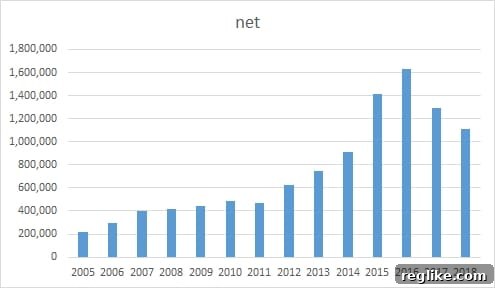
Delving deeper into the historical performance, the chart depicting the number of registered .net domains in China over the years illustrates a pattern of moderate growth, punctuated by specific market phenomena. There was a noticeable surge in registrations during 2015 and 2016, a period often referred to as the “Chips” boom in the domain industry. This boom originated primarily around .com domains, driven by speculative investment and a growing awareness of domain assets as valuable digital real estate. However, the excitement and investment fervor spilled over, creating a ripple effect that benefited other extensions, including .net, leading to a temporary uptick in its registration numbers. Investors and end-users, unable to secure premium .com domains, turned to alternatives, temporarily boosting the appeal of other TLDs.
Unfortunately, this period of accelerated growth proved to be fleeting. In the two years following the peak (referencing data up to 2018), growth for .net domains significantly decelerated, returning to a more subdued trajectory. This slowdown indicates that the “Chips” boom was an anomaly rather than a sustainable trend for .net. Long-term, the .net extension faces an uphill battle to expand its footprint in the Chinese market. The core challenges remain deeply rooted in the established preferences of Chinese companies and internet users, who consistently gravitate towards the perceived trustworthiness and brand value of .com, or the national identity and local relevance of .cn. This ingrained preference creates a formidable barrier to entry and growth for any alternative domain extension.
Intensifying Competition: The Rise of New gTLDs
Adding another layer of complexity to .net’s struggles is the relentless introduction of new Generic Top-Level Domains (gTLDs) over the past few years. The expansion of the domain name system has flooded the market with numerous alternative extensions, many of which offer more specific, descriptive, or culturally relevant options than legacy TLDs like .net. This proliferation of choices further fragments the market and diverts potential registrations away from older extensions. The list of competitors is extensive and includes:
- .site: A highly versatile and popular new gTLD, often chosen for general websites, blogs, and online presences. Its clear and direct meaning makes it an attractive alternative to traditional extensions.
- .online: Another broadly appealing gTLD, signifying an online presence or business. It directly communicates the digital nature of the entity, resonating with modern internet users.
- .website: Similar to .site, this gTLD explicitly states its purpose, offering a straightforward and intuitive option for anyone looking to establish a web presence.
- .network: This extension directly competes with .net on a semantic level, specifically targeting entities involved in networking, IT services, or online communities. Its clarity can often be preferred over the more ambiguous .net.
- .wang (网): This gTLD is of particular concern for .net. “Wang” is the Pinyin transcription of the Chinese character 网, which directly translates to “net” or “network.” This makes .wang an incredibly intuitive and culturally relevant choice for Chinese users seeking a domain related to “net” or “internet.” Its direct semantic link in the local language provides a significant competitive edge.
- .网址 (wǎng zhǐ): Even more directly threatening is .网址, a Chinese Internationalized Domain Name (IDN) extension. It translates literally to “net address” or “website address.” This extension offers a fully localized, descriptive, and memorable option for Chinese users. For those who prefer to type and recognize characters, .网址 offers unparalleled relevance and ease of understanding, directly capturing the essence of an “internet address” in their native script.
The emergence of .wang and .网址 represents a potent challenge to .net. These extensions are not merely alternatives; they are direct semantic competitors, offering clearer, more culturally aligned, and often more descriptive choices for Chinese end-users who desire a domain related to the “net” or “network.” When users have a plethora of options that more precisely convey their intended meaning, especially in their native language or Pinyin, the appeal of a general-purpose, non-local extension like .net naturally diminishes. This abundance of semantically similar choices ultimately works against .net, making it increasingly difficult for it to stand out or attract new registrations in an already crowded marketplace.
A Glimmer of Hope: Corporate Adoption and Future Prospects
Despite the formidable challenges, a small but notable glimmer of hope exists for the .net extension in China. While the 2018 Top 100 Chinese Internet Companies Report notably listed no major corporations utilizing a .net domain for their primary corporate website, this narrative saw a subtle shift in the subsequent 2019 report. The inclusion of Loyo, a prominent game developer, at position No. 84, proudly owning and utilizing Loyo.net as its matching corporate domain, signals a potential, albeit nascent, change in perception. This adoption by a significant player in the rapidly expanding gaming industry is noteworthy.
The gaming sector in China is a vibrant, innovative, and fast-growing segment of the digital economy. If more companies within this or other emerging industries, particularly those with a global outlook or a focus on network-centric services, begin to embrace .net, it could potentially pave the way for broader corporate adoption. The question then becomes: will this single instance of corporate endorsement by Loyo.net spark a trend? Will other companies, perhaps finding their ideal .com or .cn domains already taken, consider .net as a viable, professional alternative? Only time will provide the definitive answer to whether corporate adoption of .net will see a meaningful increase.
For .net to secure a stronger foothold, it would likely require a strategic rebranding or renewed marketing efforts focusing on its unique attributes, perhaps targeting specific niche industries where its “network” connotation is particularly relevant. Furthermore, educational campaigns could help redefine its image from a “secondary” option to a “specialized” or “innovative” one. However, overcoming the deeply ingrained preferences for .com and .cn, alongside the rise of highly relevant new gTLDs, remains an monumental task.
Conclusion: .NET’s Niche in a Competitive Market
In summation, the .net extension occupies a very small and increasingly challenging segment within the vast and fiercely competitive Chinese domain market. Its market share is modest, its historical growth has been inconsistent, and it faces intense pressure from both the dominant .com and .cn extensions, as well as a growing array of new gTLDs that often offer more precise and culturally relevant alternatives. The semantic overlap with extensions like .wang and .网址 poses a particularly acute threat, directly siphoning off demand for network-related domain names.
Nevertheless, the occasional instance of corporate adoption, such as Loyo.net, demonstrates that a certain level of demand from end-users and even established businesses does exist, particularly when a suitable .com or .cn is unavailable, or for specific technical use cases. While it may never rival the giants, .net could potentially carve out a more robust niche for itself by strategically targeting specific industries or user segments that value its original “network” connotation. However, for the foreseeable future, .net will continue to navigate a highly contested terrain, fighting to maintain its relevance in one of the world’s most dynamic digital economies.