
Mastering the Digital Gateway: Lessons from Seattle’s Domain Name Landscape
The relentless Texas summer heat, often soaring past 100 degrees with oppressive humidity, frequently prompts my family to seek cooler climes. Last week, our quest for respite led us to the Pacific Northwest, specifically Seattle, Washington, for a much-anticipated five-day vacation. With August’s average high temperature in Seattle typically hovering around a comfortable 75 degrees Fahrenheit, it promised to be the perfect escape. However, fate, it seems, had a different plan. We inadvertently chose the very week Seattle was experiencing an unprecedented heatwave, with temperatures climbing into the low 90s. While 90 degrees and dry might sound preferable to 100 and humid, it’s a stark reality check when you discover that air conditioning is largely a foreign concept in many Seattle establishments, making even that seemingly modest heat remarkably challenging.
Despite the unexpected warmth, our Seattle adventure proved to be a fascinating journey, not just through the city’s vibrant attractions but also through its digital landscape. As someone keenly attuned to the intricacies of online presence, I found myself observing the domain names of various local businesses and attractions. What quickly became apparent was the stark contrast between those that had clearly mastered their digital identity and those that, perhaps unknowingly, were hindering their online potential. This informal audit of Seattle’s web addresses offered valuable insights into the critical role domain names play in branding, memorability, user experience, and ultimately, a business’s overall success in the digital age, particularly for local attractions and small enterprises vying for attention in a competitive market.
The Epitome of Digital Simplicity: Woodland Park Zoo and Zoo.org
Our itinerary for Seattle undoubtedly included a visit to the renowned Woodland Park Zoo. This decision was largely influenced by my two-year-old daughter’s profound fascination with flamingos, and the zoo’s special exhibit featuring these magnificent pink birds was an irresistible draw. As we planned our day, I momentarily forgot the zoo’s opening hours. Instinctively, I reached for my phone, confident that recalling its web address would be effortless. And it was: Zoo.org. This simple, elegant, and highly memorable domain stands out as a masterclass in effective digital branding for an organization of its kind.
At first glance, one might question why a .org domain would be considered exemplary in the realm of domain name strategy. Many businesses instinctively gravitate towards .com, often seen as the default and most authoritative top-level domain. However, for the Woodland Park Zoo, an accredited non-profit zoological garden dedicated to conservation, education, and animal welfare, Zoo.org is not merely an alternative; it’s a perfectly aligned and strategically superior choice. The zoo isn’t primarily chasing type-in traffic from users who might stumble upon a generic term. Instead, its objective is to provide a memorable, trustworthy, and easily accessible digital gateway for visitors who already know of its existence or are directed to it through various marketing channels.
The brilliance of Zoo.org lies in its conciseness and immediate relevance. It’s incredibly easy to remember, simple to spell, and directly communicates the essence of the entity. Consider the alternatives: WoodlandParkZoo.com, while descriptive, is undeniably long and more prone to spelling errors. Furthermore, many locals and tourists alike might colloquially refer to it as “the Seattle Zoo,” adding another layer of potential confusion for a longer, more specific domain. Zoo.org bypasses all these complexities. It’s succinct, authoritative, and immediately recognizable, fostering an intuitive user experience that is invaluable for a public institution that serves as a major tourist attraction and community resource.
Moreover, the .org extension inherently conveys a sense of non-profit status, community focus, and trustworthiness, which aligns perfectly with the zoo’s mission. For an organization deeply involved in conservation efforts and public education, a .org domain reinforces its institutional credibility and commitment to public service rather than purely commercial interests. This strategic choice enhances its brand identity and fosters a perception of integrity, which is vital for securing donations, volunteers, and public support. In the competitive landscape of tourist attractions and non-profits, a domain like Zoo.org is a powerful asset, streamlining access to information, facilitating ticket purchases, promoting educational programs, and reinforcing the zoo’s respected position within the Seattle community and beyond. It exemplifies how a well-chosen domain can significantly amplify an organization’s mission and digital reach.
The Cautionary Tale: eSimplytheBest.net at Pike Place Market
While Woodland Park Zoo provided a shining example of domain name excellence, my observations in Seattle also revealed instances where digital strategy, specifically domain choice, fell short. One particularly striking example of a truly bewildering domain name came from a dried fruit stand nestled within the bustling, iconic Pike Place Market: eSimplytheBest.net. As a destination revered for its fresh produce, artisanal goods, and vibrant atmosphere, Pike Place Market is a treasure trove of unique small businesses, many of whom rely heavily on transient tourist traffic and word-of-mouth recommendations.
From a digital marketing perspective, eSimplytheBest.net represents almost everything one should avoid in a domain name. Firstly, its length is cumbersome. In an age where digital interactions are often fleeting, and users expect instant access, a long domain name is a significant barrier. Secondly, the inclusion of the archaic “e” prefix, a relic of the early internet era, adds an unnecessary layer of complexity and makes it sound dated rather than contemporary. The word “simply” is then negated by the very structure of the domain. Thirdly, “thebest” is a subjective, often overused descriptor that doesn’t inherently convey what the business offers. While the business clearly believes its fruit is “simply the best,” this aspirational branding choice becomes convoluted in the domain format.
Finally, the choice of a .net top-level domain, while not inherently negative, is generally less authoritative and memorable than .com for commercial entities. While .net was originally intended for network-related businesses, its widespread use by various entities has diluted its specific meaning, often leading users to default to .com if they can’t immediately recall the extension. The combination of these factors makes eSimplytheBest.net extremely difficult to remember, challenging to spell, and prone to user error when attempting to navigate directly to the website.
Despite this significant digital handicap, I must wholeheartedly vouch for the quality of their product; their dried blueberries, in particular, were absolutely delicious and became a treasured snack during our Seattle explorations. This serves as a testament to the power of a genuinely superior product sometimes overcoming even the most challenging digital branding choices. Moreover, I must commend the vendor for at least attempting to bridge the online-offline gap by printing their domain name on each bag of fruit. This initiative demonstrates an understanding of the importance of an online presence and encouraging repeat business or referrals. However, the effort is significantly undermined when the domain itself is so difficult to recall or accurately transcribe. For a small business operating in a high-traffic tourist area like Pike Place Market, where quick impressions and easy information recall are paramount, a simpler, more intuitive domain name could dramatically enhance their visibility, customer retention, and online sales potential. Imagine the lost opportunities from tourists who loved the fruit but simply couldn’t remember the website to order more or recommend it to friends.
The Smart, Keyword-Rich Choice: FreshSeafood.com
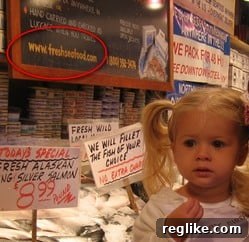
In a delightful turn of events, and proving that Pike Place Market is also a beacon of smart digital strategy, I received an update from my colleague, David Castello, a few days after our trip. David, an astute observer of domain names himself, had been in Seattle just prior to my visit and noticed an excellent domain being utilized by one of the fish markets at Pike Place: FreshSeafood.com. While uploading photos from our trip that very evening, I serendipitously discovered that I had captured a picture of my daughter standing in front of their stall, and indeed, their sign prominently displayed this perfectly chosen domain name.
FreshSeafood.com is the polar opposite of eSimplytheBest.net and stands as another sterling example of domain name best practices, especially for a business like a fish market. Its effectiveness stems from several key attributes. Firstly, it’s short and incredibly memorable. Users can instantly grasp what the business offers simply by hearing or seeing the domain. Secondly, and perhaps most crucially for SEO, it is keyword-rich. “Fresh Seafood” is precisely what potential customers would search for when looking for such products, particularly in a location famed for its aquatic bounty like Seattle.
The combination of these high-value keywords with the authoritative .com extension creates a powerful digital asset. This domain immediately conveys trustworthiness and relevance, making it easy for both locals and tourists to find the business, whether through direct navigation or via search engines. For a vendor at Pike Place Market, where competition is fierce and the quality of ingredients is a major draw, having a domain like FreshSeafood.com is an invaluable competitive advantage. It reinforces their specialization, attracts organic search traffic, and builds a strong brand identity around their core offering.
This domain perfectly encapsulates how businesses can leverage their online identity to align with their physical presence and product. It’s descriptive, functional, and intuitively understood by a global audience. For any tourist strolling through the market, a glance at the sign with FreshSeafood.com immediately tells them what they can expect and where they can find it online. For someone back home, recounting their Seattle culinary experience, sharing “FreshSeafood.com” is far easier and more effective than attempting to recall a more complex or generic name. It’s a testament to the power of simplicity and directness in the digital world, demonstrating how a well-chosen domain can significantly contribute to a business’s discoverability and perceived authority.
The Undeniable Impact: Domain Names as Digital Cornerstones
The disparate examples from our Seattle vacation — the exemplary Woodland Park Zoo, the perplexing dried fruit stand, and the shrewd fish market — collectively underscore a profound truth in today’s interconnected world: a domain name is far more than just a web address. It is the digital cornerstone of a business’s online identity, a critical component of its branding strategy, and a significant factor in its search engine optimization (SEO) and overall discoverability. For businesses of all sizes, from globally recognized tourist attractions to local market stalls, the choice of a domain name can profoundly influence their ability to connect with customers, build trust, and thrive in the digital economy.
A truly effective domain name should be short, memorable, easy to spell and pronounce, and directly relevant to the business or organization it represents. These attributes are not merely aesthetic preferences; they are foundational to user experience and digital marketing efficacy. A memorable domain facilitates word-of-mouth referrals, simplifies direct navigation, and strengthens brand recall. An easy-to-spell domain reduces the chances of misdirection and user frustration. And a relevant domain, especially one incorporating keywords, can significantly enhance a business’s visibility in search engine results, acting as a direct signal to algorithms about the content and purpose of the website.
For local businesses, particularly those reliant on tourist traffic or community engagement, a strategically chosen domain name acts as a crucial digital signpost. It can be the difference between a fleeting encounter and a lasting customer relationship. In bustling environments like Pike Place Market, where hundreds of vendors compete for attention, a domain name that clearly communicates value and is easy to remember can convert a casual browser into a loyal customer, encouraging repeat visits or online orders after they’ve returned home. Similarly, for major attractions like the Woodland Park Zoo, a strong domain name simplifies access to essential information, thereby enhancing the visitor experience and reinforcing the organization’s reputation.
The journey through Seattle’s domain landscape offered a compelling narrative about the intersection of offline commerce and online presence. It demonstrated that even in an era dominated by social media and complex digital marketing funnels, the humble domain name retains its fundamental importance. It is the digital front door, the first point of contact for many potential customers, and a crucial element in establishing credibility and authority. Therefore, investing time and thought into selecting an optimal domain name is not a luxury but a necessity for any entity aspiring to make a meaningful and lasting impact in the digital realm. It’s a strategic decision that shapes perception, drives traffic, and ultimately contributes to long-term success in an ever-evolving online world.