
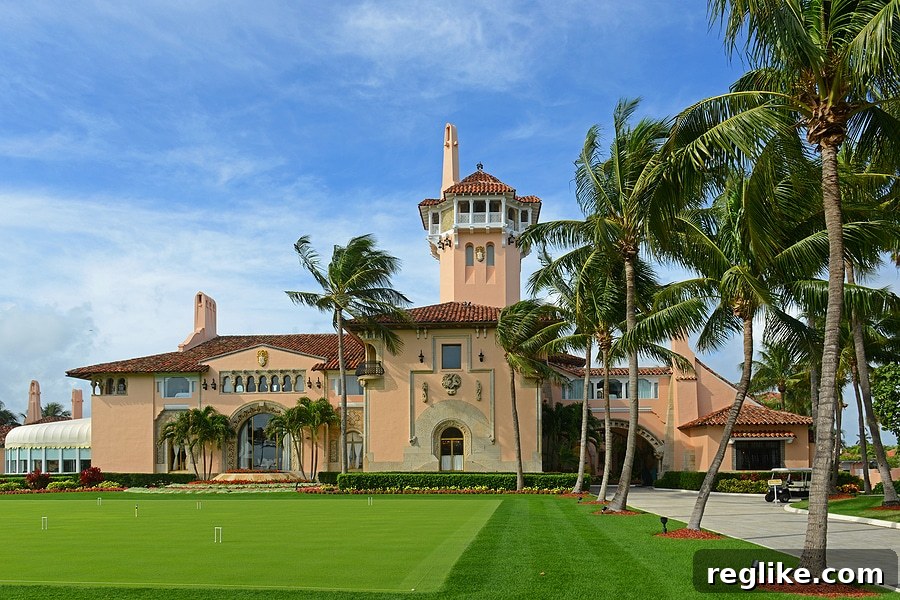
Donald Trump’s Organization Faces Setback in Mar-a-Lago Domain Disputes: A Deep Dive into Cybersquatting Claims
In the evolving landscape of online brand protection and digital real estate, even the most prominent brands can encounter significant challenges. Donald Trump’s organization recently found itself in this very predicament, losing a second cybersquatting dispute against a Mar-a-Lago-related domain name. These cases highlight the intricate legal battles surrounding domain ownership and the nuanced interpretations of intellectual property rights in the digital age. The rulings by the World Intellectual Property Organization (WIPO) panels provide valuable insights into the limitations and specific criteria governing Uniform Domain-Name Dispute-Resolution Policy (UDRP) proceedings.
The disputes centered on two critical domain names: mar-a-lago.com and maralago.com. For an organization as globally recognized as Trump’s, protecting its digital assets, especially those linked to its iconic properties like Mar-a-Lago, is paramount. Yet, these recent decisions underscore the complexities inherent in proving “bad faith” registration and use, which is a cornerstone of any successful cybersquatting claim under WIPO’s UDRP.
Understanding Cybersquatting and WIPO’s Role
Before delving deeper into the specifics of these cases, it’s crucial to understand what cybersquatting entails and the framework through which WIPO addresses it. Cybersquatting is generally defined as the bad-faith, abusive, and unregistered registration of domain names that are identical or confusingly similar to existing trademarks. The primary intent of cybersquatters is often to profit from the goodwill of the trademark owner, either by selling the domain name to the rightful owner or by diverting traffic to their own websites for commercial gain.
The World Intellectual Property Organization (WIPO) is a global forum for intellectual property services, policy, information, and cooperation. Through its Arbitration and Mediation Center, WIPO administers the UDRP, a streamlined and cost-effective alternative to traditional litigation for resolving domain name disputes. For a complainant to succeed under UDRP, they must generally prove three elements:
- The domain name is identical or confusingly similar to a trademark or service mark in which the complainant has rights.
- The respondent has no rights or legitimate interests in respect of the domain name.
- The domain name has been registered and is being used in bad faith.
The Trump organization’s challenges lay predominantly in substantiating the second and third elements, as the panels found the respondents presented compelling arguments for their legitimate interests and absence of bad faith.
The First Loss: The Case of Mar-a-Lago.com and the Pet Memorial Defense
The first significant setback for Donald Trump’s organization occurred last year, in a case filed with WIPO against the domain name mar-a-lago.com. This particular dispute presented a highly unusual and memorable defense, one that ultimately swayed the panel in favor of the respondent.
The individual who registered mar-a-lago.com put forth a truly unique and personal story. They claimed to have registered the domain name at their mother’s suggestion, as a digital memorial after the passing of three beloved family pets. Each part of “Mar-a-Lago” was attributed a special meaning:
- “Mar” was a dog named short after the Respondent’s first name, Marq.
- “A” represented “Alfred,” a duck that frequented the pond behind their home, named after the famous director Alfred Hitchcock.
- “Lago” was a nickname for “Lag,” a slow cat the family had rescued.
This narrative, while unconventional, served as a powerful counter-argument against the claim of bad faith registration and lack of legitimate interest. The WIPO panel, in this instance, likely found the respondent’s explanation to be a credible demonstration of a legitimate, non-commercial use of the domain name, distinct from any intent to capitalize on the Trump brand. This outcome underscores that while trademark owners have strong rights, the UDRP is designed to protect against abusive registrations, not to grant blanket control over all possible domain name variations, especially when a respondent can demonstrate a genuine and personal reason for their choice.
The Second Loss: Maralago.com and the Descriptive Argument
Following the loss of the hyphenated version, the Trump organization pursued a cybersquatting claim against the hyphenless domain, maralago.com. Interestingly, the same person who registered mar-a-lago.com had initially registered maralago.com, but no longer owned it at the time of this second dispute. The domain had since come into the possession of Michael Gargiulo, a well-known domain broker associated with VPN.com.
Gargiulo mounted a robust defense, arguing that the term “maralago” is fundamentally descriptive. He pointed out that it is comprised of dictionary terms that translate into “sea to lake” in several Romance languages, including Spanish (“mar a lago”). This argument is critical in intellectual property law because descriptive terms are generally considered weaker as trademarks unless they have acquired “secondary meaning” through extensive use and recognition, making them uniquely identifiable with a particular source.
The WIPO panel carefully considered Gargiulo’s arguments regarding the common, descriptive meaning of the domain. In its decision, the panel determined that Trump’s organization could not sufficiently overcome Gargiulo’s compelling evidence that “maralago” possessed a generic, widely understood meaning. The panel’s conclusion, partially quoted from the decision, encapsulated the inherent limitations of the UDRP process:
The Policy is not designed to adjudicate all types of disputes that relate in any way to domain names. Boku, Inc. v. Phuc To, WIPO Case No. D2023-1338. The Panel does not have the benefit of cross-examination of witnesses, disclosure of documents held by the parties, or the other instruments that are typically available to assist a court to resolve certain kinds of disputes. Id. Many of the Complainant’s assertions, through no fault of the Complainant, are conclusory.
This statement is profoundly significant. It highlights that the UDRP, while efficient, is not a full-fledged court of law. It lacks critical procedural mechanisms like cross-examination and extensive discovery, which are standard in civil litigation. Without these tools, panels often struggle to resolve disputes where facts are contested, or where the intent (bad faith) is not immediately obvious. The panel essentially indicated that the Trump organization’s claims, without the benefit of deeper evidentiary exploration, remained “conclusory” – meaning they asserted conclusions without sufficient supporting factual detail or proof to counter the respondent’s legitimate arguments.
Implications for Online Brand Protection and Future Disputes
These two WIPO decisions carry significant implications for brand owners seeking to protect their intellectual property in the digital sphere. They underscore several critical lessons:
- The Nuance of “Bad Faith”: Proving bad faith is not always straightforward, especially when respondents can present plausible alternative explanations for their domain registration, whether personal or descriptive.
- Descriptive Terms Pose Challenges: Brands built around descriptive terms (like “Mar-a-Lago,” which means “sea to lake”) face an uphill battle in asserting exclusive rights over domain names if a respondent can demonstrate a legitimate, non-trademark-related use based on the term’s common meaning.
- UDRP Limitations: The UDRP is a valuable tool for clear-cut cybersquatting cases, but it is not a substitute for traditional litigation. For complex disputes involving contested facts, subjective intent, or highly nuanced legitimate interests, the UDRP’s procedural limitations (lack of cross-examination, limited discovery) can make it an unsuitable forum.
- Importance of Comprehensive IP Strategy: Brand owners must consider a multi-faceted approach to intellectual property protection, including proactive domain name registration, diligent monitoring, and a clear understanding of when to pursue UDRP action versus traditional court litigation.
The panel’s suggestion that Trump’s organization “might have better luck in the courts where cross-examination is available” is a direct pointer to the next potential step for such disputes. Indeed, the legal landscape in courts offers a more comprehensive evidentiary process, allowing for deeper scrutiny of claims and counter-claims. Given Donald Trump’s recent extensive experience in various courtrooms, this is a path his organization is likely well-acquainted with, albeit one that involves significantly more time and financial investment than a WIPO UDRP case.
Conclusion: A Constant Battle for Digital Identity
The battle for the Mar-a-Lago domain names serves as a compelling case study in the ongoing struggle for online brand protection. It highlights that owning a prominent trademark does not automatically grant unchallenged control over every related domain name. The UDRP framework, while effective for many instances of blatant cybersquatting, is meticulously designed to balance trademark holders’ rights with the legitimate interests of others in using common or descriptive terms, or even deeply personal ones. As the digital world continues to expand, brand owners must remain vigilant, strategic, and adaptable, recognizing that the defense of their online identity is a perpetual and often intricate endeavor.