
Tucows’ Tiered Access Program: Navigating Post-GDPR Whois Data Requests with 2,100 Submissions and Counting
Tucows Forges Path with Tiered Access for Whois Data Amidst Evolving Privacy Landscape
In a significant move reflecting the ongoing evolution of internet governance and data privacy, leading domain name registrar Tucows (NASDAQ: TCX) recently released comprehensive data regarding requests for Whois information under its innovative tiered access program. This initiative was launched in response to the profound impact of the European Union’s General Data Protection Regulation (GDPR), which reshaped how personal data is handled across the internet. With over 2,100 data access requests received since its inception, Tucows’ program offers invaluable insights into the demand for Whois data in a privacy-first era.
The Genesis of Tiered Access: Responding to GDPR’s Mandate
The landscape of domain name registration underwent a dramatic transformation with the implementation of GDPR in May of last year. This landmark regulation, designed to protect the personal data and privacy of EU citizens, compelled registrars worldwide to re-evaluate their handling of Whois records. Historically, Whois data – which typically includes the registrant’s name, address, email, and phone number – was publicly accessible, serving as a cornerstone for accountability and transparency in the domain ecosystem. However, GDPR’s strict provisions on personal data processing rendered the blanket public disclosure of this information untenable for EU-resident registrants.
In response, Tucows, a major player managing over 20 million domain names, took proactive steps. Following GDPR’s enforcement, the company implemented a policy of masking Whois records for all domain names on its platform, regardless of the registrant’s geographic location. This ensured compliance with the new privacy standards but also created a challenge for parties with legitimate needs to access this data. To bridge this gap, Tucows introduced its tiered access program, establishing a structured and compliant pathway for requesting previously public Whois information.
The core philosophy behind Tucows’ tiered access system is to balance the fundamental right to privacy with the legitimate interests of various parties who rely on Whois data for purposes such as intellectual property enforcement, cybersecurity investigations, and consumer protection. By setting up a formal online platform, Tucows aimed to provide a transparent and accountable mechanism for data requests, moving away from the previous era of unrestricted access.
Unpacking the Numbers: 2,100 Requests and Key Trends
Since the program’s launch in May, Tucows has processed a substantial volume of requests, tallying 2,100 data access submissions. This figure underscores the persistent demand for registrant information, even under stringent privacy regulations. A closer look at the data reveals compelling trends and sheds light on who is seeking this information and why.
The Dominance of a Single Requestor
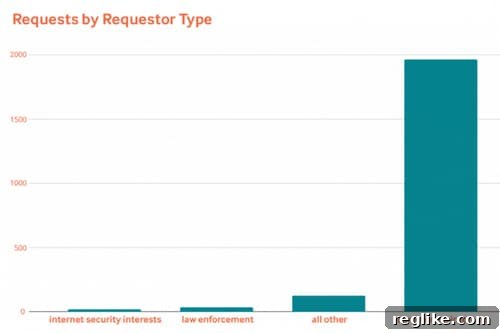
One of the most striking revelations from Tucows’ data is that a significant majority—65% of all requests—originated from a single entity. While Tucows refrained from explicitly naming this company in its official blog post, industry analysis and past reports strongly suggest that this prolific requestor is AppDetex, frequently acting on behalf of major corporations like Facebook. This trend highlights the critical role Whois data plays in intellectual property protection, particularly for large enterprises battling trademark infringement and brand abuse online. The timing of these requests, often coinciding with ICANN meetings, further suggests a strategic approach to data gathering for specific legal or enforcement objectives.
The sheer volume from one source underscores the continued struggle against online counterfeiting, phishing, and trademark violations, where identifying the domain registrant is often the first crucial step in legal action. This concentration of requests indicates that despite the increased friction introduced by privacy regulations, the necessity for identifying domain owners for commercial litigation purposes remains paramount.
Fulfillment Rates and the Challenge of Incomplete Submissions
Out of the 2,100 requests received, Tucows provided data for approximately 25%. This figure, however, does not tell the full story regarding denial rates. A deeper dive into the metrics reveals that only about 5% of all requests were outright denied by Tucows. The vast majority of unfulfilled requests—a staggering 70%—were not processed because the requestor failed to respond to Tucows’ follow-up inquiries for more information. This suggests that the primary barrier to obtaining Whois data through the tiered access program isn’t necessarily a strict denial policy, but rather the failure of requestors to provide the necessary supporting documentation or clarification required by Tucows to validate the legitimacy of their request.
Essentially, if a requestor provides all the information Tucows deems necessary to justify access under their defined criteria, the likelihood of data provision is considerably high. This distinction is crucial, as it indicates a system designed for legitimate access rather than blanket obstruction. It places the onus on the requestor to demonstrate a valid legal basis or legitimate interest, aligning with GDPR’s principles of data minimization and purpose limitation.
Commercial Litigation Dominates the Justification for Access
The purpose behind the requests is another key area of insight. Tucows reported that a substantial 90% of all data access requests stemmed from commercial litigation. This category encompasses a broad range of legal and enforcement activities, including but not limited to trademark and copyright infringement, anti-phishing efforts, combating online fraud, and other forms of intellectual property enforcement. The high percentage in this category, naturally including the significant volume from AppDetex, reinforces the notion that Whois data remains an indispensable tool for protecting brand integrity and intellectual property in the digital realm.
For businesses, identifying the individuals or entities behind malicious or infringing domain registrations is often the first step in sending cease-and-desist letters, initiating legal proceedings, or taking down illicit websites. The tiered access program, therefore, serves as a vital conduit for these legitimate commercial interests to continue their work effectively, even under the new privacy framework.
The Underrepresentation of Security Researchers
Interestingly, Tucows highlighted that very few requests originated from security researchers. This observation sparks an important discussion about the evolving needs of the cybersecurity community in a post-GDPR world. The general understanding within the industry is that many security researchers, particularly those engaged in large-scale threat intelligence and proactive defense, typically rely on bulk Whois data to connect dots, identify patterns, and uncover extensive malicious networks. Requesting individual records through a tiered access program, while effective for targeted investigations, is often not feasible or efficient for the kind of broad-spectrum analysis that underpins much of cybersecurity research.
This situation presents an ongoing challenge for the industry: how to facilitate legitimate access for security professionals who play a crucial role in protecting the internet, without compromising individual privacy. The current tiered access models, while addressing specific legal needs, may not fully cater to the unique operational requirements of security researchers who often need to correlate vast datasets to identify emerging threats and vulnerabilities across the internet’s infrastructure.
Navigating ICANN Compliance Requests
The data released by Tucows specifically excludes requests originating from ICANN Compliance. This distinction is important, as ICANN (the Internet Corporation for Assigned Names and Numbers) serves as the global governing body for domain names and has its own set of compliance and enforcement mechanisms. Tucows has clarified that it has not disclosed personal registration data in response to any of ICANN’s compliance requests. Instead, the registrar has demonstrated its ability to assist ICANN investigations effectively without compromising registrant privacy by revealing specific personal data. This approach underscores a commitment to both regulatory compliance and privacy principles, finding alternative methods to facilitate investigations when direct data disclosure is restricted.
The interaction between registrars and ICANN regarding Whois data remains a complex and evolving area. ICANN itself has been working towards a “Next-Generation gTLD Registration Data Directory Service” (often referred to as the “new Whois” or “RDDS”) that aims to create a sustainable and compliant model for domain registration data access globally. Tucows’ experience with its tiered access program will undoubtedly contribute valuable real-world data and insights into the ongoing development of such future systems.
Implications and the Path Forward
Tucows’ tiered access program serves as a critical case study in the ongoing global effort to reconcile data privacy mandates with the legitimate needs for domain registrant information. The data strongly suggests that the demand for Whois data, particularly for commercial litigation related to intellectual property, remains robust despite the added layers of requesting. While the system appears effective for those who diligently provide the required justification, it also highlights potential gaps for other crucial stakeholders like security researchers.
The insights gleaned from Tucows’ experience will be invaluable as the internet community continues to grapple with the complexities of domain registration data access. It emphasizes the need for well-defined, transparent, and efficient mechanisms that can adjudicate legitimate requests while upholding the privacy rights of domain registrants. As technology evolves and new threats emerge, the balance between transparency and privacy will remain a central challenge for registrars, policymakers, and internet governance bodies worldwide.
In conclusion, Tucows has not only navigated the post-GDPR landscape but has actively contributed to shaping it with its tiered access program. The journey of 2,100 requests provides a clear snapshot of the current environment, indicating a future where access to Whois data is more structured, purpose-driven, and subject to rigorous validation, marking a new chapter in the history of domain name management and internet privacy.