
UDRP Limitations: Understanding Why Even Clear Bad Faith Isn’t Always Enough for Domain Recovery
The digital landscape often presents challenges for brand owners, particularly when their trademarks are exploited by malicious actors. The Uniform Domain Name Dispute Resolution Policy (UDRP) stands as a crucial mechanism designed to combat cybersquatting – the abusive registration of domain names. This policy empowers trademark holders to recover domain names that infringe upon their intellectual property rights. However, a common misconception is that simply identifying a domain owner engaged in harmful activities, such as selling counterfeit goods or phishing, automatically guarantees a successful UDRP complaint.
While UDRP is an effective tool for reclaiming domain names used for illicit purposes, its application is strictly governed by a set of three specific criteria, often referred to as “prongs.” A successful complaint hinges on proving all three of these prongs. This means that even if a domain owner is undeniably engaged in illegal or unethical conduct, a UDRP panel can only rule in favor of the complainant if every one of these policy requirements is met. Failing to satisfy even a single prong can lead to the dismissal of the complaint, allowing the malicious domain to remain in the hands of the registrant.
The Uniform Domain Name Dispute Resolution Policy (UDRP) Framework
Administered by organizations like the World Intellectual Property Organization (WIPO) and the National Arbitration Forum, the UDRP provides an administrative, often faster, and less expensive alternative to traditional litigation for resolving certain types of domain name disputes. To prevail in a UDRP proceeding, a complainant (the trademark owner) must affirmatively demonstrate:
1. The Domain Name is Identical or Confusingly Similar to a Trademark or Service Mark in which the Complainant has Rights
This prong assesses the visual and phonetic similarity between the disputed domain name and the complainant’s registered trademark. Cybersquatters often rely on tactics like typosquatting (minor spelling errors), adding generic terms (e.g., “brandname-shop.com”), or truncating marks to create confusion. The goal is to deceive internet users into believing there’s an association with the legitimate brand. Panels analyze the dominant features of the trademark and how they appear within the domain name, disregarding generic top-level domains (gTLDs) like .com or .net.
2. The Respondent (Domain Name Registrant) has No Rights or Legitimate Interests in Respect of the Domain Name
Even if a domain name is similar to a trademark, the registrant might have a legitimate reason for owning it. This prong requires the complainant to establish that the respondent lacks any legitimate interest in the domain. Examples of legitimate interests can include using the domain for a bona fide offering of goods or services, being commonly known by the domain name, or making a legitimate noncommercial or fair use of the domain without intent for commercial gain to misleadingly divert consumers or tarnish the trademark. The burden then shifts to the respondent to prove they possess such rights or legitimate interests.
3. The Domain Name Has Been Registered and is Being Used in Bad Faith
This is often the most critical and complex prong. Bad faith typically involves an intent to profit from or harm a trademark owner’s brand. Examples of bad faith registration and use include:
- Registering a domain primarily for the purpose of selling it to the trademark owner or a competitor for valuable consideration in excess of documented out-of-pocket costs.
- Registering the domain to prevent the trademark owner from reflecting their mark in a corresponding domain name.
- Registering the domain primarily for the purpose of disrupting the business of a competitor.
- Using the domain to intentionally attempt to attract, for commercial gain, internet users to a website or other online location by creating a likelihood of confusion with the complainant’s mark as to the source, sponsorship, affiliation, or endorsement of the website or location or of products or services on the website or location.
- Operating a site selling counterfeit goods or engaging in phishing scams.
Proving bad faith often requires presenting evidence of the respondent’s intent and actions surrounding the domain’s registration and subsequent use.
The Zimmermann Case: A Clear Illustration of UDRP’s Limits
A recent case handled by the National Arbitration Forum, involving Australian luxury fashion label Zimmermann Wear Pty Ltd against the domain ZimOutlet(.)com, perfectly highlights the strict boundaries of UDRP. This particular decision underscores that while a domain owner’s intent may be undeniably malicious, a successful UDRP complaint still requires meticulous adherence to the policy’s three prongs. In this instance, the complaint fell short not on the grounds of bad faith, which was evident, but on the crucial first prong: confusing similarity.
The Clear Bad Faith of ZimOutlet(.)com
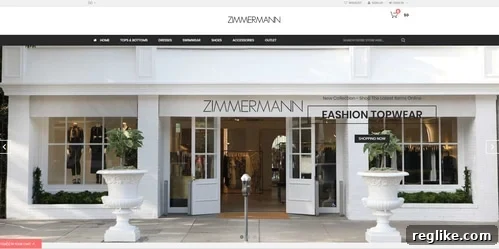
There was absolutely no ambiguity regarding the illicit activities associated with ZimOutlet(.)com. The website was meticulously designed to mimic Zimmermann, a high-end clothing company, even featuring images of its legitimate storefronts. The site’s primary purpose was to deceive consumers into believing they were purchasing authentic Zimmermann products, only to allegedly ship counterfeit goods upon order. This fraudulent operation unequivocally demonstrates bad faith on the part of the domain registrant, clearly falling under UDRP’s third prong. Such actions not only defraud consumers but also tarnish the reputation and goodwill of the genuine Zimmermann brand.
The “Confusing Similarity” Hurdle: Why “Zim” Was Not Enough
Despite the undeniable bad faith and the sale of counterfeit products, the complaint faltered on the first prong: whether “ZimOutlet(.)com” was “confusingly similar” to Zimmermann’s trademark, “ZIMMERMANN.” Panelist David E. Sorkin meticulously analyzed this aspect, distinguishing it from prior cases where partial marks were deemed confusingly similar.
Although Complainant has not offered any authority on this issue, the Panel has considered various decisions under the Policy involving domain names that incorporate the first few letters of a longer mark. In Fuji Photo Film U.S.A., Inc. v. Center for Ban on Drugs, D2004-0970 (WIPO Feb. 25, 2005), the Panel found fujfilm.com to be confusingly similar to FUJI, on the grounds that it combined the first three letters of the four-letter mark—”essentially the entirety of Complainant’s mark”—with a generic term for the complainant’s principal product. Similarly, in Chevron Intellectual Property LLC v. Linda Hearn, FA 1409285 (Forum Nov. 15, 2011), the Panel found chevoil.com to be confusingly similar to CHEVRON, combining the first four letters of the mark with a term descriptive of the complainant’s products and services. In Tesco Stores Ltd. v. Mat Feakins, DCO2013-0017 (WIPO Oct. 4, 2013), the Panel found tes.co to be confusingly similar to TESCO, even though the second-level component of the domain name corresponded to only the first three letters of the mark, on the grounds that the domain name taken in its entirety was identical to the complete mark but for the intervening dot.
Confusing similarity is particularly likely to be found where a mark is commonly referred to by its first syllable, and of course where the complainant also possesses trademark rights in the truncated form of the mark. See, e.g., Supercell Oy v. WhoisProxy.com Ltd / Jordan Rash, Application Automation LLC, D2015-1445 (finding clashbot.org confusingly similar to CLASH OF CLANS, based upon evidence that the mark is often abbreviated to “CLASH”); Caterpillar Inc. v. Jonathan Scandreth, FA 1348137 (Forum Nov. 8, 2010) (finding cataxles.com and other domain names confusingly similar to CAT and CATERPILLAR, based upon registered trademark rights in both forms of the mark); Anheuser-Busch Inc v. Dot Com Internet Solutions, D2001-0500 (WIPO June 13, 2001) (finding budcommercials.com and other domain names confusingly similar to BUD and BUDWEISER, based upon registered trademark rights in both forms of the mark).
The decisions cited above are all distinguishable from the present matter. The disputed domain name incorporates only three letters of a ten-letter trademark. While those letters correspond to the first syllable of the mark, it is not clear that they serve as the distinctive or dominant aspect of the mark. Complainant has not claimed that it has rights in ZIM or that its ZIMMERMANN mark is commonly referred to in this truncated manner. (Indeed, a cursory Google search for “zim” would likely lead one to conclude that these letters standing alone almost never refer to Complainant.) Nor does the generic term “outlet” that the domain name appends to these three letters bear any obvious connection to Complainant or its products; an “outlet” could be a discounter or retailer of virtually any sort of products.
As Sorkin elaborates, past decisions often found confusing similarity when a significant portion or a commonly recognized abbreviation of a trademark was used (e.g., “fujifilm” for FUJI, “chevoil” for CHEVRON, “tes.co” for TESCO, or “clashbot” for CLASH OF CLANS). In many of these successful cases, the truncated form was either “essentially the entirety” of a shorter mark, combined with a product-descriptive term, or the complainant held separate trademark rights in the shortened version, or the mark was commonly referred to by its abbreviated form.
However, the “Zim” in “ZimOutlet” presented a different scenario. It comprises only three letters of a ten-letter mark (“ZIMMERMANN”). While it is the first syllable, the panel noted that there was no evidence to suggest “Zim” was a distinctive or dominant aspect of the “ZIMMERMANN” mark itself. Furthermore, Zimmermann Wear Pty Ltd did not claim separate trademark rights in “ZIM,” nor was there evidence that their brand was commonly referred to by this abbreviation. A quick search for “Zim” would likely yield results unrelated to the fashion brand, reinforcing the lack of immediate association.
Adding to this, the generic term “outlet” appended to “Zim” did not create a stronger link to the complainant. An “outlet” is a common term for a discounter or retailer across various product categories, lacking any specific connection to Zimmermann’s luxury fashion offerings. Unlike “fujifilm” where “film” directly relates to Fuji’s products, “zimoutlet” with “outlet” doesn’t inherently point to “Zimmermann” clothing.
The Importance of Consistent UDRP Application and Alternative Remedies
The Zimmermann decision is a powerful reminder of the importance of consistent application of UDRP standards. While it’s tempting for panels to intervene when faced with undeniable wrongdoing, deviating from the policy’s strict criteria would undermine its integrity and predictability. Panelist Sorkin’s decision, therefore, stands as a commendation for upholding the established policy, even when the outcome allows a clearly malicious domain to persist under the UDRP framework.
This case highlights a critical lesson for brand owners: UDRP is a targeted tool, not a universal solution for all online intellectual property infringements. When a UDRP complaint fails due to a technicality like the lack of “confusing similarity,” trademark holders are not left without recourse. Alternative legal avenues and enforcement strategies exist, including:
- Traditional Litigation: Pursuing claims in national courts under trademark infringement laws (e.g., the Anticybersquatting Consumer Protection Act – ACPA in the U.S.). This can be more expensive and time-consuming but offers broader remedies, including monetary damages and stronger injunctions.
- Cease and Desist Letters: Sending formal legal notices to the domain registrant, registrar, or hosting provider demanding the cessation of infringing activities.
- Contacting Registrars and Hosting Providers: Many registrars and hosting companies have their own Acceptable Use Policies (AUPs) that prohibit illegal activities like selling counterfeit goods or phishing. Reporting such activities to these entities can often lead to the suspension or takedown of the infringing website, even without a successful UDRP.
- Consumer Protection Agencies: Reporting fraudulent activities to relevant consumer protection bodies, which can initiate investigations and take enforcement actions.
- Social Media and E-commerce Platform Takedowns: If counterfeit goods are advertised or sold on platforms like Facebook, Instagram, or eBay, trademark owners can leverage those platforms’ intellectual property enforcement policies to have the infringing content removed.
- Customs Enforcement: For physical counterfeit goods, engaging with customs authorities in various countries can prevent the import and distribution of illicit products.
Conclusion: A Balanced Approach to Brand Protection
The Zimmermann vs. ZimOutlet(.)com case serves as an invaluable lesson in brand protection within the digital sphere. It demonstrates that the Uniform Domain Name Dispute Resolution Policy, despite its effectiveness against overt cybersquatting, operates within defined parameters. The policy is designed to be a streamlined administrative process, and its strength lies in its predictable application of clear rules. The requirement to satisfy all three prongs—including the often-nuanced “confusing similarity” test—is paramount, even when the respondent’s actions are unequivocally malicious.
For businesses seeking to safeguard their trademarks online, understanding these limitations is crucial. Relying solely on UDRP as a silver bullet for all domain-related infringements can lead to disappointment. Instead, a comprehensive brand protection strategy should involve proactive monitoring, robust trademark registration across relevant jurisdictions, and a willingness to explore a spectrum of enforcement options beyond UDRP, including traditional legal actions and direct engagement with internet service providers. By adopting a multi-faceted approach, brand owners can more effectively combat online fraud and safeguard their valuable intellectual property in an ever-evolving digital landscape.