
A record traffic weekend sounds good. But was the traffic valuable?
In the vast and ever-evolving landscape of the internet, a common misconception often surfaces: “a visitor is a visitor, and a click is a click.” This notion, while appealing in its simplicity, profoundly misunderstands the dynamics of successful online engagement and monetization. For seasoned website owners and astute domain investors, the unequivocal answer is a resounding “no.” The true measure of digital success lies not merely in the volume of traffic, but in its underlying quality and intent.
Consider a recent weekend surge on Domain Name Wire, which typically experiences a steady stream of 20-30 active users during business hours, a number that predictably tapers off during weekends. However, an article detailing Toys.com’s unfortunate loss of Google rankings captured significant attention, propelling it to the front page of Digg on a Saturday. The result was an unprecedented spike: at its peak, over 500 people were simultaneously browsing the site. Over Saturday and Sunday alone, the site garnered a combined total of approximately 30,000 page views.
Such numbers are undeniably exciting, and to be clear, this is not a complaint. However, this impressive surge prompts a crucial question for any digital strategist: was this truly good traffic? The answer, as we shall explore, is nuanced and deeply dependent on one’s objectives.
Understanding the Difference: Quality Over Quantity
While 30,000 page views is a significant figure, it pales in comparison to receiving an equivalent number of visitors directly from highly targeted sources such as Google search queries, industry-specific portals like Domaining.com, or a loyal subscriber base. On the surface, one might argue that a visitor arriving from Digg is “qualified” because they intentionally clicked on a link, aware of the content they were about to consume. This reasoning is often applied to parked domain pages as well, where the argument goes: “The person clicked on the ad, so their origin shouldn’t matter.” Yet, this perspective overlooks the critical elements of user intent, engagement, and potential for conversion.
The typical Digg visitor, in this observed instance, demonstrated specific behaviors that highlighted the transient nature of their visit. On average, they viewed no more than a single page and remained on the site for a mere 16 seconds. This stands in stark contrast to what we define as a “good” or “valuable” visitor. A truly valuable visitor is someone who delves deeper, exploring multiple pages, spending several minutes on the site, potentially interacting with the community through comments, and showing an inclination to return. Crucially, they are also more likely to be a qualified prospect for advertisers, representing a genuine interest that can translate into meaningful actions.
Key Metrics for Identifying Valuable Traffic
To effectively assess traffic quality, a holistic view of analytics is essential, moving beyond mere page views. Key metrics include:
- Time on Site/Session Duration: Longer durations indicate greater engagement and interest in your content.
- Pages Per Session: Visitors who navigate through multiple pages are actively seeking more information, suggesting higher intent.
- Bounce Rate: A high bounce rate (visitors leaving after viewing only one page) often signals a mismatch between user expectation and content, or a lack of engagement.
- Conversion Rate: The percentage of visitors who complete a desired action (e.g., signing up for a newsletter, making a purchase, clicking an ad). This is often the ultimate measure of value.
- Return Visitors: Users who come back to your site demonstrate loyalty and a sustained interest in your brand or content.
- Interaction Metrics: Comments, shares, downloads, video plays – these all signal active engagement.
Below is an illustration of top referrers over a month, ranked by their average time of visit, clearly demonstrating the disparity in engagement levels:
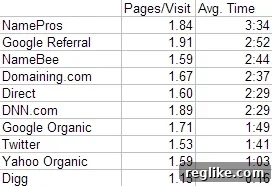
As the data visually confirms, the typical visitor originating from Digg is not highly targeted. Their brief visit, often confined to a single article, is characteristic of much “social” traffic. Such traffic is akin to a quick hit – a momentary curiosity satisfied before the user moves swiftly to the next intriguing piece of content. While a small percentage of these visitors might be more qualified and could become future regulars, the majority represent a fleeting interaction. This highlights the challenge of converting broad social media reach into sustained, meaningful engagement.
The Gold Standard: Targeted Traffic Sources
Contrast this with traffic generated from domain name-related websites, industry forums, organic Google searches for specific domain terms, or even clicks from an RSS feed on a platform like Google Reader. These visitors are inherently more valuable because they are highly targeted. They arrive with a pre-existing interest or a specific intent related to your niche. Such visitors are far more likely to linger on the site, explore diverse content, leave thoughtful comments, or click on an advertiser’s banner with genuine interest. This intrinsic value is precisely why a CPM (Cost Per Mille/Thousand impressions) advertising model can be problematic for websites attracting a high volume of low-value traffic; it inadvertently incentivizes the pursuit of sheer quantity over meaningful engagement, diluting the advertiser’s return on investment and potentially harming the site’s long-term reputation.
Why Organic Search and Niche Referrals Excel
- User Intent: Organic search traffic often stems from users actively seeking solutions, information, or products. Their queries reflect a direct need, making them highly receptive to relevant content.
- Engagement: Visitors arriving from specific niche communities or industry portals are already pre-qualified. They are part of an audience that understands and cares about the subject matter, leading to deeper engagement.
- Trust and Authority: Ranking high in search engines or being referred by reputable industry sites builds immediate trust, encouraging users to spend more time and explore further.
- Conversion Potential: High intent and engagement directly translate into higher conversion rates, whether for sales, leads, or ad clicks.
- Long-Term Value: These visitors are more likely to bookmark your site, subscribe to your newsletter, or become repeat visitors, building a loyal audience base.
The Nuance: When Broader Traffic Can Be Beneficial
However, it is important to acknowledge that not all non-domainer or broad-audience traffic is inherently “bad.” There are instances where an influx from a less targeted source can yield positive results. For example, when a prominent technology publication like TechCrunch links to Domain Name Wire, a noticeable uptick in banner clicks is often observed. The TechCrunch audience, while technical in nature, may not be deeply immersed in the nuances of domain names. A visitor, intrigued by the mention of domains, might spot an advertisement (e.g., National A-1’s ad for buying domains) and experience a moment of serendipitous discovery. They might think, “Hey, I’m a techie who registered some domains in the 90s; I should explore what this is all about.” In such cases, the broader reach serves as an awareness-building tool, potentially converting curious generalists into interested niche participants. This strategic value lies in introducing your specific niche to a relevant, yet initially unfamiliar, audience, provided your content is compelling enough to capture their newfound interest.
The Primacy of Type-In Traffic for Domain Owners
This discussion on traffic quality is particularly salient in the context of domain parking and monetization. The hierarchy of traffic quality here is distinct and critical for success. Type-in traffic stands as the undisputed gold standard. This occurs when a user directly types a domain name into their browser, driven by an intuitive understanding or a specific search intent (e.g., typing “fruitcobbler.com” because they are actively seeking fruit cobbler recipes or products). Such visitors demonstrate the highest level of intent and are often the most valuable for conversion, as their action directly reflects a need or interest precisely aligned with the domain name.
A rung below type-in traffic are visitors arriving from residual search engine links. These individuals might have clicked an old or less relevant search result, expecting to land on a particular article or information source that may no longer be precisely what they anticipated. While still carrying some intent, the potential for a mismatch or disappointment is higher, leading to a quicker bounce. As for purchased traffic and arbitrage strategies, the picture becomes even more complex. While some paid traffic can be highly effective if meticulously targeted, untargeted or low-cost arbitrage traffic often yields minimal returns, as the intent is frequently diluted and the engagement shallow. Understanding these distinctions is paramount for effective domain monetization and sustainable online business models.
Optimizing Your Strategy for Sustainable Growth
Ultimately, a successful digital strategy hinges on a keen understanding and prioritization of traffic quality over mere quantity. Website owners and domain investors must move beyond vanity metrics and delve into deeper analytics to understand user behavior, intent, and engagement. By focusing on attracting visitors who are genuinely interested, willing to engage, and likely to convert, businesses can build a more robust, profitable, and sustainable online presence. This involves a continuous cycle of optimizing content for target audiences, refining SEO strategies for high-intent keywords, cultivating strong community engagement, and strategically leveraging diverse traffic sources while carefully monitoring their performance.
In the digital realm, every click represents a potential interaction. By discerning the true value behind each visitor, we can transform fleeting attention into lasting relationships and meaningful conversions.