
The digital landscape is in constant flux, and few areas embody this evolution more dramatically than domain name registration. As businesses and individuals strive to carve out their unique space online, the choice of a domain name—and the platform used to acquire it—becomes paramount. In this dynamic environment, domain registrars are constantly evaluating their strategies, balancing the enduring appeal of established domain extensions with the burgeoning potential of new frontiers. One such registrar, United Domains, has adopted a particularly bold approach that raises intriguing questions about priorities, user experience, and the future direction of online identity.
For decades, the .COM domain has reigned supreme, synonymous with credibility, global reach, and a default expectation for any serious online presence. Its ubiquity has etched it into the collective consciousness, making it the first choice for millions seeking to establish their digital footprint. However, the internet’s governing body, ICANN, embarked on a program to introduce hundreds of new generic Top-Level Domains (gTLDs), promising greater choice, innovation, and relevance for niche markets. These new TLDs, ranging from industry-specific options like .TECH and .APP to more creative extensions such as .PIZZA and .GAMES, have opened up a vast new inventory of domain names.
The core question for registrars today is how to navigate this evolving landscape. Should they continue to heavily promote the well-trodden path of .COM, .NET, and .ORG, or should they lean into the potential of new gTLDs, even if it means altering established user journeys? United Domains, part of the same corporate family as the well-known hosting provider 1&1 (which itself has been aggressively marketing new TLD “pre-reservations” through national advertising campaigns), has clearly chosen the latter, implementing a strategy that prioritizes the future over the present in a rather conspicuous manner.
A visit to UnitedDomains.com’s homepage immediately reveals this strategic shift. Unlike many registrars that feature .COM prominently, often as the default or primary search option, United Domains presents a different narrative. The top of the homepage features a distinct header that separates the domain world into two categories: “New Top-Level Domains” and “Classic Domains.” While this categorization might seem innocuous, the subsequent design choices speak volumes about the company’s focus.
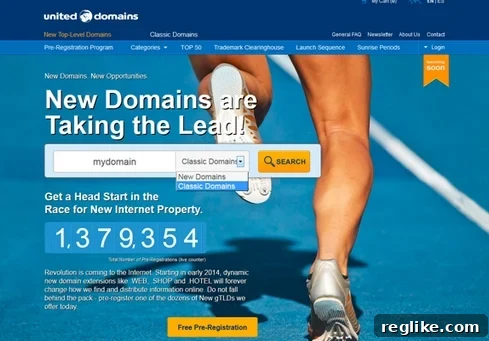
The most striking element is the main domain search box, the gateway for most users seeking a new online identity. This prominent feature, designed to capture immediate intent, *defaults to searching for new TLDs*. This means that if a user, accustomed to the conventional search experience, types a keyword like “mybusiness” into the box, they will not be presented with options for “mybusiness.com,” “mybusiness.net,” or other long-established extensions. Instead, the search results will exclusively showcase opportunities to “pre-register” new TLDs such as .WEB, .SHOP, or .MUSIC. Many of these domains, particularly .WEB, were subject to protracted launch processes and were unlikely to become fully available for another year or more at the time of this observation. This immediately creates a potential disconnect for users who arrive at the site with a clear intention of registering a traditional .COM domain, forcing them to actively seek out alternatives.
From a user experience perspective, this prioritization can be frustrating. Imagine a small business owner, already navigating the complexities of launching their venture, landing on a registrar’s site specifically to secure their desired .COM. If their initial search yields only options for domains like “mybusiness.shop” or “mybusiness.music” (which may not even be relevant to their industry), they are faced with an unexpected hurdle. This design choice implies that United Domains is willing to risk a certain degree of immediate customer churn or confusion in order to cultivate a robust lead list for these emerging domain extensions. The long-term bet seems to be on capturing early adopters and establishing a strong position in the newer, potentially less saturated market of gTLDs.
The homepage’s promotional strategy further underlines this commitment. The United Domains homepage is not static; it dynamically cycles through a series of prominent promotions. While many registrars use this space to highlight special offers on popular domains or hosting packages, United Domains dedicates a significant portion of its prime real estate to other initiatives. Specifically, the second slide in this promotional sequence is dedicated entirely to the Trademark Clearinghouse (TMCH). The TMCH is a vital mechanism for trademark holders, allowing them to protect their brands across the vast new landscape of gTLDs by registering their trademarks centrally. While promoting the TMCH is a valuable service for brand owners, its placement as a primary rotating banner – and notably, a banner that completely removes the domain search box from view – again detracts from the immediate goal of general domain registration. For a brief period, as this slide is active, there is no direct path for a casual visitor to search for *any* domain name, old or new.
It is only upon reaching the third slide in this carefully orchestrated sequence that traditional, existing domain names receive any direct promotional focus. This structured delay means that a user specifically looking for a .COM or .NET domain must either actively navigate away from the main search area (if they didn’t realize the default search was for new TLDs) or patiently wait for the promotional slides to cycle through to the segment that addresses their needs. This multi-step process adds friction to what should ideally be a seamless and intuitive search-and-register experience.
The rationale behind such a strategy, though potentially disruptive to the immediate user, is not without its business logic. New gTLDs represent a significant revenue opportunity for registrars. They often come with higher initial registration fees, and securing early registrations can lock in customers for recurring annual renewals. Furthermore, by aggressively pushing pre-registrations, United Domains is building a valuable database of interested parties for future gTLD launches, positioning themselves as a go-to provider in this expanding market. This forward-looking approach suggests a belief that the long-term growth potential of new TLDs outweighs the short-term impact on .COM registrations.
However, this strategy carries inherent risks. The sheer volume of new TLDs has led to varied adoption rates, with some proving incredibly popular (e.g., .APP, .XYZ, .SITE) while others struggle to gain traction. The public’s trust and familiarity with .COM are deeply ingrained, and convincing businesses and individuals to opt for newer, less recognized extensions requires sustained marketing and a compelling value proposition. While a new TLD might offer a more precise or creative name, the perceived authority and memorability of a .COM domain often remain unparalleled.
It’s also worth noting the broader context of United Domains’ operations. As part of the same corporate group as 1&1, a company that has invested heavily in advertising new TLD pre-reservations, there appears to be a consistent, group-wide strategic emphasis on these emerging domain types. This suggests a coordinated effort to capture market share in this new frontier, leveraging the collective resources and marketing power of the larger entity.
Despite this aggressive push for new TLDs, United Domains is not a newcomer to the traditional domain market. The company boasts a significant existing portfolio, with over 300,000 registered .COM domains under its management. This substantial base underscores the company’s established presence and success within the classic domain space, making their current homepage strategy all the more intriguing. It highlights a deliberate shift rather than an oversight or a lack of capacity to handle traditional registrations.
For businesses concerned with SEO and online branding, the choice of TLD is often a secondary consideration to the quality of content and the overall user experience of their website. However, the initial perception and ease of recall associated with a domain name cannot be understated. While search engines generally treat all TLDs equally in terms of ranking signals, user trust and brand recognition often lean heavily towards .COM. A domain like “mybusiness.com” carries an immediate sense of legitimacy and professionalism that newer, less familiar extensions are still working to build. Therefore, registrars like United Domains walk a fine line: promoting innovation while not alienating a vast user base still seeking the familiar and trusted.
In conclusion, United Domains’ homepage strategy represents a fascinating case study in how domain registrars are adapting to a rapidly changing internet landscape. By prioritizing new gTLDs and their associated pre-registration processes, even at the apparent expense of immediately showcasing traditional .COM options, the company is making a clear long-term bet. This approach, while potentially causing initial friction for some users, aims to position United Domains at the forefront of the next wave of online identity. Whether this bold move will ultimately secure them a dominant position in the evolving domain market, or if it will prove too disruptive for their existing and prospective customer base, remains a critical question for the industry to observe.