
United Internet Rises: Seizing Dominant Share in the New TLD Market After Initial Challenges
The landscape of domain name registrations is in constant flux, especially with the introduction of new generic Top-Level Domains (gTLDs). For a significant period, GoDaddy, a household name in the domain and hosting industry, held a seemingly unshakeable lead in the burgeoning new TLD market. However, recent data indicates a notable shift in momentum, with United Internet, a powerful conglomerate encompassing brands like 1&1, Sedo, InterNetX, and United Domains, rapidly gaining ground and capturing substantial market share from its long-standing competitor.
This dynamic turn of events follows an initial phase where United Internet, despite a substantial investment of approximately $50 million in advertising pre-registrations for new top-level domain names, struggled to convert that outlay into immediate market dominance. Early batches of new TLDs saw GoDaddy consistently outperforming its rivals in registration volumes, leading to questions about the effectiveness of United Internet’s aggressive marketing spend. Yet, as the new TLD rollout has progressed and strategies have matured, the tides have undeniably turned in recent weeks, signalling a significant recalibration of competitive advantage in this evolving digital space.
The Shifting Sands of Domain Market Dominance
The change in market dynamics has become increasingly apparent, particularly with the latest releases of Donuts domain names. According to updated figures from nTLDstats.com, a leading authority for tracking new TLD statistics, United Internet’s group of companies, specifically 1&1 and United Domains, has demonstrated a strong lead in registrations for the most recent launches. This performance starkly contrasts with the initial period, where GoDaddy held a commanding position.
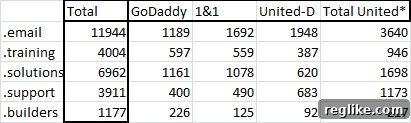
(Note: The data presented here primarily reflects registrations under 1&1 and United-Domains, which are the brands most heavily promoted for pre-registrations within the United Internet portfolio.)
A closer look at the competitive landscape reveals that 1&1 alone managed to surpass GoDaddy in two out of five recent matchups. When the registration figures for United-Domains are added into the equation, United Internet’s collective strength secured a victory in every contested TLD launch, with the sole exception of the .builders domain. This consistent performance across multiple launches underscores a fundamental shift in how new TLDs are being adopted and registered by consumers and businesses alike. Observations from other recent launches further corroborate this trend, suggesting that United Internet’s newfound momentum is not an isolated incident but rather a sustained pattern of growth.
Key Drivers Behind United Internet’s Resurgence
Several strategic factors appear to be contributing to United Internet’s remarkable turnaround and its aggressive capture of new TLD market share. These elements collectively highlight a multi-faceted approach to overcoming initial hurdles and establishing a formidable presence in a highly competitive arena.
Enhanced Technology and Domain Acquisition Prowess
One primary factor contributing to United Internet’s success is a probable enhancement in its technological capabilities for acquiring domain names, particularly in scenarios involving intense competition. Pre-registrations for new TLDs often operate similarly to “drop catching,” a process where registrars vie to secure domains the moment they become available. This demands sophisticated, high-speed systems capable of executing registrations instantaneously. It is highly plausible that United Internet has significantly refined its technical infrastructure and operational processes, allowing its brands like 1&1 and United Domains to execute pre-registrations more effectively and secure desired domain names ahead of competitors, including GoDaddy. This technological edge can be critical in highly anticipated or limited-availability TLD launches, where speed is paramount.
Aggressive Pricing Strategies Attracting New Users
Another significant catalyst is 1&1’s highly aggressive and competitive pricing strategy. 1&1 has been observed offering the first year of new TLD registrations at approximately half the price of GoDaddy. This “cut-rate pricing” serves as a powerful incentive for potential registrants, especially those who might be experimenting with new TLDs for the first time or managing a portfolio of multiple domains. Such an attractive entry price can draw customers away from established players like GoDaddy, encouraging them to try 1&1’s services. While renewal prices may eventually align more closely with market rates, the initial steep discount is an effective strategy for customer acquisition and expanding market footprint, fostering a larger base of new TLD users within the United Internet ecosystem.
Elevated Marketing and Promotional Efforts
United Internet has also visibly stepped up its marketing and promotional activities for new TLDs across its various channels. This includes more prominent placement on its homepages, increased visibility in email marketing campaigns, and potentially cross-promotion through its other brands like Sedo and InterNetX. In contrast, GoDaddy, while still a marketing behemoth, may not have been dedicating the same level of concentrated, top-tier promotional real estate specifically to new TLDs. Increased visibility and education are crucial for new TLDs, as many users are still learning about their existence and potential benefits. By making new TLDs more accessible and visible through heightened marketing, United Internet is effectively guiding potential customers towards its offerings and capturing a larger share of the burgeoning demand.
Broader Market Share Dynamics and Future Outlook
When looking at the overall market share of new TLDs, GoDaddy’s dominant position has been slightly eroded. While still a major player, its share has reportedly dipped to approximately 30%. In parallel, 1&1 and United-Domains have each carved out around 10% of the new TLD market, collectively placing United Internet in a much stronger competitive stance. This combined share highlights the collective power of United Internet’s diversified portfolio and its ability to compete on multiple fronts.
A notable factor contributing to GoDaddy’s slight decline in overall new TLD numbers was its decision to sit out the initial launch and subsequent promotion of .Berlin. This move proved to be a strategic misstep, as .Berlin has emerged as the second most registered new TLD to date, demonstrating strong local appeal and adoption. In stark contrast, 1&1 capitalized on this opportunity by offering .berlin registrations for free for a year to local customers, a shrewd move that resonated deeply within the Berlin community and significantly boosted its registration numbers for that specific TLD. Missing out on such a high-performing, geographically specific TLD can have broader implications for market share and perceived leadership in the new domain space.
It is crucial to remember that the new TLD rollout process is still in its relatively early stages. The market is dynamic, and shifts in leadership and strategy are likely to continue as more TLDs are launched, and consumer adoption patterns evolve. The current landscape is a testament to the fact that agility, innovative pricing, targeted marketing, and robust technology are paramount for success in this rapidly changing industry. The competition between domain registrars will undoubtedly intensify, driving further innovation and potentially leading to more surprises in the years to come.
What Does This Shift Mean for the Domain Industry?
The recent ascendancy of United Internet in the new TLD market signals a maturing industry where initial brand recognition might give way to strategic execution, technological superiority, and aggressive market tactics. It challenges the notion of any single, unassailable leader and underlines the importance of adaptability. As new TLDs continue to roll out and gain mainstream acceptance, the battle for registrations will likely continue to be fought on multiple fronts, from pricing wars to technological arms races and sophisticated marketing campaigns.
This evolving competition ultimately benefits end-users, who gain access to a wider variety of domain options at potentially more competitive prices. The push by companies like United Internet to democratize access to new TLDs, particularly through attractive initial offers, could accelerate the overall adoption rate of these modern web addresses. As we look ahead, the domain industry promises to remain a vibrant and competitive ecosystem.
What are your thoughts on this significant shift in the new TLD market? What factors do you believe have been most impactful in United Internet’s recent surge?