

Maximizing Domain Value: A Comprehensive Guide to Hybrid Pay-Per-Click Parking Strategies
In the competitive landscape of domain name investing, extracting maximum value from your digital assets requires a shrewd approach. While the ultimate goal for many domainers is a lucrative sale, the interim period often presents opportunities for passive income. This guide explores the powerful strategy of hybrid domain parking – a method that blends pay-per-click (PPC) advertising with prominent “For Sale” messaging. By understanding and implementing such a strategy, domain investors can transform dormant assets into active revenue streams, optimizing their portfolio’s performance.

An Important Update on Integrations: This article details the mechanics of a once-popular hybrid parking integration between Dan.com and Bodis. However, it’s critical for readers to know that Dan.com (now part of GoDaddy) has discontinued its direct partnership with Bodis following its acquisition. While the specific integration described here is no longer active, the fundamental principles of hybrid domain parking, strategic traffic monetization, and identifying high-value domains remain incredibly relevant. This guide serves as a valuable case study to illustrate these timeless strategies, encouraging you to explore current parking solutions offered by Dan.com or other leading domain monetization platforms.
The Strategic Imperative of Hybrid Domain Parking
Historically, domain investors often chose between two primary monetization paths for their undeveloped domains: displaying a “For Sale” page or utilizing a PPC parking page. The former aims for a direct sale, capturing serious buyers, while the latter generates passive income from ad clicks. Hybrid parking elegantly combines these two approaches, offering a dynamic solution that can cater to a wider spectrum of visitors and maximize revenue potential.
While the overall revenue generated from domain parking has seen its ups and downs, strategic implementation can still lead to significant returns. Consider the real-world example of a domain purchased for $200 that subsequently generated close to $1,000 in parking revenue over a few years. This success story underscores the power of identifying domains with latent traffic potential and applying the right monetization strategy.
Hybrid parking is particularly beneficial for domains that receive a steady stream of traffic but may not yet be ripe for immediate sale, or for those whose visitors might be exploring various related services before making a purchase decision. By presenting both a sales opportunity and relevant advertisements, you ensure that every visitor interaction contributes to your domain’s overall value, whether through a direct inquiry or an ad click.
Step-by-Step: Implementing a Hybrid Parking Strategy (Based on Past Practices)
Understanding the historical setup process for hybrid parking, such as the Dan.com/Bodis integration, provides a valuable framework for how similar systems function today. These steps highlight the essential considerations for any domain owner looking to leverage hybrid monetization.
Step 1: Establishing Your Domain Parking Account
The first foundational step is to create an account with a dedicated domain parking provider. In the context of our example, this would have been Bodis. Parking providers specialize in displaying contextually relevant advertisements on undeveloped domain names, leveraging advanced algorithms to optimize ad placement and maximize potential earnings from incoming traffic.
When selecting a current domain parking provider, it’s crucial to evaluate their reputation, revenue share models, payout schedules, the quality of their advertising partners, and their reporting dashboards. A robust parking partner is indispensable for effectively converting your domain traffic into a reliable income stream. Researching multiple providers and comparing their features against your portfolio’s needs is a wise initial investment of time.
Step 2: Integrating Your Parking Provider with Your Domain Marketplace
The power of hybrid parking stems from the seamless integration between your domain marketplace (where your domains are listed for sale) and your chosen parking provider. Historically, platforms like Dan.com offered intuitive settings for this integration.
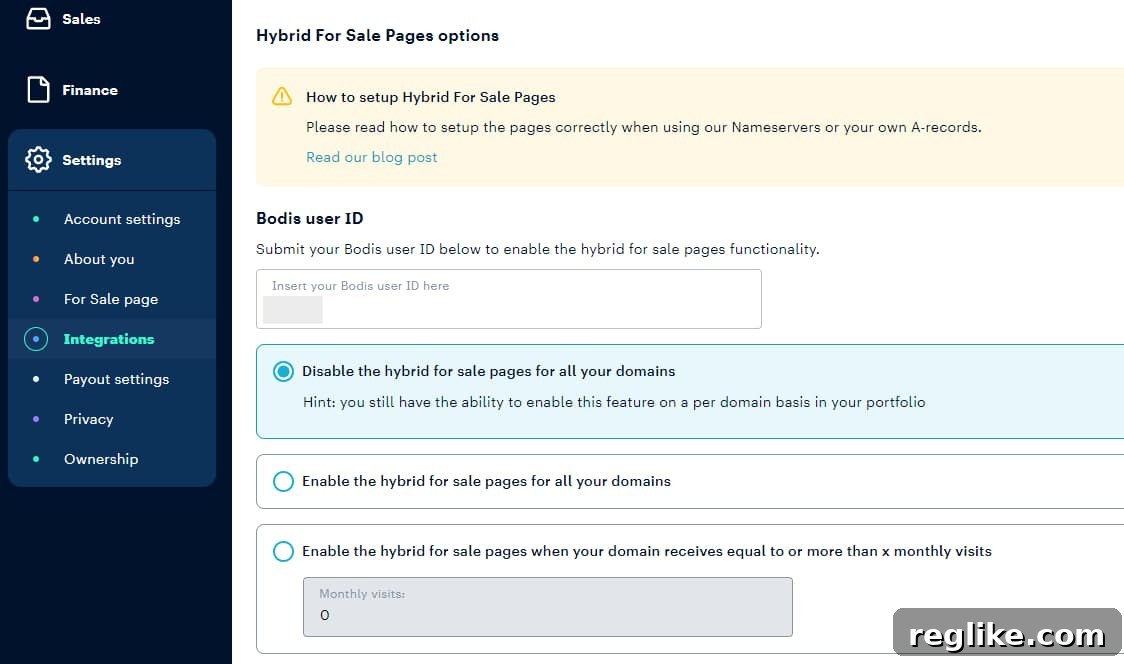
Within your domain marketplace’s settings, typically found under sections like “Integrations,” “Monetization,” or “Parking Options,” you would locate the relevant input field for your parking provider’s user ID. This critical link allows your marketplace to communicate with the parking service, ensuring that ads are correctly displayed on the designated domain landers.
During this setup, you’re usually presented with strategic options to define how hybrid parking applies across your portfolio:
- Disable Hybrid (PPC) on All Domains: This default setting maintains pure “For Sale” landers, ideal for highly valuable domains where immediate sale is the sole focus.
- Add PPC to All Domains: A blanket approach that might suit portfolios largely comprised of generic, traffic-driven domains where ad revenue is prioritized across the board.
- Add PPC Only to Domains Meeting a Certain Traffic Threshold: An automated, data-driven option that targets domains with proven traffic volume.
From an optimization standpoint, choosing an option that allows for granular, domain-by-domain control is often the most effective. For instance, initially disabling hybrid parking and then selectively activating it provides the flexibility to test and refine your strategy based on individual domain performance. While automated thresholds offer convenience, they might not always align perfectly with the unique characteristics and monetization potential of every domain.
Step 3: Strategic Domain Selection for Hybrid Monetization
Identifying which domains are best suited for hybrid parking is a critical step that significantly impacts your revenue. The most promising candidates are typically those that consistently receive meaningful, legitimate traffic. In platforms like Dan.com, this process was simplified by allowing users to sort their domain lists by “Views,” quickly highlighting high-potential assets.
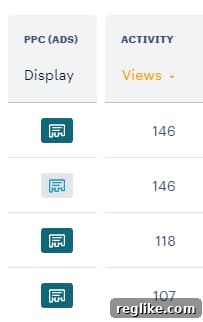
Once you’ve identified a domain with promising traffic, activating the PPC ads was often as simple as clicking a dedicated icon within the domain management interface. This targeted approach allows you to experiment with PPC on domains where it makes the most sense, without potentially distracting high-intent buyers from domains where a direct sale is the primary objective. Consider factors like keyword relevance, traffic source, and potential ad category value when making these selections.
Step 4: The Crucial Missing Piece – Registering Domains with Your Parking Provider
This particular step was a frequent point of confusion for many users of the Dan.com/Bodis integration, and it underscores a universal requirement for most hybrid parking setups. It’s not enough to simply enable PPC ads within your domain marketplace. You *must* also formally add and configure these domains directly within your chosen parking provider’s account (e.g., Bodis).
When you enable the PPC option on your domain marketplace, the domain’s DNS settings are typically updated to point to the marketplace’s parking name servers or a specific URL (e.g., dan.example.com). This redirection mechanism ensures that visitors land on the marketplace’s specialized page, which then dynamically integrates with your parking provider to display ads. During this critical DNS propagation period, which can range from a few minutes to a few hours, your domain might experience a brief period of inaccessibility. While inconvenient, this temporary downtime is a necessary part of establishing the new redirection.
The dual registration is essential because the parking provider needs to have explicit knowledge and control over which domains are associated with your account to accurately serve ads and correctly attribute revenue. This step becomes even more vital if you opt for automated solutions, such as applying PPC to domains that automatically meet a certain traffic threshold. In such cases, it’s highly recommended to add your *entire* domain portfolio to your parking provider’s account in advance. This proactive measure ensures that when a domain on your marketplace crosses the predetermined traffic threshold, the parking provider is instantly prepared to serve ads, preventing any loss of potential revenue due to unconfigured domains.
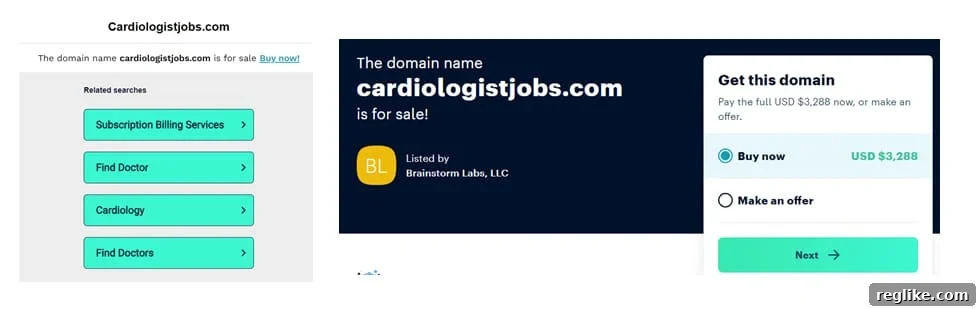
The successful integration culminates in a sophisticated lander that expertly combines a compelling “For Sale” message with relevant, monetizing advertisements:
Step 5: Continuous Monitoring, Analysis, and Optimization
Once your hybrid parking setup is live, the work is far from over. Ongoing monitoring, detailed analysis, and iterative adjustments are paramount to maximizing your long-term earnings. While your domain marketplace dashboard will provide valuable traffic analytics, precise revenue figures typically reside within your parking provider’s account. This separation of data is normal, as the parking provider is directly responsible for processing and tracking ad-related earnings.
When reviewing performance, critically assess the quality of the traffic reported by your marketplace. High “Views” don’t automatically equate to high revenue. Domain traffic can come from a multitude of sources, including bots, mistyped URLs, automated scanners, or even residual links. These types of visits rarely convert into profitable ad clicks. Therefore, a domain with a significant number of views might yield surprisingly low PPC revenue if the underlying traffic quality is poor.
Focus on key performance indicators (KPIs) such as Click-Through Rate (CTR) and Revenue Per Mille (RPM – revenue per thousand impressions). A low CTR or RPM on a domain receiving substantial traffic suggests issues like irrelevant ads, unengaged visitors, or low-quality traffic. This is where the inherent flexibility of a hybrid strategy becomes invaluable: if a domain isn’t performing as expected with PPC ads, you can easily revert it to a pure “For Sale” lander, often with minimal to no downtime. This agile process of continuous testing, thorough analysis, and strategic adjustment is the cornerstone of optimizing your domain portfolio for sustained profitability.
Universal Lessons Beyond Specific Integrations: Enduring Domain Monetization Strategies
While the direct Dan.com/Bodis integration is a historical reference, the insights gained from such setups offer timeless wisdom for anyone engaged in domain monetization:
- Strategic Domain Selection is Paramount: Recognize that not all domains are equally suited for parking. Prioritize high-traffic, generic, keyword-rich domains that naturally attract commercial interest for your parking efforts. Reserve highly brandable, specific, or premium domains for direct sale, where their intrinsic value warrants a pure sales focus.
- Diversify Your Revenue Streams: Relying solely on direct sales can lead to inconsistent cash flow. Integrating passive ad revenue provides a crucial financial buffer and ensures that domains not yet sold are still contributing value to your portfolio.
- Deeply Understand Your Traffic: Don’t be swayed by vanity metrics like raw view counts. Investigate your analytics to discern the true source and quality of your traffic. Is it legitimate human interest? Does it align with potential advertising categories? High-quality traffic is the bedrock of profitable PPC.
- Embrace Experimentation and Adaptability: The domain market, ad technologies, and user behaviors are constantly evolving. Be willing to experiment with different parking providers, test various ad layouts, and adjust your monetization strategies regularly. What yields success for one domain or in one period might not be optimal for another.
- Cultivate Patience and Persistence: Building a substantial parking revenue stream often requires time and consistent effort. Some domains may be “slow burners,” like the $200 domain that eventually earned $1,000 over three years. This illustrates that even modest monthly traffic (e.g., 65 visitors/month) can become highly profitable if it falls within a high-value advertising category.
Conclusion: A Smarter Approach to Domain Portfolio Management
In conclusion, while the specific tools and platforms for hybrid domain parking may evolve, the core strategy of intelligently combining direct sales efforts with pay-per-click advertising remains an incredibly powerful and relevant approach for domain investors. It champions a proactive and data-driven approach to portfolio management, where each domain is carefully assessed for its unique and dynamic monetization potential.
By diligently understanding the mechanics of hybrid parking – from the initial setup of accounts and seamless platform integration to the strategic selection of domains and rigorous performance monitoring – domain owners can unlock significant additional revenue streams. This ensures that their valuable digital assets are consistently working harder for them. Whether you are a seasoned domainer seeking to refine your strategies or just beginning your journey in domain investing, exploring strategic hybrid parking options, alongside dedicated “For Sale” pages, is a highly recommended endeavor to maximize the overall value and profitability of your domain portfolio.