
The Quest for the Perfect Digital Identity: Revolutionizing Domain Name Search with Smart Technology
In the vast and ever-expanding digital landscape, a domain name is more than just an address; it’s the cornerstone of an online presence, a brand’s identity, and often, the first point of contact for customers. Yet, the journey to finding the ideal domain name can be fraught with challenges. Traditional domain search tools often fall short, struggling to deliver truly relevant suggestions amidst a sea of options, especially with the proliferation of new Top Level Domains (TLDs).
Recognizing this critical gap, Donuts, a leading registry for new TLDs, has unveiled an innovative solution designed to empower domain registrars and, ultimately, improve the domain discovery experience for everyone. Today, Donuts announced the official release of its free domain search tool, aptly named Relevant Name Search (RNS), aiming to inject intelligence and semantic understanding into a process that has long relied on rudimentary keyword matching.
The Evolving Landscape of Domain Names and the Need for Smarter Search
For decades, the internet was largely defined by the .com extension. While still dominant, the introduction of hundreds of new TLDs – such as .tech, .online, .shop, .blog, .agency, and countless others – has dramatically reshaped the domain ecosystem. These new extensions offer unparalleled opportunities for businesses and individuals to secure highly specific, memorable, and brand-aligned domain names that were previously unavailable or impractical under older TLDs. However, this wealth of choice also presents a new challenge: how do users navigate this expanded universe to find a domain that genuinely resonates with their needs?
Many existing domain name registrars, despite their crucial role in connecting users with their digital identities, struggle to provide sophisticated search results. Their tools often rely on basic keyword matching, returning a lengthy list of domains that might contain the entered terms but lack contextual or semantic relevance. This issue is particularly pronounced when dealing with the nuanced meanings embedded within new TLDs. For instance, a search for “coffee” might return .com, .net, .org variants, but fail to suggest a highly relevant option like “MyGreatCoffee.cafe” or “LocalBrew.shop” without specific prompting. RNS is meticulously designed to address and rectify this very problem.
While Donuts’ strategic objective in making RNS available to domain name registrars clearly aligns with its broader goal of facilitating the sale and adoption of more domains under new TLDs, the company emphasizes a crucial distinguishing factor: the tool is entirely registry-neutral. This commitment means that RNS is engineered to suggest relevant domain names across all TLDs, not just those managed by Donuts. This neutrality positions RNS as a valuable asset for any registrar committed to providing a comprehensive and unbiased domain search experience to its clientele, fostering trust and improving the overall quality of domain discovery.
Putting RNS to the Test: A Comparative Analysis
To assess the real-world performance and capabilities of RNS, I conducted several tests, drawing on my previous experience with its beta version and comparing its results against a prominent industry player. Earlier, I had the opportunity to test the beta version of RNS while it was live on Name.com, and my initial impressions were largely positive, indicating a strong capability for delivering relevant results. This past week, I conducted three specific domain searches and directly compared the outcomes with those provided by GoDaddy, a registrar known for its substantial investments in search technology and user experience.
Here’s a visual representation of some of the domain search results from my testing:
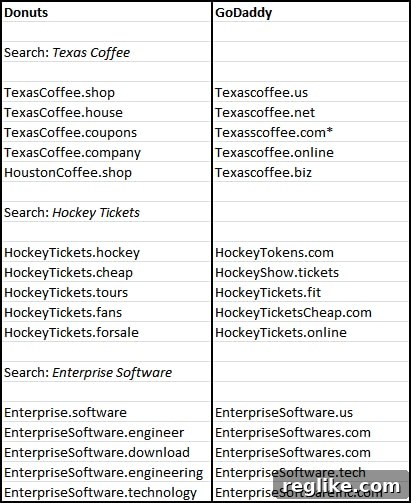
Several important observations emerged during this comparative analysis, shedding light on the differing approaches and optimization strategies employed by each service:
1. Availability Checking: To ensure a fair comparison, I activated the “availability checking” feature on RNS. This allowed the tool to function similarly to GoDaddy, which, for the most part, prioritizes displaying only available domains, thus streamlining the user’s selection process. It’s worth noting that with availability checking disabled, the Donuts tool demonstrated its broad scope by also returning .com and .net options on some of my searches, underscoring its registry-neutral design.
2. Filtering Out Distractions: During the evaluation of GoDaddy’s results, I consciously chose to disregard any listings marked as “premium” or “ad.” This decision was made to focus purely on the organic relevance of the suggested domain names, rather than those influenced by commercial promotion or higher price points, which can often skew a direct comparison of pure search efficacy.
3. GoDaddy’s Inconsistent Suggestions: An interesting finding from GoDaddy’s search results highlighted a potential area of variability. In one instance, the initial search returned an unusual suggestion, “TexassCoffee.com.” However, upon a subsequent, identical search, this result was replaced with “TexasCoffee.menu.” This variability suggests that GoDaddy’s algorithm might incorporate dynamic factors, or perhaps A/B testing, that can lead to different results for the same query over time, potentially optimizing for different metrics like conversion rates or exploring alternative TLDs.
Assessing Performance: Beyond Simple Comparison
The question of which service returns “better” results is, admittedly, complex and cannot be definitively answered with a simple judgment based on a few searches. The reality is that domain registrars operate with diverse optimization goals. GoDaddy, for example, undoubtedly fine-tunes its search algorithms to achieve a balance between maximizing conversions (the number of successful domain registrations) and driving total revenue (which includes premium domains and ancillary services). As an external observer, I am not privy to their proprietary data or intricate optimization strategies, making a complete assessment of their overall effectiveness challenging.
Furthermore, it is crucial to recognize that GoDaddy, with its massive market share and substantial internal engineering capabilities, is not the primary target market for Donuts’ RNS tool. Instead, RNS is strategically aimed at the vast number of other domain registrars – particularly those that have not, or cannot, invest significant engineering resources into developing highly sophisticated, proprietary domain search functionalities. For these registrars, RNS offers an accessible, high-quality solution that can immediately elevate their service offerings without requiring substantial upfront development costs or ongoing maintenance burdens.
Despite these caveats, the tests unequivocally demonstrated that Donuts’ RNS tool excels in a critical area: its ability to return genuinely semantically relevant domain names. This capability is a game-changer for registrars who want to help their customers find meaningful domain names, especially in the context of the rich diversity offered by new TLDs.
The Power of Semantic Relevance in Domain Discovery
At its core, the brilliance of RNS lies in its embrace of semantic search. Unlike traditional keyword-based searches that simply look for exact word matches, semantic search attempts to understand the user’s intent and the contextual meaning behind their query. For example, if a user searches for “eco-friendly cleaning,” a semantic engine might suggest domains related to “green hygiene,” “sustainable sanitation,” or “environmental upkeep” combined with appropriate TLDs like .green, .earth, or .solutions. This intelligent understanding allows RNS to bridge the gap between a user’s initial idea and a perfect, available domain name, often leveraging the specificity of new TLDs to create highly tailored suggestions.
This approach significantly enhances the user experience by reducing frustration and increasing the likelihood of finding a domain that truly fits. For businesses, this means a more relevant and impactful online identity. For individuals, it simplifies the process of establishing a personal brand or online presence. The ability of RNS to grasp these underlying meanings ensures that registrars can present a diverse yet pertinent array of options, moving beyond generic .com suggestions to explore the untapped potential of hundreds of new, descriptive TLDs.
Strategic Implications for Domain Registrars
The introduction of RNS carries significant strategic implications for domain registrars across the spectrum:
1. Leveling the Playing Field: Smaller and mid-sized registrars, often outmatched by the R&D budgets of industry giants, can now offer a sophisticated search experience comparable to, or even surpassing, that of their larger competitors, without the prohibitive costs of in-house development.
2. Enhancing Customer Experience: By providing more relevant and satisfying search results, registrars can significantly improve customer satisfaction, leading to higher conversion rates and increased customer loyalty. A positive discovery process often translates directly into higher sales.
3. Driving New TLD Adoption: RNS acts as a powerful catalyst for the adoption of new TLDs. By intelligently pairing search queries with contextually appropriate extensions, it helps users discover the immense value and specificity these new options offer, moving beyond the ingrained habit of defaulting to .com.
4. Reducing Operational Burden: Outsourcing the complexity of advanced domain search to a specialized tool like RNS frees up registrars’ internal engineering teams to focus on other core business functions, innovating in areas where they can add unique value.
5. Competitive Differentiation: In a crowded market, offering superior domain discovery tools can be a key differentiator, attracting new customers and cementing a registrar’s reputation as a forward-thinking and user-centric provider.
Conclusion: The Future of Domain Search is Intelligent and Accessible
Donuts’ Relevant Name Search (RNS) is more than just another domain search tool; it represents a significant leap forward in how users discover and acquire their digital identities. By harnessing the power of semantic understanding and offering a registry-neutral platform, RNS tackles a long-standing challenge in the domain industry: providing truly relevant and meaningful search results.
This free tool is a testament to the ongoing innovation within the domain name space, demonstrating a clear commitment to enhancing the user experience and democratizing access to cutting-edge search technology for registrars of all sizes. As the internet continues to evolve and new TLDs proliferate, the demand for intelligent, intuitive, and highly relevant domain discovery tools will only grow. RNS positions itself as a vital component of this future, empowering registrars to better serve their customers and helping millions of users find the perfect, semantically aligned domain name that truly reflects their brand, passion, or purpose in the digital world. The journey to a relevant online identity has just become a whole lot smarter and more accessible.