
CentralNic’s 2015 Performance: Unpacking New TLD Revenue Growth and Domain Market Dynamics
In the dynamic world of domain names, insights into the financial performance of key industry players often reveal broader market trends and underlying challenges. CentralNic (LSE:CNIC), a prominent global provider of domain name services, released its audited 2015 results, offering a compelling snapshot of its operational and financial health during a pivotal period for the nascent new Top-Level Domain (TLD) market. While the company demonstrated robust overall growth, a closer examination of its new TLD revenue stream suggests a more nuanced picture than what might be initially perceived.
The year 2015 was significant for CentralNic, marked by strategic acquisitions and an expanding footprint in the digital identity space. The company reported a total revenue of £10.4 million, a substantial increase from the £6.1 million recorded in 2014. This impressive jump was largely fueled by two primary drivers: the strategic acquisition of Internet.bs and robust sales of premium domain names. Internet.bs, a global domain registrar and wholesale provider, made a significant contribution, adding £3.3 million in revenue during its first full year under CentralNic’s ownership. Its initial partial year contribution in 2014, following its acquisition in June, was £1.51 million, clearly demonstrating the accretive nature of this strategic move on the company’s top line. Beyond acquisitions, CentralNic also benefited from enhanced performance in the high-value premium domain segment, further bolstering its revenue figures.
Understanding CentralNic’s Financial Health Beyond Revenue
Beyond the headline revenue figures, a deeper dive into CentralNic’s financial metrics provides a more comprehensive understanding of its operational efficiency and profitability. The company reported an adjusted EBITDA (Earnings Before Interest, Taxes, Depreciation, and Amortization) of £3.2 million, indicating healthy operational profitability before accounting for non-operating expenses. Furthermore, profit after tax stood at £0.9 million. These figures underscore CentralNic’s ability to not only grow its revenue base but also to manage its costs effectively and translate top-line growth into tangible profits for its shareholders.
However, when analyzing the financial performance of domain name companies, it is crucial to understand the unique accounting principles governing revenue recognition. Due to the multi-year nature of domain registrations, revenue is typically recognized over the life of the domain registration rather than at the point of sale. This accounting nuance means that ‘billings,’ ‘cash sales,’ or ‘cash flow’ often provide a more immediate and accurate reflection of the company’s commercial activity and market demand. In this context, CentralNic’s 2015 billings of £26.87 million stand out, representing a remarkable 172% increase over the 2014 figures. This surge in billings is a powerful indicator of strong underlying sales momentum and future revenue potential, suggesting robust market demand for the domain names and services managed by CentralNic.
The Nuance of New TLD Revenue Growth
CentralNic plays a critical role as a registry backend provider for some of the most prominent new TLDs launched under ICANN’s expansion program, including popular extensions like .xyz and various TLDs managed by Radix. Given this significant involvement, one might naturally expect the company’s wholesale division, which encompasses new TLD revenue, to exhibit explosive growth. However, the reported figures present a more temperate trajectory.
In 2015, CentralNic’s wholesale division generated £3.13 million in revenue, a modest increase of approximately £0.3 million compared to the previous year. This incremental growth, while positive, appears relatively conservative, especially considering the rapid expansion of new TLD registrations on CentralNic’s platform. By February 2016, the total number of new TLDs operated on CentralNic’s platform had reached an impressive 4 million. This disparity between the substantial increase in domain registrations and the more measured growth in wholesale revenue raises important questions about the pricing models and market dynamics within the new TLD ecosystem.
The following chart, embedded in the original report, provides an intriguing visual representation of revenue distribution:
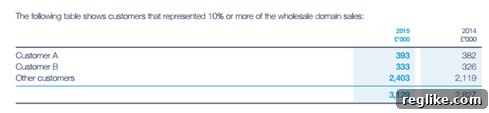
This illustration suggests that in the reporting year, none of CentralNic’s individual new TLD clients contributed more than £0.4 million in revenue to the company. It’s crucial to remember that this represents revenue, not gross sales, implying the portion recognized by CentralNic as its service fee. This observation leads to a significant inference: CentralNic likely employs highly competitive pricing structures, possibly offering substantial volume discounts to its larger registry customers. For TLDs with millions of registrations, this could mean that the effective per-name fee charged by CentralNic, as the backend provider, drops significantly below the typical wholesale price of a domain, perhaps even under $1 per name once certain volume thresholds are met.
Implications for the New TLD Market
This pricing strategy highlights the intense competition among registry backend providers and the drive to secure large-volume contracts, even at reduced per-unit margins. For new TLD registries, the emphasis shifts to accumulating a massive base of registrations, often through promotional pricing and strategic partnerships, to establish market presence and perceived success. For backend providers like CentralNic, while the per-domain revenue might be lower, the sheer volume of domains managed translates into substantial cumulative revenue and strengthens their position as a critical infrastructure provider in the domain industry.
The relatively slow growth in wholesale revenue for new TLDs, despite significant registration numbers, reflects the ongoing challenges faced by many new extensions in converting registrations into consistent, high-value renewals. It also underscores the complexity of building sustainable business models in a market still largely dominated by legacy TLDs like .com and .net. While new TLDs offer increased choice and branding opportunities, gaining widespread adoption and premium pricing power requires sustained marketing efforts, compelling use cases, and time.
The Strategic Role of Premium Domains
Alongside its core registry services, CentralNic maintains a robust portfolio of premium domain names, which serves as another vital revenue stream and strategic asset. The company disclosed that it currently owns approximately 37,000 domain names available for resale. These are not standard, inexpensive registrations but carefully selected, high-value names that command significantly higher prices due to their brevity, relevance, brandability, or keyword value. Last year, this segment proved to be highly lucrative, with CentralNic pulling in £3.22 million from the sale of these premium digital assets.
The premium domain market operates on different principles than standard domain registrations. It caters to businesses, entrepreneurs, and investors seeking distinctive online identities or valuable digital real estate. CentralNic’s strategy of acquiring and monetizing such a substantial portfolio demonstrates a savvy understanding of the inherent value in premium digital assets. This diversification of income streams, combining long-term recurring revenue from registry services with high-margin, episodic sales from premium domains, provides CentralNic with a balanced and resilient business model. It allows the company to capitalize on both the volume-driven growth of new TLDs and the value-driven opportunities in the secondary domain market.
CentralNic’s Position and the Future of the Domain Industry
CentralNic’s 2015 financial results, particularly when analyzed in the context of new TLD revenue growth, offer invaluable insights into the evolving landscape of the domain name industry. The company’s overall financial strength, driven by strategic acquisitions and strong billings, positions it as a resilient player in the digital infrastructure space. However, the specific dynamics of new TLD revenue, characterized by high volume and potentially lower per-unit fees, highlight the competitive pressures and the nuanced path to profitability for these newer extensions.
As the internet continues to expand and digital identities become increasingly critical for individuals and businesses, the demand for domain names, both new and traditional, will persist. CentralNic, with its diversified portfolio of services spanning registry backend provision, registrar operations, and premium domain sales, is well-placed to navigate these evolving market conditions. The lessons from 2015 underscore the importance of scale, strategic partnerships, and a flexible pricing approach in the new TLD space, while simultaneously reaffirming the enduring value of premium domain assets. The journey of new TLDs is still unfolding, and companies like CentralNic will continue to be instrumental in shaping their future success and integration into the global digital ecosystem.
For more detailed financial information, interested parties can refer to CentralNic’s official annual report for 2015: PDF Document.