
Exploring the Financial Trajectory of ICANN: Growth, New TLDs, and the Current Budget Challenge
Navigating ICANN’s Financial Headwinds: An In-Depth Analysis
The Internet Corporation for Assigned Names and Numbers (ICANN), a pivotal organization in the stewardship of the internet’s global naming system, finds itself at a critical juncture, wrestling with a notable budget crunch. This financial strain is multifaceted, stemming from revenues that have fallen short of projections, coupled with a necessary re-evaluation of its required reserve fund – a fund that has recently seen utilization. Such challenges demand a close examination of ICANN’s financial evolution, particularly its growth trajectory over the past decade.
Before delving into potential solutions or the underlying causes, it’s essential to first establish a clear understanding of ICANN’s financial scale and operational shifts. This article embarks on a detailed exploration of the non-profit’s historical expenses through a series of illustrative charts, spanning the critical 2009-2017 fiscal years. By dissecting these figures, we can uncover patterns and key inflection points that have shaped ICANN’s current financial landscape.
Understanding ICANN’s Fiscal Operations: A Look at Historical Expenses
To accurately interpret ICANN’s financial data, it’s important to note its fiscal year (FY) structure. ICANN’s fiscal year concludes in June. Consequently, data for, say, FY 2016 refers to the period ending June 2016, with its financial reporting often appearing in the subsequent year’s tax returns. For consistency and accuracy, the financial figures presented here are primarily sourced from ICANN’s official tax returns, with the exception of FY 2017 data, which is derived from its comprehensive audited financial statements.
The initial chart offers a macroscopic view of ICANN’s total expenses from Fiscal Year 2009 through Fiscal Year 2017. This overarching perspective immediately highlights a significant transformation in the organization’s operational scale and expenditure patterns.
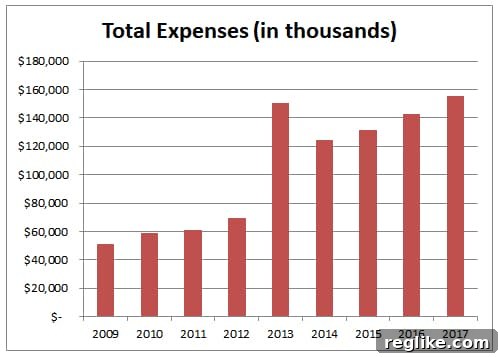
A striking feature of this historical expense overview is the substantial escalation observed in Fiscal Year 2013. This period marked an unprecedented surge in ICANN’s operational expenditure, largely attributable to its role in evaluating the immense volume of applications for new top-level domain names (New gTLDs). This was a monumental undertaking for ICANN, demanding significant resources and a considerable expansion of its operational capacity.
During FY 2013, ICANN’s total expenses ballooned from approximately $70 million to an impressive $150 million. This dramatic increase, almost doubling its previous year’s expenditure, underscores the scale of the New gTLD program. Remarkably, nearly the entire difference – an estimated $73 million out of an $80 million increase – was directly attributed to the costs associated with the New gTLD initiative. This includes both the direct operational costs and the prudential risk expenses associated with managing such a complex and globally impactful program, carefully excluding financial investment expenses to focus purely on operational outlay.
The Surge and Aftermath: Deconstructing New TLD Program Costs
The New gTLD Program, launched in 2012, represented the most significant expansion of the internet’s domain name system since its inception. It allowed for the creation of hundreds of new domain extensions beyond traditional ones like .com or .org, introducing possibilities like .app, .london, .xyz, and many others. This ambitious program required ICANN to build and manage entirely new processes for application intake, technical evaluation, legal review, dispute resolution, and community engagement on a global scale. The increased expenditure in FY 2013 was a direct reflection of this immense operational load, encompassing staffing, infrastructure, legal counsel, expert panels, and extensive meeting logistics required to process thousands of applications.
However, the narrative becomes particularly intriguing when examining the financial figures for the subsequent year, Fiscal Year 2014. In this period, ICANN’s specifically allocated expenses for the New gTLD program experienced a substantial reduction, dropping by approximately $50 million. Intuitively, one might expect a commensurate decrease in ICANN’s overall operational costs as the peak of the New gTLD application processing subsided. Yet, the total organizational expenses only fell by $26 million.
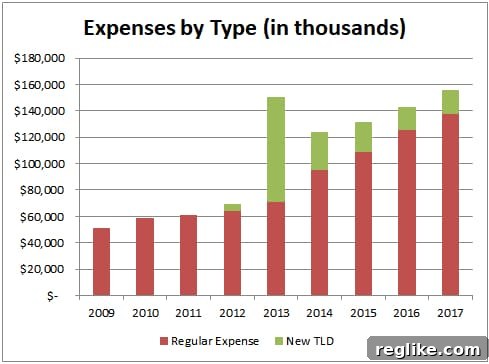
This discrepancy raises pertinent questions about the nature of ICANN’s financial growth and its ability to scale down operations post-major projects. To visualize this trend more clearly, the following stacked chart breaks down each year’s expenses into two primary categories: regular operational costs and those specifically tied to the New gTLD program.
Unpacking the Post-Expansion Cost Dynamics
The stacked chart vividly illustrates the “problem” implied earlier. While the New gTLD segment of the budget showed a clear ramp-up and then a significant reduction, the “regular” operational expenses did not contract proportionately. In fact, if New TLD costs decreased by $50 million but total costs only decreased by $26 million, it logically follows that ICANN’s baseline “regular” operational expenses must have increased by approximately $24 million in FY 2014. This is a crucial observation for understanding ICANN’s long-term financial stability.
Several factors could contribute to this phenomenon. One possibility is the “stickiness” of organizational growth. When an organization rapidly scales up for a major initiative like the New gTLD Program, it often acquires new personnel, infrastructure, and establishes new processes. Even after the peak activity subsides, some of these expanded capabilities and resources may become integrated into the “regular” operations, leading to a higher baseline expenditure than before the expansion. This could include retaining specialized staff, maintaining new IT systems, or absorbing increased administrative overhead. The ongoing management and oversight of the now-live New gTLDs also represents a continuous operational cost that was non-existent prior to the program’s launch.
Another factor could be the natural evolution of ICANN’s mandate. As the internet ecosystem constantly changes, ICANN’s responsibilities might expand to address emerging issues in security, stability, or resiliency of the DNS, or new policy development initiatives driven by its multi-stakeholder community. Such expansions, even outside of the New gTLD context, would naturally lead to increased operational costs, contributing to the elevated baseline. The complexity of global internet governance, requiring extensive travel, expert consultation, and continuous engagement with diverse stakeholders worldwide, also naturally drives expenses.
Implications for Future Sustainability and the Current Budget Crunch
This historical pattern of expenses – where significant project-driven growth leads to a higher sustained operational baseline rather than a full return to pre-project levels – is highly relevant to ICANN’s current budget crunch. If the organization consistently expands its “regular” operational footprint following major initiatives, it creates a structural challenge for financial sustainability, especially when coupled with unpredictable revenue streams, such as those derived from domain registrations that can fluctuate with market dynamics.
Understanding this trajectory is paramount for ICANN’s strategic planning. It highlights the need for rigorous cost management, meticulous financial forecasting, and a proactive approach to ensure that organizational growth remains aligned with its core mission and available resources. It also underscores the importance of transparent financial reporting, enabling ICANN’s diverse global community of stakeholders to understand the true costs of operations and contribute to informed discussions about resource allocation.
The current re-evaluation of the required reserve fund, and its recent utilization, further emphasizes the critical need to address these underlying financial dynamics. A healthy reserve fund is crucial for ICANN’s resilience, allowing it to navigate unforeseen challenges and continue its vital role in maintaining a stable and secure internet. Therefore, scrutinizing historical spending patterns, particularly the way “regular” expenses have grown, offers valuable insights into how ICANN can better manage its financial future and ensure long-term stability.
In the next installment of this analysis, we will broaden our perspective by examining the organizational headcount at ICANN. Understanding how staff numbers have evolved in parallel with these expense shifts will provide another crucial dimension to our understanding of ICANN’s growth and the ongoing challenges to its financial equilibrium.