
Namecheap’s H1 2023 Domain Insights: Decoding Top TLDs, Renewal Trends, and Customer Behavior
In the dynamic realm of the internet, a domain name is far more than just an address; it’s the foundational pillar of an online identity, a brand’s digital storefront, or an individual’s personal corner of the web. Understanding the intricate patterns of domain registration, the popularity of various extensions, and critical metrics like renewal rates provides invaluable intelligence for businesses, entrepreneurs, and digital enthusiasts alike. Leading domain registrar, Namecheap, has once again contributed significantly to this understanding by releasing its comprehensive Domain Insights & Trends Report for the first half of 2023. This pivotal report offers a deep dive into the current state of the domain market, highlighting the most sought-after top-level domains (TLDs), uncovering surprising renewal statistics, and shedding light on fascinating customer ownership behaviors.
The Enduring Reign of .COM and the Emergence of Niche gTLDs
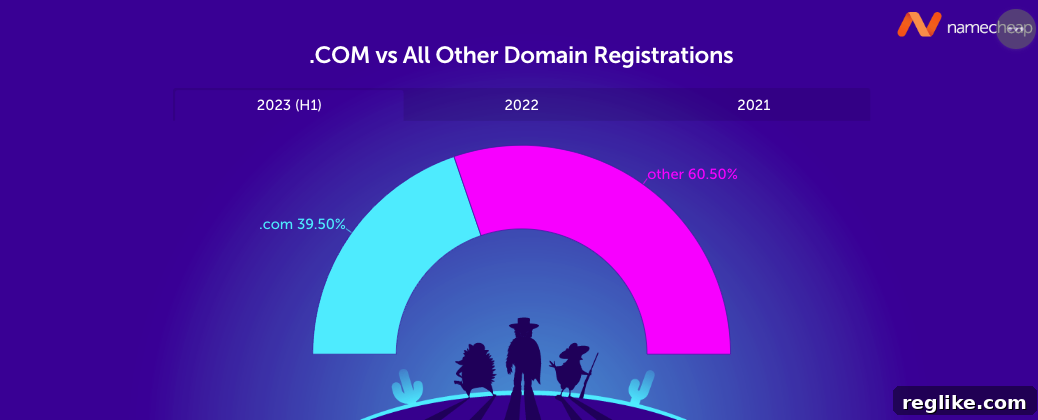
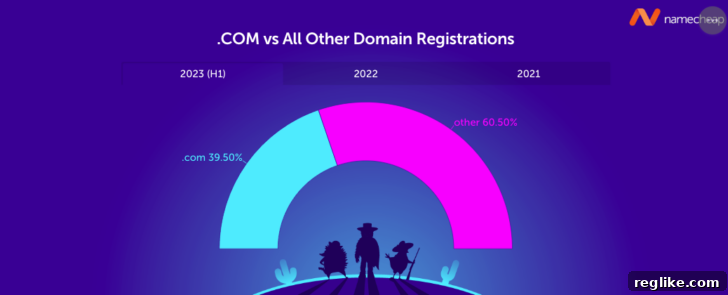
The Namecheap report reaffirms a consistent truth within the domain industry: .com remains the unparalleled leader. Throughout the first six months of 2023, a substantial 40% of all new domain registrations processed by Namecheap proudly bore the .com extension. As visually represented in the accompanying chart, this statistic is a powerful testament to .com’s continued global appeal, inherent credibility, and universal recognition. For countless businesses, startups, and personal brands worldwide, a .com address is not merely a preference but often a perceived necessity, symbolizing authority and long-term viability in the digital sphere.
However, while .com firmly holds its ground, the report also brings to the forefront the growing influence and adoption of several generic top-level domains (gTLDs). Completing Namecheap’s global top five most registered TLDs, following the dominant .com, were .xyz, .shop, .click, and .online. The strong performance of these particular gTLDs indicates a noticeable shift in user preferences and domain naming strategies, reflecting a more diversified and specialized approach to online identity.
A Closer Look at the Top Emerging gTLDs:
- .xyz: Positioned as a versatile, modern, and often more affordable alternative to .com, .xyz continues to attract a diverse user base. It’s particularly popular among tech startups, innovative projects, and individuals seeking a creative and memorable domain name without the constraints of traditional options. Its open-ended nature allows for broad applicability across various industries.
- .shop: In an era where e-commerce is not just prevalent but essential, the .shop TLD offers an immediately recognizable and highly relevant extension for online retailers, boutiques, service providers, and anyone engaged in digital commerce. Its directness simplifies branding and clearly communicates the website’s primary function to potential customers.
- .click: This newer gTLD resonates strongly with marketing and advertising initiatives. It conveys a sense of action, engagement, and direct response, making it an excellent choice for landing pages, call-to-action URLs, and campaigns where brevity and immediate impact are crucial. Its rise signifies a trend towards more functional and action-oriented domain names.
- .online: As a broad and universally understood TLD, .online serves as a straightforward and inclusive option for virtually any type of web presence. It signifies a digital space without limiting the user to a specific industry or niche, offering maximum flexibility for businesses, portfolios, and personal websites that aim for a general internet presence.
The collective success of these gTLDs suggests a dynamic domain market where users are increasingly comfortable and strategic in selecting extensions that precisely align with their brand, purpose, or industry, moving beyond the automatic default of .com when a more descriptive alternative is available.
Regional Divergence: North American Domain Preferences
While global statistics provide a broad overview, Namecheap’s report meticulously breaks down trends by region, illustrating how domain preferences can vary significantly based on geographical, cultural, and historical factors. In North America, for instance, the landscape of top domain registrations presented a subtly different picture. Here, the ubiquitous .com was predictably followed by .net and .org, marking a departure from the global top five which featured more specialized gTLDs.
Understanding the North American Pattern:
- .net (Network): Originally conceived for network infrastructure providers, .net has evolved into a well-established and respected alternative to .com, especially when a desired .com name is unavailable. In North America, it continues to be a popular choice for technology companies, internet service providers, and businesses that wish to project a professional and reliable image.
- .org (Organization): This TLD has long been synonymous with non-profit organizations, charities, educational institutions, and community groups. Its strong presence in the top North American registrations underscores the robust non-profit sector and the significant number of community-driven online initiatives thriving within the region. The .org extension carries an inherent trust and legacy that resonates deeply with North American audiences.
These regional insights emphasize that even as newer gTLDs gain global traction, traditional TLDs like .net and .org retain considerable influence and specific relevance in mature markets such as North America, often reflecting established perceptions of their intended use and the types of entities they represent.
Unpacking Domain Renewal Rates: A Critical Metric for User Commitment
One of the most telling indicators of a domain’s perceived long-term value and an owner’s commitment is its renewal rate. Namecheap’s report offers compelling insights into these figures for recently registered domains (specifically, those registered between January 1, 2021, and the first half of 2023), unveiling some truly intriguing statistics that warrant closer examination.
Remarkably, the .dev TLD recorded the highest renewal rate at an impressive 59%. This robust figure strongly suggests that domains registered under .dev are typically linked to serious, long-term development projects, professional portfolios, or technology-focused businesses. The .dev TLD, managed by Google, was specifically designed for developers and tech innovators, and its high retention rate is a clear sign that it is effectively reaching its target audience—users who find enduring utility and value in their chosen domain names.
The Intriging Case of .COM Renewal Rates at Namecheap
Perhaps the most thought-provoking revelation from the report concerns the .com renewal rate, which stood at a mere 31% for recently registered domains at Namecheap. This statistic immediately draws attention due to its significant divergence from industry benchmarks. Verisign, the authoritative registry for .com, consistently reports overall .com renewal rates hovering between 73% and 74%. It is crucial to acknowledge, as the original report correctly clarifies, that Verisign’s figures encompass the entirety of .com domains, including those that have been renewed numerous times over many years. This naturally inflates the average due to the inherent stability and established value of older, long-held domains.
However, even when focusing on initial renewal rates (typically after the first year), industry consensus and anecdotal evidence often place this figure around 50%. Namecheap’s reported 31% for recently registered .coms falls considerably below this commonly expected threshold. This notable disparity compels us to consider several potential explanations and contributing factors:
- Namecheap’s Market Positioning and Customer Base: Namecheap is renowned for its competitive pricing, frequent promotions, and user-friendly platform. This strategic positioning often attracts a diverse customer segment, including many who are new to domain ownership, budget-conscious, or engaging in experimental registrations. These users might be testing a business idea, registering a domain for a short-term project, or engaging in speculative purchases that may not evolve into long-term ventures.
- Ephemeral Projects and Testing: A lower first-year .com renewal rate could indicate that a significant portion of new registrations are for temporary marketing campaigns, small-scale personal projects, or business concepts that are quickly iterated upon or abandoned if they don’t gain immediate traction. Domains associated with “fail fast” startup mentalities or fleeting online initiatives are inherently less likely to be renewed for a second year.
- Domain Speculation and Flipping: While not the sole factor, some individuals register .com domains purely for speculative resale. If a domain fails to attract a buyer or generate sufficient interest within its initial registration period, the owner may choose to let it expire rather than incur renewal costs, especially if they manage a large portfolio of such domains.
- Specific Data Window: The report’s focus on “recently registered domains” (Jan 2021 – H1 2023) is a relatively narrow window. This specific cohort might include a disproportionately higher number of short-term, experimental, or speculative registrations compared to a broader sample of all .com domains, which would naturally include many well-established, high-value sites.
This lower .com renewal rate at Namecheap presents a compelling data point, underscoring the multifaceted motivations behind domain registrations and the varying levels of long-term commitment observed across different user segments, even within the universally desired .com TLD. It suggests that while .com remains the benchmark, its application among new registrants can range from critical business infrastructure to transient digital experiments.
The AI Revolution’s Influence: Surging .AI Registrations and Key ccTLDs
The first half of 2023 was unmistakably marked by a global explosion of interest and investment in artificial intelligence. This technological paradigm shift has had a direct and significant impact on the domain market, as vividly illustrated by Namecheap’s report. Unsurprisingly, the report highlights a substantial surge in registrations for the .ai ccTLD (country code Top-Level Domain). Though originally designated for Anguilla, a British overseas territory, .ai has ingeniously transcended its geographical roots to become the de facto domain extension for companies, startups, and research initiatives operating in the artificial intelligence sector, thanks to its evocative abbreviation.
The report revealed that .ai emerged as the fourth-most registered ccTLD at Namecheap. This achievement is particularly noteworthy, placing it just behind long-established and geographically dominant country codes such as .co, .us, and .co.uk. Such a rapid ascent underscores how specific TLDs can, through clever association and timely relevance, redefine their primary function to represent a burgeoning industry or a groundbreaking concept.
Other Prominent ccTLDs and Their Enduring Significance:
- .co (Colombia): Much like .ai, .co has successfully evolved beyond its country code origin to become a globally recognized, shorter, and often more modern alternative to .com. It is widely adopted by startups, tech companies, and individuals seeking a sleek and memorable domain name, particularly when their preferred .com is unavailable.
- .us (United States): This ccTLD is specifically designated for entities with a connection to the United States, including citizens, businesses, and organizations. Its consistent strong performance at Namecheap reflects a robust and sustained interest in establishing a distinct and recognizable American online presence, crucial for local targeting and national identity.
- .co.uk (United Kingdom): As the primary and most recognized ccTLD for the United Kingdom, .co.uk remains an indispensable choice for businesses, organizations, and individuals aiming to connect with the UK market. Its prevalence highlights the ongoing importance of localized domain identities for targeted regional engagement.
The stellar performance of .ai is a clear and compelling indicator of how major technological advancements and shifting cultural narratives can profoundly and rapidly reshape domain registration trends, creating new avenues for branding, industry identification, and online presence.
Customer Ownership Patterns: Insights into User Behavior and Market Segments
Beyond the popularity of TLDs and their renewal characteristics, Namecheap’s report also offers invaluable insights into the domain ownership patterns of its customer base. The data paints a compelling picture of a diverse user demographic, with a significant majority of customers opting for single or very limited domain ownership.
Specifically, the company disclosed that a substantial 57% of its customers who registered a new domain in the first half of this year own just one domain at Namecheap. Adding to this, an additional 29% own precisely two domains. This means that an overwhelming 86% of Namecheap’s new registrants in H1 2023 are either first-time domain owners or manage a very small, focused portfolio of digital assets.
Key Implications of These Ownership Patterns:
- Focus on Core Projects and Identity: This data strongly suggests that a considerable segment of Namecheap’s new customer base consists of small business owners, freelancers, bloggers, aspiring entrepreneurs, or individuals launching specific personal projects. Their primary objective is typically to establish a single, central, and effective online presence for their core endeavor.
- Accessibility and Ease of Entry: Namecheap’s reputation for affordability, user-friendly interfaces, and reliable support likely makes it an attractive gateway for new entrants into the domain world. These users often have immediate, straightforward needs for one or two domains and appreciate a platform that facilitates this without unnecessary complexity.
- Distinction from Domain Investors: This trend presents a clear contrast to “domainers” or domain investors, who by definition own extensive portfolios, often comprising hundreds or even thousands of domains for speculative or development purposes. While Namecheap undoubtedly serves some larger portfolio holders, the H1 2023 data for new registrations highlights a robust influx of users primarily focused on establishing individual, purpose-driven web presences.
Understanding these granular ownership patterns is crucial for Namecheap to precisely tailor its product offerings, marketing strategies, and customer support. It reinforces the understanding that, for a significant portion of the global internet population, a domain name is not primarily a speculative investment but rather an essential and practical component of their digital identity or business infrastructure.
Conclusion: Navigating a Dynamic and Evolving Domain Landscape
Namecheap’s Domain Insights & Trends Report for the first half of 2023 serves as an indispensable guide for anyone seeking to understand and navigate the complex, rapidly evolving domain market. From the unwavering global dominance of .com and the strategic rise of niche gTLDs like .shop and .online, to the distinct regional preferences evident in North America, the report vividly illustrates the myriad factors influencing domain choices and market dynamics.
The detailed analysis of renewal rates provides particularly valuable insights, with the high retention of .dev domains signifying strong user commitment, and the lower-than-average .com renewals at Namecheap sparking important discussions about user motivations and domain lifecycles. Furthermore, the report powerfully demonstrates how global technological advancements, exemplified by the explosion of interest in artificial intelligence, directly translate into measurable shifts in domain registration patterns, notably with the soaring popularity of the .ai TLD.
Finally, the customer ownership data offers a fascinating glimpse into the typical Namecheap user, highlighting a significant demographic primarily focused on establishing and maintaining individual web presences rather than managing extensive domain portfolios. As the digital ecosystem continues its relentless expansion, remaining attuned to these evolving trends is paramount for individuals and businesses striving to secure a relevant, effective, and lasting online identity.
For those keen to delve deeper into the rich data and comprehensive analysis provided by Namecheap, the full report is an essential resource:
Access the Full Namecheap Domain Insights & Trends Report 2023 Here