
The Global Internet: Navigating New TLDs and the Directional Divide
In an increasingly interconnected world, the internet’s reach extends far beyond linguistic and cultural borders. The introduction of new Top-Level Domains (TLDs) has been heralded as a monumental leap forward, promising unprecedented opportunities for branding, identity, and accessibility on the digital frontier. Yet, what constitutes “new opportunities to the left of the dot” is not universally understood, especially when confronted with the fascinating complexities of languages that read from right to left. This subtle, yet profound, distinction shapes the very interaction users have with the internet, transforming the conventional notion of domain structure for millions globally.
The journey towards a more inclusive internet took a significant turn when ICANN, the Internet Corporation for Assigned Names and Numbers, unveiled the list of top-level domain name applications at a media event in London. This pivotal moment, occurring in the summer of 2012, was intended to showcase the vast potential of an expanded domain name system. However, it also brought to light a critical challenge: the presentation of Arabic Internationalized Domain Names (IDNs). A notable concern within the community arose because these Arabic IDNs were initially presented from left to right, rather than their natural and culturally intuitive right-to-left orientation. This seemingly minor detail highlighted a fundamental clash between the internet’s ASCII-centric origins and the diverse linguistic realities of its global user base.
Understanding this challenge requires an appreciation for the mechanics of different writing systems. Some scripts, including major global languages like Arabic and Hebrew, are inherently read from right to left. This directional flow isn’t merely a matter of text arrangement; it permeates every aspect of how these languages are written, perceived, and processed. From the direction of writing individual characters to the overall flow of sentences and paragraphs, the right-to-left orientation is intrinsic to these scripts. Ignoring this fundamental aspect in digital interfaces can lead to confusion, inefficiency, and a diminished user experience, making true global internet accessibility a distant dream rather than a reality.
The practical implications of this directional difference truly hit home for many when interacting with these scripts in everyday digital environments. A compelling personal anecdote illustrates this perfectly: when writing about the registry agreement for شبكة (shabaka), a new Arabic IDN TLD, the unique behavior of the cursor became immediately apparent. Whenever this Arabic word was pasted into a standard text editor like WordPress, the cursor would instinctively jump to the left of the word, rather than settling to its right, as would be expected with left-to-right languages. This seemingly small glitch underscores a larger problem: the underlying software infrastructure often assumes a left-to-right default, creating friction for users of right-to-left languages. For millions, such subtle technical hiccups transform routine digital tasks into frustrating battles against an unyielding system.
This fundamental difference begs a crucial question: how does this work in practice for domain names? If a language is to be read from right to left, is the top-level domain not “right of the dot” in the traditional sense? The intuitive understanding for English speakers, where “domain.tld” places the TLD to the right, becomes inverted. For a user accustomed to reading from right to left, the logical flow dictates that the most encompassing part of the address – the TLD – should appear on the left, followed by the specific domain name to its right, thereby maintaining the natural reading progression. This inversion is not just a stylistic preference; it is a cognitive imperative for seamless interaction.
Indeed, that’s precisely the case. For right-to-left languages, the spatial relationship of a domain name in the user’s perception is flipped. The TLD, which is positioned to the right of the dot in the ASCII representation (e.g., .com), is conceptually understood and processed as being to the left of the dot when read in a right-to-left script. This shift in perception is vital for domain registrars, web developers, and policy makers to acknowledge and accommodate. Failing to do so can create a disconnect between the technical structure and the user’s intuitive understanding, hindering the very goal of universal internet access and usability. The internet’s global expansion necessitates a flexible and adaptive framework, one that respects and integrates diverse linguistic structures rather than imposing a single, narrow standard.
To delve deeper into this fascinating aspect of domain name management and user experience, insights from organizations at the forefront of domain registration and technology are invaluable. Reaching out to a couple of companies specializing in this field shed considerable light on the practical solutions and existing infrastructure that address these challenges. These industry players are not merely observers; they are active participants in shaping the future of the global domain name system, working to ensure that technological frameworks align with linguistic diversity. Their expertise provides a crucial bridge between the technical specifications of domain names and the real-world experiences of internet users across varied linguistic backgrounds.
ARI Registry Services, a prominent provider in the domain name industry, offered some concrete examples and clear explanations that illuminated the practical implementation of right-to-left domain name handling. Their contribution highlighted the significant advancements made in browser technology and operating systems to natively support these scripts. Their insights underscored that the complexity isn’t merely about character display but about ensuring a cohesive and intuitive user experience from input to rendering. As pioneers in managing new TLDs, their operational experience provides a robust framework for understanding how these linguistic nuances are addressed at a foundational level, ensuring accessibility and usability for communities worldwide.
As it turns out, most major browsers have sophisticated localized versions designed to flawlessly handle right-to-left scripts. These versions are not just about translating menus; they incorporate advanced rendering engines that account for reading direction, cursor placement, and text selection in languages like Arabic and Hebrew. Modern browsers, including Chrome, Firefox, Safari, and Edge, utilize the Unicode BiDi (Bidirectional) Algorithm and other advanced text rendering technologies to ensure that text appears correctly, even when mixing LTR and RTL scripts within the same line or page. This means that while the underlying domain name structure might remain LTR at a technical ASCII level, the presentation layer for RTL users is dynamically adjusted to reflect their natural reading flow, thereby minimizing cognitive load and enhancing readability.
A compelling and tangible illustration of this phenomenon can be observed with already delegated country code domains. Consider the example of امارات. or .emarat. This IDN TLD, representing the United Arab Emirates, beautifully demonstrates how right-to-left domain names are presented and interacted with. A screenshot from the aeDA’s (.ae Domain Administration) official web site vividly captures this unique structure:
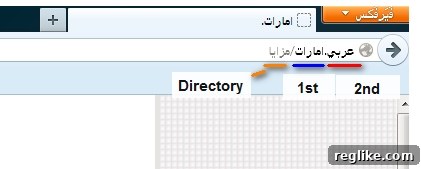
In this visual representation, the domain name unfolds precisely as a right-to-left reader would expect. The second-level domain, which typically carries the specific brand or entity name, is positioned to the far right. This is then followed immediately to its left by the customary dot separator. Finally, the top-level domain, امارات. (emarat.), appears to the left of the dot, followed by any directory or page URL components further to the left. This arrangement mirrors the natural flow of reading Arabic, where information progresses from right to left, making the domain address intuitive and easy to parse for native speakers. This implementation isn’t merely a cosmetic change; it’s a fundamental shift in how digital addresses are presented, ensuring harmony between technology and linguistic norms.
To further solidify this conceptual shift, let’s imagine the familiar Domain Name Wire website adapted for an Arabic-speaking audience. If we consider a typical URL like “domainnamewire.com/about,” the structure in a left-to-right context places “about” as the most specific part, followed by “com” as the general TLD. However, for an Arabic reader, this linear progression is inverted in their mind. In an Arabic context, this page would conceptually and visually be structured something like “tuoba/moc.eriwemanniamod” when viewed through the lens of a right-to-left reading flow. While the underlying ASCII encoding remains the same, the user’s perception and interaction with this string are fundamentally altered. The “about” directory would be perceived as being on the far left of the domain, gradually progressing rightwards through the domain components until the specific identifier “domainnamewire” is on the far right. This cognitive reorientation highlights the deep implications for branding, user guidance, and the overall digital experience in right-to-left linguistic environments.
Therefore, in many countries and linguistic communities, the traditional excitement surrounding “expanding opportunities to the right of the dot” simply doesn’t resonate in the same way. The concept of appending new generic TLDs like .app, .blog, or .shop to the right of an existing domain name is an LTR-centric construct. Instead, these communities are buzzing with a different kind of anticipation: they are eagerly focused on expanding opportunities to the left of the dot. For them, the introduction of new IDN TLDs in their native scripts, such as شبكة. (shabaka), عربي. (arabi), or موقع. (mawqi), represents a profound step towards digital self-determination and cultural relevance. These new TLDs allow them to create entire domain names in their own language, from the root to the specific page, fostering a truly localized and intuitive internet experience. This focus on “left of the dot” is not just a technicality; it’s a testament to the internet’s ongoing evolution towards genuine global inclusivity, respecting and reflecting the diverse ways humanity communicates.