
The fly on Mike Pence’s head became one of the most unexpected viral moments of the 2020 election cycle, a brief, bizarre spectacle that quickly transcended mere political humor to spark an extraordinary conspiracy theory. This seemingly trivial incident offered a fascinating glimpse into the rapid-fire world of political opportunism, digital marketing, and the pervasive nature of misinformation in contemporary society.
The Infamous Fly: From Viral Moment to Conspiracy Theory Catalyst
In the unpredictable landscape of modern politics, sometimes the smallest events cast the longest shadows. Such was the case during the 2020 vice presidential debate when a common housefly decided to perch itself on then-Vice President Mike Pence’s perfectly coiffed white hair for an astonishing two minutes. This seemingly innocuous incident, captured live on national television, quickly spiraled into a cultural phenomenon, evolving from a moment of pure, unadulterated political humor into the fertile ground for an intricate conspiracy theory.
The Unexpected Star of the Debate: A Two-Minute Perch
The year 2020 was already fraught with unprecedented political tension and a global pandemic. Debates were high-stakes affairs, scrutinized for every word, gesture, and nuance. Yet, amidst the policy discussions and political sparring between Vice President Pence and Senator Kamala Harris, it was an uninvited insect that stole the show. The fly, a small, dark speck against Pence’s prominent head, became an instant internet sensation. Its prolonged stay prompted countless memes, witty remarks, and even a flurry of merchandise. Social media exploded with reactions, late-night hosts reveled in the comedic gold, and for a fleeting moment, the nation collectively paused to marvel at the sheer absurdity of the situation.
The visual impact was undeniable. In a political arena often characterized by tightly controlled narratives and meticulously planned appearances, the fly represented an unforeseen, organic disruption. It was a reminder of the unpredictable nature of live events and the ability of the mundane to become extraordinary in the public eye. This shared, spontaneous moment of levity provided a brief respite from the relentless seriousness of the election cycle, uniting people across political divides in shared amusement.
Rapid Response: The Biden Campaign’s Digital Acumen
In the cutthroat world of political campaigns, every second counts, especially when a viral moment presents itself. The Joe Biden campaign demonstrated remarkable agility and digital savviness in capitalizing on the “Pence fly” incident. Within minutes of the fly’s departure, a campaign associate registered the domain name FlyWillVote.com. This shrewd move was more than just a quick joke; it was a strategically brilliant piece of political marketing. The newly registered domain was promptly forwarded to IWillVote.com, a pre-existing campaign initiative aimed at encouraging voter registration and participation.
The Biden campaign then amplified this digital maneuver by tweeting out the link, instantly sending the internet into a fresh wave of engagement. This act transformed a spontaneous, humorous event into a tangible call to action, intertwining pop culture with political messaging. The speed and wit with which the campaign responded highlighted the importance of real-time engagement in modern political communication. It was a textbook example of leveraging a viral moment to reinforce core campaign objectives, demonstrating an understanding of online culture and digital outreach that resonated with a broad audience.
This quick-thinking approach showcased the dynamic nature of contemporary political strategy, where humor and digital tools are deployed to connect with voters in novel and memorable ways. It was playful, opportunistic, and incredibly effective in drawing attention back to the critical message of voting, all while tapping into the collective amusement sparked by the debate’s winged intruder.
The Unsettling Turn: The Birth of a Conspiracy Theory
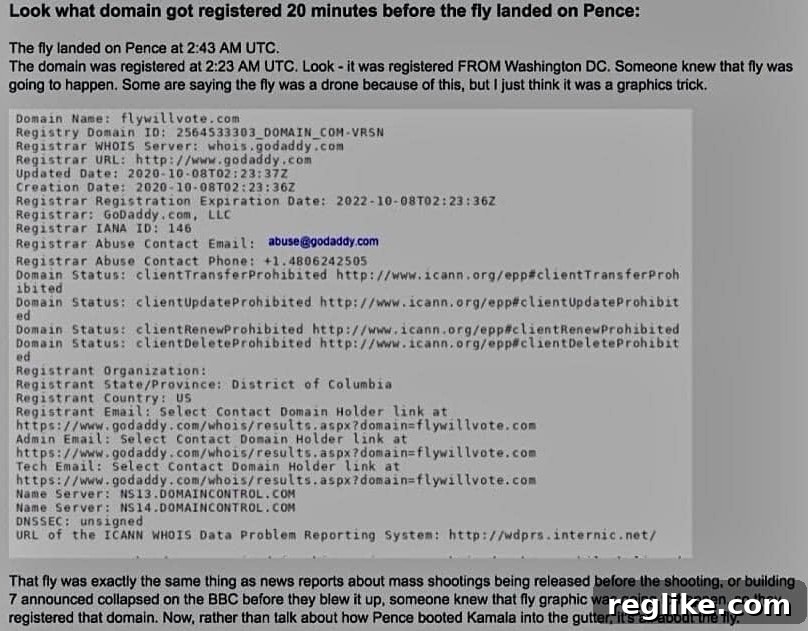
What began as a universally funny moment, skillfully leveraged for political messaging, soon took a peculiar and unsettling turn. Believe it or not, the “Pence fly” incident became the subject of an elaborate conspiracy theory. Some individuals, refusing to accept the simplicity of an opportunistic political response, began to propagate the belief that the registration of FlyWillVote.com occurred before the fly ever landed on Vice President Pence’s head. The implication was clear: this was not a spontaneous reaction but a pre-planned event, an elaborate plot to create a viral distraction or to subtly manipulate public opinion.
Initially, when encountering these claims, one might assume they were satirical, a meta-commentary on the prevalence of conspiracy theories themselves. The idea of anyone genuinely believing in a plot involving a meticulously trained fly or a pre-emptive domain registration seemed far-fetched, almost a parody of critical thinking. However, as the discussions evolved and “timelines of events” (like the one shown in the accompanying image) began to circulate, it became alarmingly clear that a significant number of people genuinely subscribed to this improbable narrative. They meticulously sought out “evidence,” piecing together unrelated facts or misinterpreting publicly available domain registration data to construct a coherent (to them) storyline of manipulation.
This rapid shift from humor to deep-seated suspicion underscores a troubling aspect of the modern information ecosystem. In an era of rampant misinformation and declining trust in traditional institutions, even the most absurd claims can gain traction, fueled by confirmation bias and the echo chambers of social media. The “Pence fly” conspiracy theory, though seemingly trivial, serves as a microcosm of how seemingly innocuous events can be weaponized or misinterpreted to fit pre-existing narratives of distrust and elaborate hidden agendas.
Deconstructing the Improbable: A Look at Logic and Fact
To anyone with a basic understanding of reality and the practicalities of political campaigning, the notion of orchestrating a fly to land on a specific individual at a specific moment is, quite frankly, absurd. The natural world is notoriously difficult to control, and the idea of training an insect for such a precise, televised mission borders on science fiction. Furthermore, the motive for such an elaborate, low-impact plot strains credulity. What grand political advantage would such a complex scheme achieve that couldn’t be gained through far simpler and more reliable means?
The core of the conspiracy, the claim that FlyWillVote.com was registered *before* the fly landed, is also easily disproven by publicly available domain registration records. These records show the precise timestamp of domain creation, which in this case, clearly indicates registration occurred *after* the debate incident. The speed of the Biden campaign’s response, while impressive, falls well within the capabilities of a modern, digitally savvy team monitoring real-time events. What some conspiracy theorists might interpret as suspicious pre-planning is, in reality, simply efficient political opportunism.
The human mind is adept at pattern recognition, sometimes to its detriment. In the absence of clear information or when driven by a desire to find deeper meaning, individuals can mistakenly connect disparate events, creating a narrative that confirms their existing biases. This quest for hidden truths, while sometimes a noble pursuit, can devolve into paranoia when facts are disregarded in favor of speculative and emotionally driven interpretations. The “Pence fly” conspiracy is a stark reminder of the importance of critical thinking and the diligent verification of information, even when faced with what seems like an intriguing alternative explanation.
The Broader Implications: Conspiracy Theories in the Digital Age
The journey of the “Pence fly” from a viral joke to a full-blown conspiracy theory offers a sobering lesson about the contemporary information landscape. In an age dominated by social media algorithms and fragmented news consumption, conspiracy theories, no matter how outlandish, can spread with alarming speed and reach. They tap into a primal human need for explanation and control, especially during times of uncertainty or political polarization. When complex realities are distilled into simple, often villainous, narratives, they can offer a comforting sense of understanding, even if that understanding is entirely divorced from reality.
The proliferation of such theories poses significant risks to democratic societies. They erode trust in established institutions, foster deep divisions, and can even incite real-world harm. When citizens lose faith in objective truth and verifiable facts, the very foundation of informed public discourse begins to crumble. The “post-truth” era, characterized by a blurring of lines between fact and fiction, makes it increasingly challenging to engage in constructive dialogue and address pressing societal issues.
Addressing this challenge requires a multi-faceted approach. It demands greater media literacy from the public, a commitment to journalistic integrity from news organizations, and responsible content moderation from social media platforms. Moreover, it calls for a collective effort to cultivate a culture of skepticism towards unsubstantiated claims, encouraging individuals to question sources and verify information before accepting it as truth.
Empathy, Understanding, and the Call for Critical Thinking
It’s often tempting, and admittedly I’ve been guilty of it on occasion, to ridicule individuals who subscribe to far-fetched conspiracy theories. There’s a certain intellectual arrogance that can lead one to dismiss such beliefs as mere foolishness. However, as the original author hinted, looking at these tendencies through the lens of mental health or psychological vulnerability suggests a more compassionate approach. Sometimes, the adherence to elaborate conspiracies can stem from feelings of powerlessness, anxiety, or a deep-seated distrust that is itself a symptom of broader societal or individual struggles.
Instead of mockery, which often only entrenches people further in their beliefs, a more constructive path involves promoting critical thinking and fostering environments where individuals feel safe to question their own assumptions without fear of humiliation. Encouraging people to engage with diverse sources of information, to scrutinize evidence, and to understand the psychological mechanisms behind belief formation can be far more impactful than simply debunking a claim with facts alone. For those whose beliefs are deeply ingrained or significantly impacting their well-being, suggesting professional help might indeed be the most empathetic and responsible course of action.
Ultimately, the saga of the fly on Mike Pence’s head serves as a peculiar, yet potent, case study. It reminds us that in the age of instantaneous information, a seemingly trivial event can rapidly evolve, reflecting both the remarkable ingenuity of political campaigns and the profound susceptibility of public discourse to the allure of conspiracy. Navigating this complex landscape requires not just vigilance in fact-checking but also an understanding of the human element behind belief, and a commitment to fostering a more informed and resilient society.