The Elusive Advantage: Why New gTLD Priority Numbers Don’t Dictate Contract Timelines
In the complex landscape of new Top-Level Domains (gTLDs), initial priority numbers were once seen as a significant advantage, particularly for uncontested strings. However, recent contract executions with ICANN reveal a different reality: these early priority numbers do not consistently correlate with the speed or order of signed registry agreements. This evolving dynamic underscores the multi-faceted nature of the gTLD application process, where numerous factors beyond a mere lottery draw dictate the path to launch.
The highly anticipated ICANN New gTLD Program, launched with the promise of expanding the internet’s naming system, introduced a novel method for processing hundreds of applications: a priority draw. Applicants who submitted similar or identical strings, or those simply eager to get their applications evaluated sooner, keenly awaited their priority number, hoping a low number would streamline their journey. The underlying assumption was that a lower number would place an applicant earlier in the evaluation queue, thus leading to a faster progression through the subsequent stages, culminating in a swift contract signing. This perception created a sense of triumph for those who drew favorable, low numbers, as if they had won an early “sweepstakes” in a competitive race.
Contrasting Journeys: The .career and .careers Enigma
A recent comparison of two distinct yet related gTLDs, .career and .careers, perfectly illustrates this emerging trend. Just yesterday, ICANN formally executed its contract with dotCareer, LLC for the .career top-level domain. This application carried a priority draw number of 119. Intuitively, one might expect an application with such a relatively low number to be among the first to secure its registry agreement.
However, a full week prior, on October 2, Donuts completed its contract execution with ICANN for the .careers top-level domain. Remarkably, that specific application held a priority number of 501. This stark contrast highlights the significant disconnect: the contract for priority #501 was signed and sealed before that of #119. The perceived initial advantage attributed to companies that drew lower numbers for seemingly uncontested strings is proving to be, quite evidently, elusive. This real-world example serves as a powerful testament to the intricate and often unpredictable journey that each new gTLD application undertakes.
A Kaleidoscope of Priority Numbers: The Broader Picture
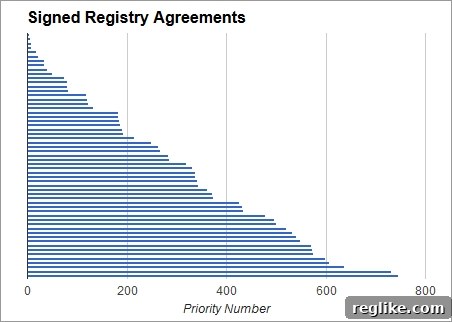
As of now, ICANN has posted a total of 57 new TLD applications that have progressed to the contract signing stage. A review of these applications reveals a vast spectrum of priority numbers, ranging from the exceptionally low #3 for the Arabic string شبكة (Shabaka) to the significantly higher #746 for .buzz. This wide distribution further reinforces the observation that an early priority number does not guarantee an expedited route to a signed registry agreement. The initial draw was merely the starting gun in a marathon, not a sprint, and many hurdles and detours lie along the path.
The reasons for this out-of-order signing process are numerous and multi-layered, reflecting the inherent complexities of establishing new roots in the internet’s fundamental infrastructure. While applications generally proceeded through the initial evaluation funnel in a more or less numerical order, subsequent stages introduce factors that can cause significant delays and reordering of the queue. These factors are critical to understand for anyone involved in or observing the new gTLD program.
Navigating the Labyrinth: Key Factors Delaying Contract Execution
Several pivotal elements contribute to applications being signed out of sequence, effectively transforming the initial linear progression into a complex, non-linear journey:
1. Governmental Advisory Committee (GAC) Advice
The Governmental Advisory Committee (GAC) plays a crucial role in the ICANN ecosystem, providing advice to the ICANN Board on public policy matters relating to the new gTLD program. When the GAC issues advice regarding a specific string or a category of strings, it can lead to significant delays. This advice often stems from concerns about public interest, potential misuse, cultural sensitivities, or national security implications. An application might be put on hold, subjected to additional scrutiny, or even required to implement specific safeguards based on GAC recommendations, regardless of its initial priority number. This consultative process, while vital for robust governance, naturally extends the timeline for affected applications.
2. Contention Sets and Resolution
One of the most common and impactful reasons for delays is the existence of “contention sets.” This occurs when multiple applicants apply for the exact same string or very similar strings that ICANN deems confusingly similar (e.g., .shop and .store). Resolving these contentions is a complex process that can involve various mechanisms:
- Private Agreements: Applicants may negotiate and reach a private resolution, where one applicant withdraws, or they agree to co-exist under certain conditions.
- Community Priority Evaluation (CPE): If one applicant can demonstrate a strong “community” claim, they might receive priority.
- Auction: In many cases, if no other resolution is reached, the contending parties enter an auction to determine who will operate the TLD.
Each of these resolution paths requires time, negotiation, and formal processes, inherently delaying the execution of the registry agreement, even if the application had a very low priority number initially.
3. Applicant Internal Processes and Legal Departments
The journey from application approval to a signed registry agreement is not solely dependent on ICANN’s processing speed. Applicants themselves play a critical role, and their internal organizational complexities can introduce substantial delays. The ICANN Registry Agreement is an incredibly detailed and legally binding document, often hundreds of pages long, covering technical specifications, operational requirements, legal indemnities, financial obligations, and compliance protocols. Legal departments of applicant organizations need to meticulously review every clause, ensuring alignment with their business strategy, risk tolerance, and national legal frameworks. This internal legal review, coupled with the establishment of necessary technical infrastructure, backend provider agreements, financial models, and corporate governance structures, can be a time-consuming endeavor, regardless of how quickly ICANN has processed the application up to that point.
4. Technical Readiness and Operational Testing
Before a new gTLD can go live, the applicant, who will become the registry operator, must demonstrate full technical readiness. This involves setting up robust and secure registry systems, implementing DNSSEC, establishing data escrow services, and proving compliance with various technical specifications set forth by ICANN. The operational capabilities must be thoroughly tested and validated. Any unforeseen technical challenges or delays in setting up the required infrastructure can push back the contract signing date, as ICANN needs assurance that the new TLD can operate reliably and securely from day one.
Beyond the Lottery: The Importance of Diligence and Preparedness
The initial excitement surrounding the priority draw last December, where many applicants felt they had “won the sweepstakes,” has been tempered by the realities of the gTLD implementation phase. It’s becoming increasingly clear that while a low priority number might have offered a slight early advantage in terms of initial review, it is merely one minor data point in a much larger and more intricate process. The journey to becoming a live TLD registry operator is a testament to perseverance, meticulous planning, and the ability to navigate a labyrinth of regulatory, legal, and technical requirements.
For current and future gTLD applicants, the key takeaway is profound: success in launching a new TLD hinges less on the luck of an initial draw and more on strategic planning, robust legal preparedness, solid technical infrastructure, and the ability to effectively respond to complex policy inputs, such as GAC advice. The emphasis shifts from merely “getting in line” to “being ready” when your turn, regardless of its original numerical designation, finally arrives. This ensures the integrity and stability of the internet’s naming system as it continues to expand.
Implications for the gTLD Ecosystem
This dynamic progression of contract signings has significant implications for the entire new gTLD ecosystem. It underscores the complexity inherent in ICANN’s role as a global multi-stakeholder organization tasked with governing the internet’s unique identifiers. It also provides valuable lessons for future rounds of new gTLD applications, highlighting that meticulous preparation and a comprehensive understanding of all potential bottlenecks are far more valuable than an early position in a queue. Ultimately, the successful deployment of new TLDs relies on a holistic approach, where technical, legal, policy, and business considerations are carefully balanced and expertly managed throughout the entire lifecycle of the application.
In the chart below, each bar represents one application that has successfully reached the registry agreement stage, offering a visual representation of the diverse range of priority numbers involved.