
Verisign patents aspects of its TLD creation and management system.
Verisign’s Groundbreaking Patent: Revolutionizing TLD Management and Creation
The intricate world of domain names forms the bedrock of our digital landscape, enabling seamless navigation across the internet. At its core, the efficient management and creation of Top-Level Domains (TLDs) are paramount for the stability and expansion of this digital realm. Verisign, the venerable operator of the .com and .net registries, has once again underscored its pivotal role in internet infrastructure by securing a significant patent for its advanced TLD creation and management system. This intellectual property milestone not only solidifies Verisign’s innovative standing but also sheds light on the complex processes that underpin the very architecture of the internet, ensuring the seamless operation of countless websites globally.
For decades, registering a domain name was largely confined to a handful of well-known TLDs like .com, .org, and .net. However, the internet underwent a transformative period with the introduction of new generic Top-Level Domains (gTLDs). This expansion, spearheaded by ICANN (Internet Corporation for Assigned Names and Numbers), opened up a vast new frontier for online identities, allowing businesses, organizations, and individuals to secure more descriptive and localized domain names, ranging from industry-specific extensions like .app and .blog to geographical ones like .london and playful options like .xyz. This unprecedented proliferation of TLDs brought with it a corresponding surge in demand for sophisticated backend management solutions capable of handling immense scale and diverse requirements.
The Evolving Landscape of Domain Name Management
The journey of a domain name, from its initial registration request to its active presence on the internet, involves a complex interplay of various entities and systems. At the apex are the domain name registries, entities responsible for managing the authoritative database of all domain names under a specific TLD. Companies like CentralNic, Neustar (which has since become part of GoDaddy Registry), and Verisign have long stood as indispensable pillars in this ecosystem, offering critical registry services that ensure the smooth operation and high availability of millions of websites globally.
When the applications for new TLDs first opened up, many aspiring registry operators, often specialized companies, community groups, or even large corporations seeking their own branded TLDs, found themselves without the necessary technical infrastructure or deep expertise to manage the intricate backend operations of their new domains. Consequently, they turned to established registry service providers, leveraging their existing platforms, robust security protocols, extensive operational experience, and compliance frameworks. These providers were instrumental in handling the massive influx of new domain registrations, ensuring strict compliance with ICANN policies, and maintaining the unwavering stability and security of the Domain Name System (DNS).
Challenges in Orchestrating a Diverse TLD Portfolio
The introduction of hundreds of new gTLDs, each potentially coming with its own unique set of rules, policies, and technical requirements, significantly amplified the complexity of domain management. A single registry service provider might need to support an incredibly diverse portfolio of domain name extensions, ranging from those with highly strict eligibility criteria (e.g., .bank, requiring specific financial industry accreditation) to open, unrestricted ones (e.g., .xyz, available to anyone). This demanded an unprecedented level of flexibility, scalability, and robustness from existing registry systems.
Registry service providers were thus compelled to either embark on extensive overhauls of their legacy systems or develop entirely new management platforms from the ground up. These next-generation platforms had to accommodate a wide array of functionalities, including but not limited to: real-time domain provisioning and de-provisioning, comprehensive Whois data management, robust security measures against sophisticated cyber threats like DDoS attacks and DNS hijacking, extensive reporting capabilities for regulatory compliance, and highly scalable infrastructure designed to handle fluctuating registration volumes and peak traffic loads. The overarching goal was to create agile, resilient systems capable of adapting swiftly to the evolving demands of a rapidly expanding and increasingly complex domain name space, ensuring both operational efficiency and unwavering security.
Verisign’s Patented Innovation: “Methods and Systems for Creating New Domains”
Amidst this backdrop of increasing complexity and the urgent need for advanced solutions, Verisign, widely recognized as the steward of the crucial .com domain and a foundational element of global internet infrastructure, has been granted U.S. Patent number 10,015,134. Titled “Methods and systems for creating new domains,” this patent underscores Verisign’s pioneering efforts in streamlining and standardizing the often-arduous process of establishing and managing Top-Level Domains. The patent, which encompasses 21 distinct claims, offers a valuable glimpse into the sophisticated architecture Verisign employs to maintain its position at the forefront of the domain name industry and ensure the reliability of its services.
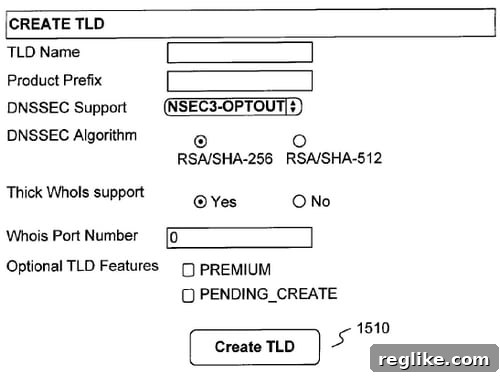
The core innovation detailed in the patent revolves around a sophisticated “Domain Manager” system. As succinctly outlined in the patent’s abstract, this system empowers users—typically experienced registry administrators, technical personnel, or authorized domain operators—to meticulously input, configure, and manage all necessary and optional data required for the creation of new domains, whether they are new TLDs or Second-Level Domains (SLDs) under an existing TLD. This crucial data can range from fundamental technical parameters, such as DNS server configurations, zone file details, and cryptographic keys, to administrative policies like registration rules, eligibility criteria, pricing structures, and dispute resolution mechanisms.
Systems and methods for creating a new domain, such as a top-level domain or a second-level domain, make use of a Domain Manager that enables a user to enter data that is necessary or optional to implement the creation of a new domain. Systems such as, for example, a Registry and one or more Registrars, may use the data defined by the Domain Manager to create a new domain.
This “Domain Manager” acts as a central, intelligent hub, orchestrating the various components and workflows involved in the entire domain creation lifecycle. By standardizing the input, validation, and processing of critical information, the system significantly reduces the potential for human error and operational inefficiencies that often plague complex technical operations. The patent details how various downstream systems, including the Registry itself and the multitude of Registrars that interface with it, can seamlessly leverage this precisely defined and validated data to bring new domains to life. This integrated and automated approach ensures consistency, accuracy, and interoperability across the entire domain ecosystem, from the low-level technical specifications and DNS configurations to the high-level user-facing registration processes and policy enforcement.
Delving Deeper: The Technical Nuances of the Patented System
The 21 claims within U.S. Patent 10,015,134 likely cover a broad spectrum of technical and procedural aspects related to robust domain management. While the full specifics are proprietary, we can infer that these claims address key areas crucial for the efficient and secure operation of a domain registry:
- Intelligent Data Input and Validation: Methods for ensuring the accuracy, completeness, and validity of domain configuration data entered into the Domain Manager. This would include automated checks against predefined technical standards, policy rules, and cryptographic requirements to prevent errors and ensure compliance.
- Automated System Provisioning: Techniques for automatically provisioning and de-provisioning resources (e.g., DNS records, database entries, security configurations) based on the input data, thereby automating much of the technical setup and teardown required for a new TLD or Second-Level Domain (SLD) activation.
- Dynamic Policy Enforcement: Mechanisms to embed, manage, and enforce specific registration policies, eligibility criteria, and technical constraints directly into the system, ensuring compliance from the outset of the domain lifecycle and adapting to policy changes.
- Seamless Interoperability and API Integration: Methods for the Domain Manager to seamlessly communicate and integrate with other critical systems within the registry infrastructure, such as Whois services, billing and accounting systems, security monitoring platforms, and various registrar interfaces, to facilitate a holistic and cohesive domain management environment.
- Architectural Scalability and Reliability: Fundamental architectural features that enable the system to efficiently handle a rapidly growing number of TLDs, millions of domain registrations, and massive DNS query loads without compromising performance, security, or service availability.
- Audit Trails and Reporting: Systems for logging all changes and actions within the Domain Manager, providing comprehensive audit trails and robust reporting capabilities essential for accountability, compliance, and operational analysis.
This comprehensive approach highlights Verisign’s unwavering commitment to building highly robust, scalable, and extensively automated systems. Such sophisticated infrastructure is absolutely essential for managing a critical piece of global internet infrastructure like the .com and .net registries, as well as effectively supporting the diverse requirements of new gTLDs.
The Strategic Importance of Intellectual Property in Internet Infrastructure
The journey to obtaining a patent, as evidenced by Verisign’s arduous process which began with the initial filing of 30 claims in 2011 and culminated with the grant of Patent 10,015,134 years later, is often a long and demanding one. This extended timeline underscores both the inherent complexity of the innovation involved and the rigorous examination required by patent offices worldwide. For a company like Verisign, which operates at the very foundation of the internet, investing significant resources into securing such patents is a strategic imperative that yields multiple crucial benefits.
Intellectual property, particularly patents, serves multiple critical functions in the highly competitive technology sector. Firstly, it offers a distinct competitive advantage, legally protecting the innovator’s substantial investment in research and development and creating significant barriers to entry for potential competitors. This allows Verisign to differentiate its advanced offerings and maintain its market leadership in the highly specialized field of registry services. Secondly, patents can become a valuable source of revenue through strategic licensing agreements, enabling other entities to utilize the patented technology under specific terms and conditions. Thirdly, and perhaps most importantly in the context of foundational internet infrastructure, patents can play a crucial role in establishing industry standards by publicly documenting and demonstrating innovative, effective solutions to common, complex problems within the domain name space.
Protecting these innovations through patents ensures that the company can continue to invest confidently in improving and expanding its services, knowing that its unique contributions are legally safeguarded. This ultimately benefits the entire internet ecosystem by fostering a stable, secure, and continuously evolving environment for critical domain name operations, encouraging further innovation across the industry.
Verisign’s Enduring Legacy and Future Outlook
As the long-standing and trusted steward of the most critical domain spaces, .com and .net, Verisign’s profound influence on the global internet is undeniable. Its unwavering commitment to operational excellence, unparalleled security measures, and absolute stability have made .com the most trusted and widely used TLD globally, forming the backbone of millions of online businesses and personal identities. The acquisition of Patent 10,015,134 further solidifies Verisign’s technological leadership and strategic position within the domain industry. It serves as a clear demonstration of their ongoing innovation not just in meticulously maintaining existing infrastructure but in actively developing more efficient, secure, and scalable methods for its future expansion and evolution.
Looking ahead, the demand for increasingly sophisticated domain management systems will only intensify. With continuous advancements in internet technology, the potential for new types of domain identifiers (e.g., decentralized blockchain-based domains) or evolving regulatory landscapes will require registries to remain at the absolute cutting edge of innovation. Verisign’s proactive and strategic approach to patenting its core systems ensures it is exceptionally well-positioned to adapt to these complex future challenges and capitalize on emerging opportunities, safeguarding its crucial role in the internet’s ongoing development.
Broader Industry Context: Innovation Beyond Verisign
Verisign is not alone in its strategic pursuit of intellectual property in the dynamic domain name space. Other key players also recognize the immense value of protecting their unique innovations. For instance, CIRA (Canadian Internet Registration Authority), the respected registry for the .ca domain name, also has a pending patent for aspects of its TLD management system. This clearly indicates a broader industry trend where diligent registry operators are keen to safeguard their unique methodologies, proprietary software, and technological advancements, often driven by the need for enhanced security, efficiency, and compliance.
These patents, both granted and pending, collectively contribute significantly to the continuous evolution and improvement of registry services across the board. They drive advancements in crucial areas such as domain security (e.g., widespread DNSSEC implementation to combat spoofing), sophisticated dispute resolution mechanisms, enhanced analytics for granular domain usage insights, and the deep automation of complex administrative and technical tasks. Such innovations are absolutely crucial for maintaining the resilience, trustworthiness, and overall efficiency of the global DNS, which is the foundational backbone of the entire internet and a critical component of our modern digital economy.
Conclusion: Paving the Way for a More Structured Digital Future
Verisign’s patent for “Methods and systems for creating new domains” represents a truly significant achievement in the realm of internet infrastructure and domain name management. It highlights the complex engineering, meticulous attention to detail, and strategic foresight required to manage the vast and ever-growing universe of domain names that form our digital world. By providing a streamlined, robust, and highly automated system for TLD creation and management, Verisign not only significantly enhances its own operational capabilities and service reliability but also contributes fundamentally to the overall stability, security, and scalability of the entire internet for all users and businesses.
This patent is far more than just a legal document; it is a profound testament to the continuous innovation and technological advancement necessary to sustain, expand, and secure the digital world we inhabit daily. As the internet continues its rapid evolution, the underlying systems that manage its foundational elements – like domain names – will remain critically important. Verisign’s latest patent firmly places it at the vanguard of this ongoing development, ensuring a more structured, efficient, and reliable digital future for everyone who connects to the global network.