
Unpacking the Digital Landscape: Why Parked Domains Dominate New TLD Registrations
The continuous expansion of the internet has ushered in an era of unprecedented choice, particularly with the introduction of numerous new Top-Level Domains (TLDs) and generic Top-Level Domains (gTLDs). These new extensions, intended to diversify online identity and offer more relevant digital addresses, have sparked considerable interest among businesses and individuals alike. However, a comprehensive analysis by Verisign, a leading global provider of domain name registry services, reveals a compelling and somewhat surprising trend in the early adoption phase of these novel internet identifiers. The study indicates that a significant majority of new TLD registrations are initially being used as parked domains rather than actively developed websites. This crucial insight offers a valuable “snapshot” of the internet’s evolving infrastructure, shedding light on initial user behavior and the immediate challenges and opportunities within the new gTLD landscape.
Verisign, renowned for its stewardship of critical internet infrastructure, including the .com and .net registries, periodically conducts in-depth research to monitor and understand the dynamics of domain name usage. Their latest analysis specifically scrutinized registrations under the new top-level domain names to ascertain the actual deployment of these second-level domains. The objective was to determine whether these new digital properties were being utilized for active online presences, such as business websites, personal blogs, or informational portals, or if they were primarily serving as placeholders. This meticulous examination aimed to provide data-driven clarity on the early utility and registrant intent behind the acquisition of these contemporary domain extensions.
The central finding of Verisign’s insightful study is both striking and indicative of the nascent stage of the new gTLD program: a mere 3% of the domains registered under these new TLDs are currently being used to host a “business website.” This statistic implies that the vast majority of these newly acquired digital addresses are not yet functioning as active commercial or informational platforms. Instead, the analysis concludes that the predominant use case for these early registrations is domain parking. A parked domain is a registered domain name that does not host any active website content or email services but typically displays a generic placeholder page, which may include advertisements, a “coming soon” message, or simple contact information. This overwhelming prevalence of parked domains suggests a strong speculative interest among registrants or a phased approach to website development, where the acquisition of the domain precedes its active use.
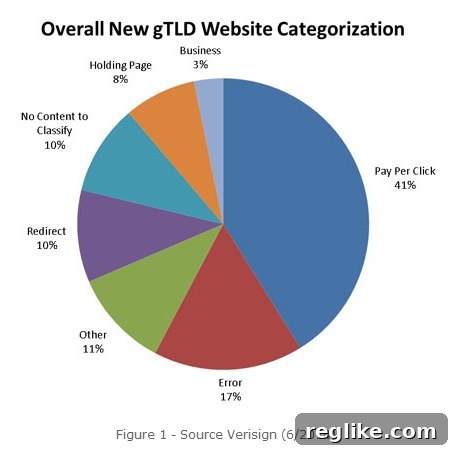
The graphical representation of this data, commonly presented as a pie chart, visually underscores the disproportionate allocation of new TLDs to parking. While specific subcategories for active use might exist (e.g., personal websites, blogs, non-commercial projects), the overarching narrative from Verisign’s chart clearly illustrates that live content development is a minority activity in this early phase. This pattern stands in stark contrast to the established usage models observed in more mature and widely adopted TLDs. Understanding the precise breakdown of these categories is invaluable for various stakeholders: domain investors seeking to identify trends, businesses evaluating strategic domain acquisitions, and the Internet Corporation for Assigned Names and Numbers (ICANN) as it continues to refine its policies for the new gTLD program and assess its overall impact on the internet ecosystem.
A particularly illuminating aspect of Verisign’s analysis emerges when comparing these findings with their reporting standards for the well-established .com and .net TLDs. For these legacy extensions, Verisign typically categorizes domain usage into three distinct buckets: one-page websites, multiple-page websites, and domains with no active website. The historical distribution for .com and .net consistently shows a much healthier landscape, with approximately 20% dedicated to one-page sites, a robust 65% for multiple-page websites, and a comparatively low 15% classified as having no website. This marked difference vividly highlights the contrasting maturity levels between the new gTLDs and their veteran counterparts. The prevalence of active, multi-page websites within .com and .net signifies an environment where domains are predominantly utilized for comprehensive, developed online presences. The original analysis also noted that Verisign had been asked whether they would apply the same detailed methodology used for new TLDs to .com and .net, a comparison that would undoubtedly yield even deeper insights into the distinct developmental trajectories of these domain spaces.
In adherence to rigorous analytical standards, Verisign prudently included several important caveats and highlighted significant outliers that could influence the interpretation of the data. These contextual details are critical for a nuanced understanding of the initial findings. One notable factor mentioned was the substantial impact of large-scale registrations by specific entities. For instance, the percentage of parked pages would have been considerably lower if not for the extensive practice of Web.com registering and parking numerous .xyz domain names on behalf of its clientele. This scenario suggests that a portion of the observed “parking” might not strictly reflect individual speculative investments but rather be part of a broader service offering or a strategic mass acquisition by providers. While the intent might differ, the immediate outcome on the internet remains the same: a registered domain not yet hosting unique or active content. Such large-scale operations can indeed skew early-stage data for new TLDs, potentially making the pace of active development appear slower than it might otherwise be without these specific influences.
Another crucial element emphasized by Verisign is the relative youth of these new top-level domain names. At the time the analysis was conducted, every new TLD registration under scrutiny was less than eight months old. This timeframe is paramount to consider, as the development of a fully functional and robust website, particularly for a business, often extends beyond the initial domain registration phase. Many domain registrants acquire names early with long-term strategic plans for development, holding them until the necessary resources, content, or market conditions align. Given this relatively short window, it is entirely plausible that a significant number of these domains are still in their preliminary stages of lifecycle—either awaiting content, design, or strategic launch. The author of the original article further speculated that if a similar analysis were performed on .com domains registered within an equivalent eight-month period, the results might also show a pronounced skew towards parked pages, suggesting that a period of initial inactivity before full development is a common characteristic across all TLDs, regardless of their age or popularity.
Verisign’s official commentary accompanying these findings maintained a carefully neutral and objective tone. The report deliberately refrained from drawing definitive or sweeping conclusions from the data, instead portraying it as merely an “interesting snapshot of the first few months of new gTLD general availability.” The organization wisely noted that it is still “early days for new gTLDs,” implicitly acknowledging that usage patterns are dynamic and highly likely to evolve considerably over time as the market matures. This measured approach reflects a keen understanding of the long-term potential and inherent volatility of the domain market. However, for industry observers closely attuned to the nuances of domain policy and competitive dynamics, Verisign’s historical stance regarding the expansion of new TLDs is widely understood. As the operator of the dominant .com and .net registries, Verisign has often voiced concerns about potential market fragmentation or the dilution of established internet identity that a rapid proliferation of new TLDs could entail. Their cautious reporting, while rigorously factual, subtly aligns with a broader sentiment that the ultimate success, utility, and impact of new gTLDs remain under considerable observation and scrutiny within the domain community.
The early dominance of parked domains among new gTLD registrations carries several significant implications for the broader internet ecosystem. For domain investors, it reinforces the speculative dimension of early adoption, where the perceived value often resides in the name itself rather than its immediate development potential. For businesses and entrepreneurs, this trend presents a dual scenario: a potential challenge in establishing a distinctive online presence amidst a sea of undeveloped domains, yet also a clear opportunity to acquire highly relevant and desirable domain names before they are developed and monetized by competitors. From an end-user perspective, encountering numerous parked pages when attempting to access a specific new TLD can lead to frustration and potentially impact the perceived utility and credibility of these newer extensions. Nevertheless, it is crucial to recognize that domain parking serves legitimate purposes, including temporary holding, indicating future development intent, or functioning as a rudimentary landing page for lead generation and initial inquiries.
As the new gTLD program progresses and gains further traction, it will be exceptionally insightful to monitor how these usage patterns transform. Will the proportion of active, developed websites increase substantially as registrants transition from initial acquisition to full-scale development? Will specific new gTLDs demonstrate greater popularity or utility for particular niches or industries? The answers to these questions will be shaped by a confluence of factors, including the effectiveness of marketing campaigns by registry operators, the availability of user-friendly content management systems and development tools, and the overarching economic climate influencing digital investment decisions. The journey of new gTLDs is unequivocally in its early chapters, and these foundational statistics from Verisign serve as a critical benchmark against which all future developments and shifts in domain usage can be accurately measured. They serve as a powerful reminder that while registering a domain name is a vital first step, cultivating a vibrant and effective online presence is a continuous, dynamic process demanding strategic vision, sustained effort, and adaptability.
In conclusion, Verisign’s detailed analysis provides compelling evidence that parked domains currently constitute the overwhelming majority of new TLD registrations during their initial months of availability. While this finding prompts extensive discussion regarding the immediate utility and often speculative nature of new gTLDs, it is paramount to consider the contextual caveats, particularly the nascent age of these domains and the specific market activities of large-scale registrants. This “snapshot” offers invaluable insights for the entire domain industry, clearly indicating that the full potential of new TLDs is still largely nascent, and their long-term impact on the digital landscape is yet to fully unfold. As the global digital ecosystem continues its rapid expansion, sustained monitoring of these evolving trends will be essential for comprehending the true evolution of online identity, digital strategy, and the diverse ways in which domain names are utilized across the world.