
The pandemic played a role, but the future is uncertain.
Verisign (NASDAQ: VRSN), the esteemed steward of the internet’s most recognized domain extensions, .com and .net, is poised to release its latest earnings report this Thursday. Market analysts and internet infrastructure observers are eagerly awaiting the results, not just for financial metrics, but for a particularly unusual data point: a reported decline in the total base of registered .com and .net domain names. This shift marks a significant departure from the consistent, albeit modest, growth patterns the company has reported for years, signaling a potential inflection point in the digital landscape.
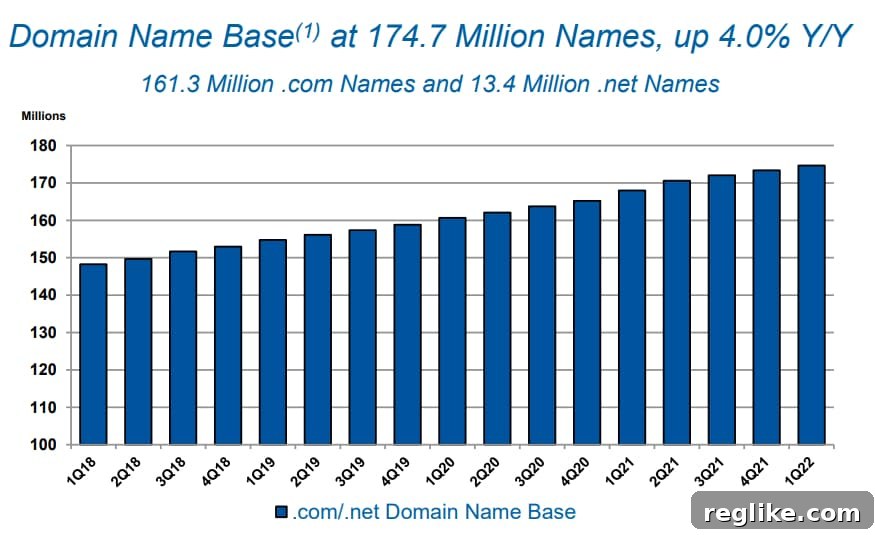
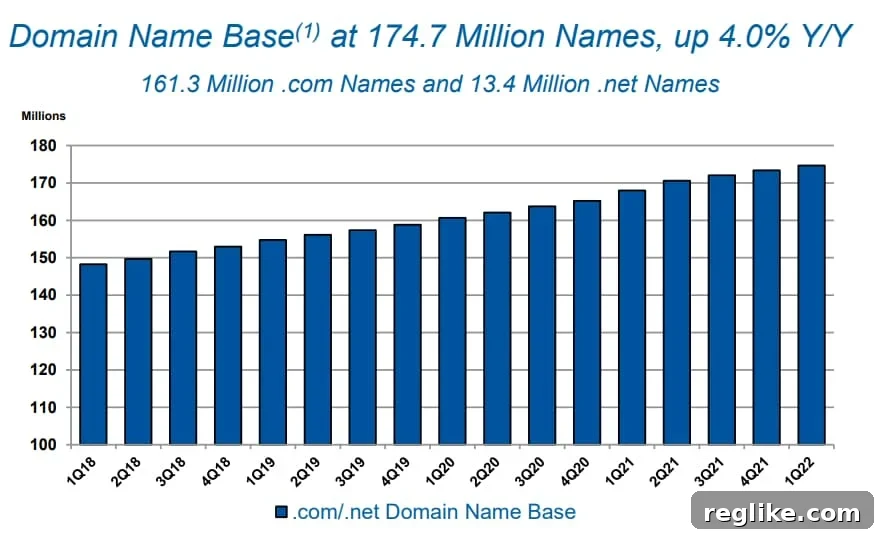
For decades, Verisign has been a pillar of the internet economy, consistently demonstrating an upward trajectory in domain registrations. Quarter after quarter, the company has managed a steady expansion of its domain portfolio, reflecting the ongoing global digitization and the relentless march of businesses and individuals online. Indeed, the first quarter of this year saw the addition of over a million new domains under its management, reinforcing this long-standing trend. However, preliminary indications suggest that the second quarter of 2022 might tell a different story, with the number of active domains potentially entering negative territory.
At the close of Q1, Verisign reported an impressive 174.7 million .com and .net domains under its stewardship. By the end of Q2, however, publicly available zone data on its website indicated a decrease, with figures hovering between 174.2 and 174.3 million domains. This downward movement has continued, with the current count standing at approximately 174.1 million domains at the time of this analysis. This sustained reduction across the quarter underscores a notable change in market dynamics.
The decline was not isolated to a single extension; both .com and .net experienced a reduction in their registration bases during this period. The ubiquitous .com domain, a cornerstone of online identity, saw its numbers contract from 161.3 million to 161.0 million. Similarly, the .net domain, often chosen by networking companies and for alternative uses, registered a drop from 13.4 million to 13.2 million. These figures, derived from Verisign’s own data, highlight a broad-based deceleration in domain name growth.
Such a development naturally prompts a critical question that echoes through the corridors of the internet industry: Have we reached “peak .com”? Is the world’s seemingly insatiable appetite for domains ending in .com finally satiated? This inquiry is far from straightforward, presenting a complex interplay of factors, trends, and market sentiment.
The notion of “peak .com” suggests a saturation point where the utility or desirability of new .com domains diminishes, leading to either stagnation or decline. For years, the internet’s expansion seemed limitless, with new businesses, ventures, and personal projects constantly requiring a digital address. However, as the digital landscape matures, and alternative online presences (like social media profiles or app-centric models) gain prominence, some speculate that the foundational role of traditional websites, and thus .com domains, might be evolving. This is a highly nuanced discussion, demanding a closer look at underlying economic shifts, technological advancements, and user behavior.
Interestingly, Verisign itself seemed to anticipate this reversal of fortunes. Following its Q1 earnings, the company proactively adjusted its annual guidance downwards, acknowledging a potential slowdown in domain growth. In a move reflecting increased caution, Verisign also ceased providing quarterly guidance specifically for the domain base, a decision that underscores the evolving and less predictable nature of the market it operates within. This forward-looking adjustment suggests that the company has been monitoring trends that pointed towards this eventual dip.
A primary hypothesis for this recent downturn revolves around the concept of “pull-forward demand,” largely influenced by the unprecedented global circumstances of the COVID-19 pandemic. As lockdowns swept the globe and remote work became the norm, businesses across all sectors were compelled to rapidly accelerate their digital transformation initiatives. Many enterprises that might have gradually transitioned online in 2022, 2023, or even 2024, suddenly found themselves in urgent need of an immediate online presence. This created a dramatic surge in new domain registrations.
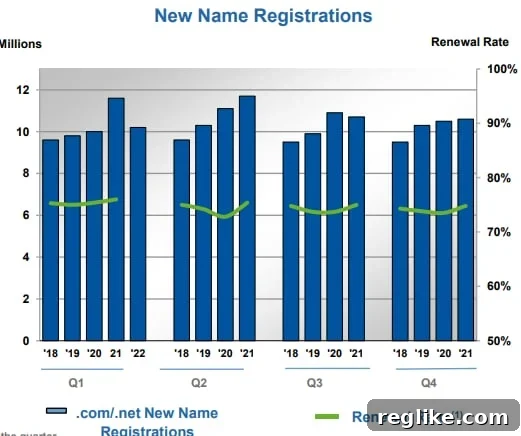
The chart above vividly illustrates this phenomenon, showcasing particularly strong new registration growth in Q2 2020 and Q2 2021. During these quarters, as the world grappled with the pandemic’s immediate challenges, the rush to establish or expand an online footprint translated directly into robust demand for domain names. This period of accelerated adoption effectively borrowed demand from future years, bringing forward registrations that would have otherwise occurred later.
Now, as the immediate urgency of the pandemic subsides, the market is experiencing a natural correction. Many businesses that registered a domain name a couple of years ahead of their original schedule simply do not need to acquire a new domain this year. This phenomenon, known as market saturation or demand normalization, is a common aftermath of periods of extraordinary growth driven by external shocks.
Compounding this effect is the current renewal cycle. A significant portion of the domains registered during the pandemic surge are now coming up for their first or second renewals. In Q2 2022, approximately 39.5 million .com and .net domains were scheduled for renewal or potential expiration. This is a notable increase compared to the 36.6 million domains due for renewal in the same quarter the previous year. The higher volume of domains facing renewal, many of which were fresh registrations during an unusual period, plays a crucial role in the net decline.
It is a well-observed trend in the domain industry that first-year registrations typically exhibit lower renewal rates compared to more mature domains. Many domains registered initially might be speculative, temporary, or part of experimental projects that do not fully materialize. As these domains reach their first renewal period, a certain percentage naturally lapse. Given the unprecedented volume of new registrations during the pandemic, it stands to reason that a larger number of these “first-year” domains are now lapsing, contributing significantly to the overall decline in the active domain base.
From an optimistic perspective, this downturn could be interpreted as a mere re-equilibration of the market following an anomalous period of hyper-growth. Much like how video conferencing platforms such as Zoom experienced an explosive surge in usage as remote work became universal, Verisign similarly benefited from the urgent global shift towards online operations. This view suggests that the current dip is not indicative of a fundamental weakness in the domain market but rather a natural unwinding of pandemic-driven exceptional demand.
However, there’s a compelling alternative interpretation that cannot be ignored: that we might indeed be witnessing “peak .com.” This perspective posits that the era of relentless growth for the traditional .com domain is reaching its fundamental limits. Proponents of this view suggest that evolving internet usage patterns, coupled with an increasingly crowded digital landscape, are leading users and businesses to seek alternatives beyond the established .com suffix.
One key factor driving this alternative view is the proliferation and growing acceptance of new Generic Top-Level Domains (gTLDs). Extensions like .app, .store, .online, .tech, and hundreds more offer businesses more specific, descriptive, or geographically relevant online identities. While .com retains its unparalleled brand recognition and trust, these newer gTLDs provide creative options for branding and niche targeting, potentially diverting some demand away from .com and .net. Additionally, the rise of powerful social media platforms and mobile applications as primary points of online presence for many individuals and even small businesses could reduce the perceived necessity of owning a dedicated website and a .com domain.
Another argument for “peak .com” is the sheer scale of the existing domain base. With hundreds of millions of domains already registered, finding short, memorable, and available .com names becomes increasingly challenging. This scarcity can push new entrants towards alternative TLDs or simply make them less likely to pursue a traditional website at all, relying instead on other digital channels. The idea is that the domain base has grown so immensely that sustaining continuous growth becomes an almost insurmountable task.
Yet, history often offers a cautionary tale for those quick to declare the end of an era. It’s worth remembering that similar declarations of “peak internet” or “peak .com” were made nearly two decades ago. In the early 2000s, following the dot-com bubble burst, many industry pundits questioned the long-term viability and growth potential of domain names. Predictions of market saturation and declining relevance were not uncommon. However, what transpired was not a decline, but a sustained period of robust growth, fueled by the relentless expansion of global internet penetration, the rise of e-commerce, and the increasing digitization of everyday life.
This historical context serves as a powerful reminder that the internet ecosystem is dynamic and constantly evolving. While current trends present new challenges, the adaptability and enduring value proposition of .com domains, particularly for established businesses and global brands, should not be underestimated. The perceived scarcity of “good” .com names might also fuel a secondary market for premium domains, indicating their continued value rather than obsolescence.
Beyond the internal dynamics of the domain market, broader macroeconomic factors undoubtedly play a role in the observed slowdown. The global economy is currently navigating a period of significant uncertainty, characterized by high inflation, rising interest rates, and widespread concerns about a potential recession. Such an environment typically dampens entrepreneurial activity and new business formation, which are key drivers of domain name registrations. When businesses tighten their belts, discretionary spending on new domains or expanding online footprints might be deferred.
Looking ahead, Verisign’s performance and the trajectory of .com and .net domains will serve as a crucial barometer for the health of the underlying digital economy. If the current dip is indeed a temporary correction stemming from pandemic-induced pull-forward demand, we might see stabilization or even a resumption of modest growth once the market recalibrates. However, if it signifies a more fundamental shift towards market saturation or a lasting change in how businesses establish their online identity, Verisign and the wider domain industry will need to adapt to a new paradigm.
The coming quarters will be critical in discerning whether this is a momentary fluctuation or a harbinger of a more enduring trend. For now, the internet community watches with keen interest as Verisign prepares to shed more light on these pivotal changes. The questions surrounding “peak .com” and the future of domain registration remain open, underscored by the unique economic and technological shifts shaping our digital world.