
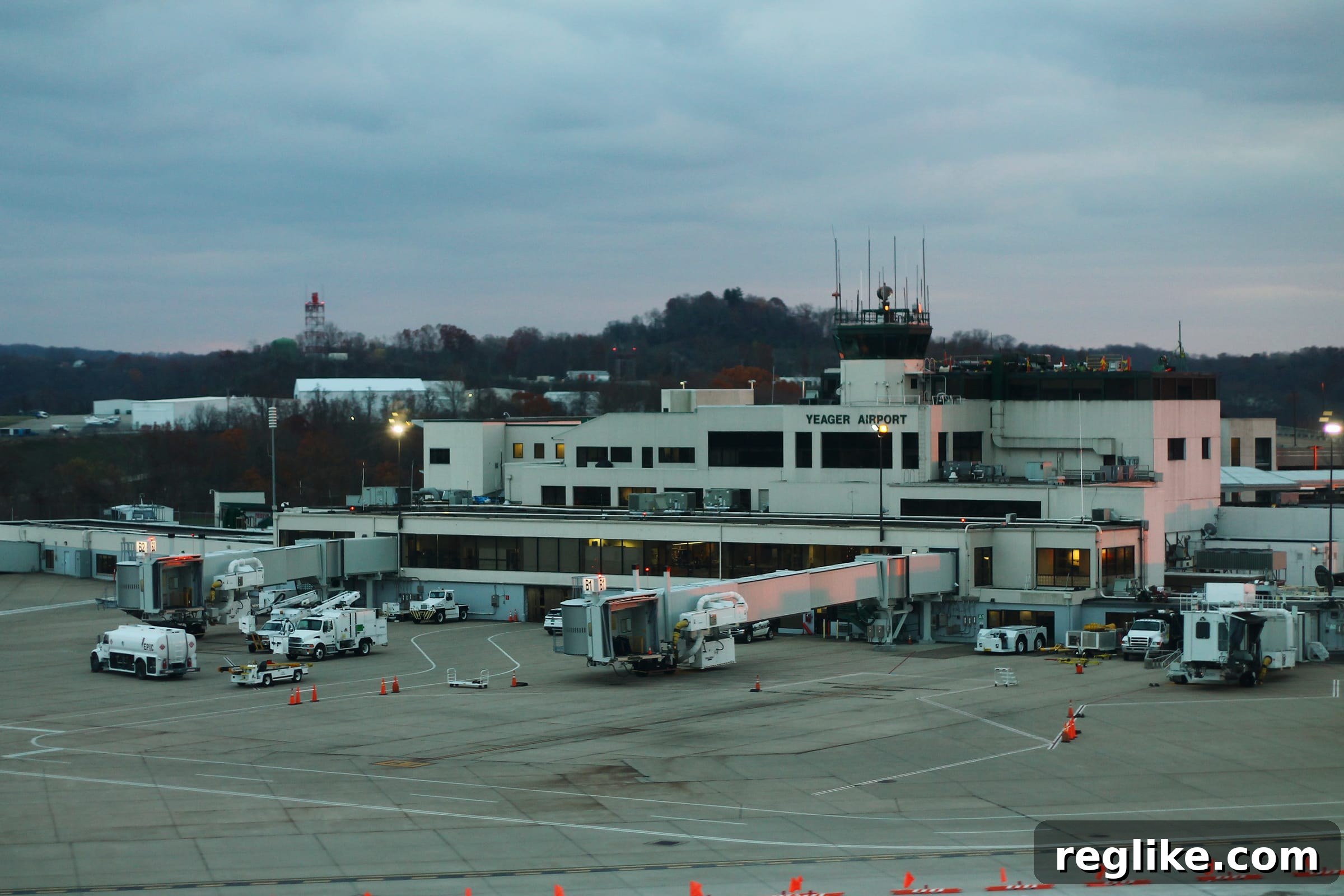
The Critical Role of Evidence: How West Virginia’s Yeager Airport Faced a Reverse Domain Name Hijacking Ruling
In the complex landscape of online branding and intellectual property, the importance of robust evidence cannot be overstated. This lesson was vividly demonstrated in a recent Uniform Domain Name Dispute Resolution Policy (UDRP) case involving the Central West Virginia Regional Airport Authority, which operates the West Virginia International Yeager Airport, and the domain name flyCRW.com. What began as an attempt to reclaim a domain under claims of cybersquatting took an unexpected turn, resulting in a finding of Reverse Domain Name Hijacking (RDNH) against the airport itself. This case serves as a powerful reminder that even seemingly strong claims can crumble without the necessary evidentiary foundation.
The airport authority initiated a UDRP dispute, alleging that the registrant of flyCRW.com was cybersquatting on its supposed trademark. However, the airport’s case, despite its potential, faltered due to a critical oversight: a failure to provide sufficient, dated evidence to support its claims of prior trademark rights. The ruling by the UDRP panelist highlights the stringent requirements for proving ownership and use of a trademark in the digital sphere and underscores the severe consequences for complainants who fail to meet this evidentiary burden.
Understanding the UDRP: A Framework for Resolving Domain Name Disputes
To fully grasp the significance of the Yeager Airport case, it’s essential to understand the Uniform Domain Name Dispute Resolution Policy (UDRP). Established by the Internet Corporation for Assigned Names and Numbers (ICANN) in 1999, the UDRP provides an administrative process for resolving disputes concerning domain names that allegedly infringe upon trademark rights. It was designed to offer a quicker, more cost-effective alternative to traditional litigation for trademark owners dealing with cybersquatting.
For a complainant to succeed in a UDRP proceeding, they must typically prove three cumulative elements:
- The domain name is identical or confusingly similar to a trademark or service mark in which the complainant has rights.
- The registrant (domain name owner) has no rights or legitimate interests in respect of the domain name.
- The domain name has been registered and is being used in bad faith.
A crucial aspect of the first element, particularly in cases involving common law trademarks (unregistered marks established through use), is demonstrating that trademark rights existed *prior* to the domain name’s registration. This temporal requirement became the central pivot around which the Yeager Airport’s case ultimately turned.
The Heart of the Dispute: Yeager Airport and flyCRW.com
The Central West Virginia Regional Airport Authority contended that the domain name flyCRW.com was confusingly similar to its FLYCRW mark. The airport had filed a trademark application for FLYCRW in September 2021, which was subsequently registered in October 2022. Importantly, the trademark application cited a “first use in commerce” date of 2017. This claim of prior use was foundational to their argument, as the disputed domain name, flyCRW.com, was registered in 2019, ostensibly *after* the airport had begun using the mark.
On the surface, it appeared the airport had a plausible case. If they could definitively establish rights in the FLYCRW mark dating back to 2017, predating the 2019 domain registration, they would have cleared a major hurdle. However, the path to success in a UDRP case is paved not just with allegations but with verifiable proof. And it was here that the airport’s strategy encountered its fatal flaw.
The Insufficiency of Evidence: A Case Undermined
The core issue, as meticulously outlined by Panelist Alan L. Limbury, was the glaring absence of concrete evidence to substantiate the airport’s claims of prior use. Despite asserting extensive use of the FLYCRW mark in connection with its airport services since 2017, the evidence presented was woefully inadequate. The panelist noted:
Exhibit A to the Complaint is the only evidence provided by Complainant in support of its claimed first use of the FLYCRW mark in commerce prior to the registration of the flycrw.com domain name. This is a screenshot of the main page of Complainant’s website at “www.yeagerairport.com” which displays a logo followed by the letters CRW and the words “West Virginia International Yeager Airport” and “#FLYCRW”. Complainant has provided no evidence as to the date of the screenshot nor of the number of views of that page of its website occurring prior to the registration of the flycrw.com domain name.
Nor has Complainant produced any evidence that, “through long and extensive use of the mark FLYCRW in connection with its airport services since 2017”, it had acquired common law trademark rights prior to the registration of the domain name, nor that Respondent was “indisputably aware of Complainant and its mark when the Domain Name was registered.”
This excerpt from the panelist’s decision is critical. A single, undated screenshot, without any context regarding its publication date or the extent of public exposure before the domain’s registration, simply does not constitute sufficient proof of common law trademark rights. Establishing common law rights requires demonstrating actual, continuous, and widespread use of a mark in commerce, associating it in the public mind with a specific source of goods or services. This could include dated marketing materials, advertising campaigns, invoices, sales figures, press releases, social media posts with specific timestamps, or other documentation clearly showing commercial activity under the mark prior to the domain’s registration.
Without such concrete evidence, the airport could not demonstrate that it possessed rights in the FLYCRW mark that predated the 2019 registration of flyCRW.com. This failure was ultimately determinative, as the burden of proof rests squarely on the complainant in UDRP proceedings. The domain owner, who did not respond to the dispute, was therefore not required to present any defense, as the complainant had not successfully established its initial claims.
The Stigma of Reverse Domain Name Hijacking (RDNH)
The case took a more serious turn when Panelist Limbury proceeded to find the complainant guilty of Reverse Domain Name Hijacking (RDNH). RDNH occurs when a trademark owner attempts to use the UDRP process in bad faith to improperly obtain a domain name from its legitimate registrant. It’s a mechanism to deter abusive complaints and protect domain registrants from harassment.
The panelist’s reasoning for this severe finding was clear:
Complainant failed to produce any evidence in support of its conclusory and unsubstantiated arguments claiming use by Complainant of the FLYCRW mark prior to the registration of the domain name nor any evidence supporting any of the exceptions set out in the WIPO Jurisprudential Overview 3.0, ¶3.8.2.
The lack of any such evidence has been fatal to the success of the Complaint, since Respondent could not be shown to have had Complainant or its mark in mind when registering the domain name.
Complainant, through its Counsel, relied upon the case of Finaxa S.A. v. Spiral Matrix, WIPO Case No. D2005-1044, in which the disputed domain name was registered several years after the registration of the complainant’s trademarks.
This persuades the Panel that Complainant, represented by Counsel, appreciated that its Complaint should fail. The Panel therefore finds that the Complaint was brought in bad faith and constitutes an abuse of the administrative proceeding.
The panelist emphasized that the airport, represented by legal counsel (Babst Calland Clements & Zomnir, PC), should have been fully aware of the evidentiary deficiencies in their case. The specific act of citing the Finaxa S.A. v. Spiral Matrix case, where the trademark clearly predated the domain name, further cemented the panelist’s conclusion. This demonstrated that the complainant understood the fundamental importance of prior rights but proceeded with a complaint lacking such proof for their own case. This suggested an attempt to leverage the UDRP process despite knowing the lack of a legitimate basis, constituting bad faith and an abuse of the system.
Lessons Learned for Trademark Owners and Digital Asset Management
This ruling from the West Virginia International Yeager Airport case offers critical takeaways for any entity operating in the digital space, whether they are a large organization or a small business:
For Complainants (Trademark Owners):
- Evidence is Paramount: Never underestimate the power of concrete, dated, and verifiable evidence. Mere claims or assertions, even from established entities, are insufficient in UDRP proceedings. For common law rights, compile a robust portfolio of marketing materials, press releases, invoices, and usage statistics with clear timestamps.
- Understand “Prior Rights”: The timeline of trademark use relative to domain registration is often the most critical factor. Ensure your trademark rights, whether registered or common law, demonstrably predate the disputed domain’s registration date.
- Strategic Legal Counsel: While the airport had counsel, this case underscores the need for counsel to conduct thorough due diligence regarding evidence before filing a complaint. Counsel also has an ethical obligation not to pursue frivolous claims.
- Risk of RDNH: Be aware that bringing a weak case, especially with legal representation, can lead to a finding of Reverse Domain Name Hijacking, which can damage reputation and create a negative precedent.
For Respondents (Domain Registrants):
- Don’t Panic if Unrepresented: This case shows that even if you don’t respond to a UDRP complaint, a weak case from the complainant, particularly regarding evidence of prior rights, can still lead to a favorable outcome for the respondent. However, responding with a strong defense is generally advisable.
- RDNH as a Shield: The RDNH mechanism is a vital safeguard against abusive complaints, ensuring the UDRP is used as intended—to combat genuine cybersquatting, not to extort domain names.
Conclusion: The Enduring Importance of Diligence
The West Virginia International Yeager Airport’s UDRP attempt against flyCRW.com serves as a compelling narrative on the indispensable role of evidence in asserting digital rights. What might have been an “easy win” for the airport, given the domain owner’s non-response, became a public finding of bad faith due to a fundamental failure in substantiating its claims. This case is a stark reminder that in the arena of domain name disputes, diligence, meticulous preparation, and adherence to evidentiary standards are not just advisable; they are absolutely essential. It reinforces the principle that while intellectual property rights are fiercely protected, their assertion must always be backed by undeniable proof, ensuring fairness and integrity within the UDRP system.