
Wix Announces Major Cost Reductions and Strategic Shift as Digital Demand Normalizes to Pre-Pandemic Levels.
Wix Unveils Q2 Earnings and Aggressive Cost Reduction Plan Amidst Evolving Market Dynamics
In a significant announcement shaping its future trajectory, Wix (NASDAQ: WIX), the globally recognized website building platform, today revealed its second-quarter earnings alongside a comprehensive cost reduction strategy. This plan notably includes workforce adjustments, signaling a proactive pivot by the company to align with current market realities. The move comes as demand for digital tools and online presence solutions, which experienced an unprecedented surge during the peak of the COVID-19 pandemic, has largely receded to pre-pandemic levels.
This trend is not isolated to Wix. Industry peers and major players in the digital infrastructure space, such as Tucows, a prominent internet services provider, and Verisign, the authoritative registry for .com and .net domain names, have reported similar shifts in demand for the foundational elements of the internet. This collective experience underscores a broader industry normalization following an extraordinary period of accelerated digital transformation.
Q2 Performance Snapshot: Navigating Headwinds and Sustaining Growth
For the second quarter, Wix reported a robust 9% year-over-year increase in revenue, reaching an impressive $345.2 million. While this represents solid growth in a challenging economic environment, it’s important to note that adverse exchange rate fluctuations effectively shaved two percentage points off this growth, highlighting the impact of global currency volatility on international businesses. Despite these macroeconomic headwinds, the company’s ability to expand its top line demonstrates the continued underlying strength of its platform and services.
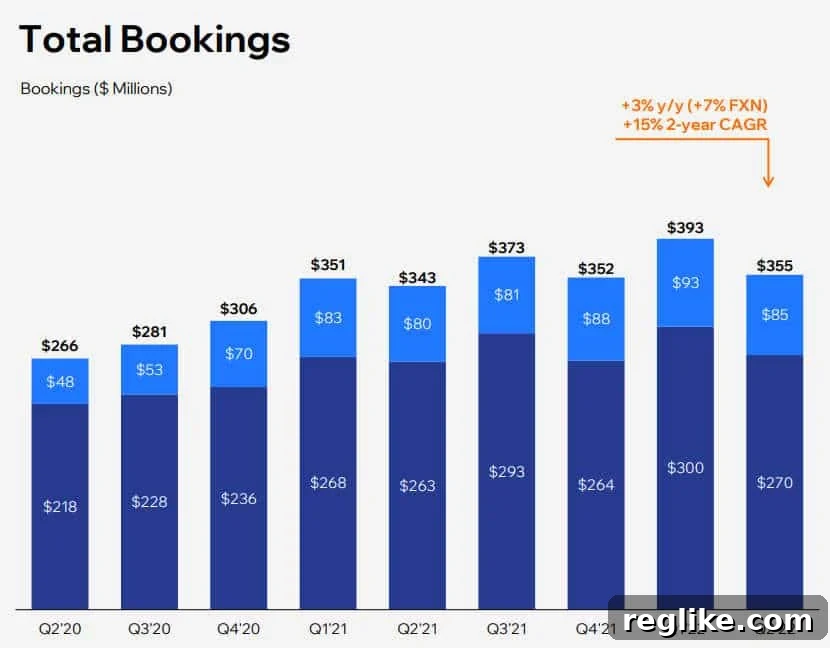
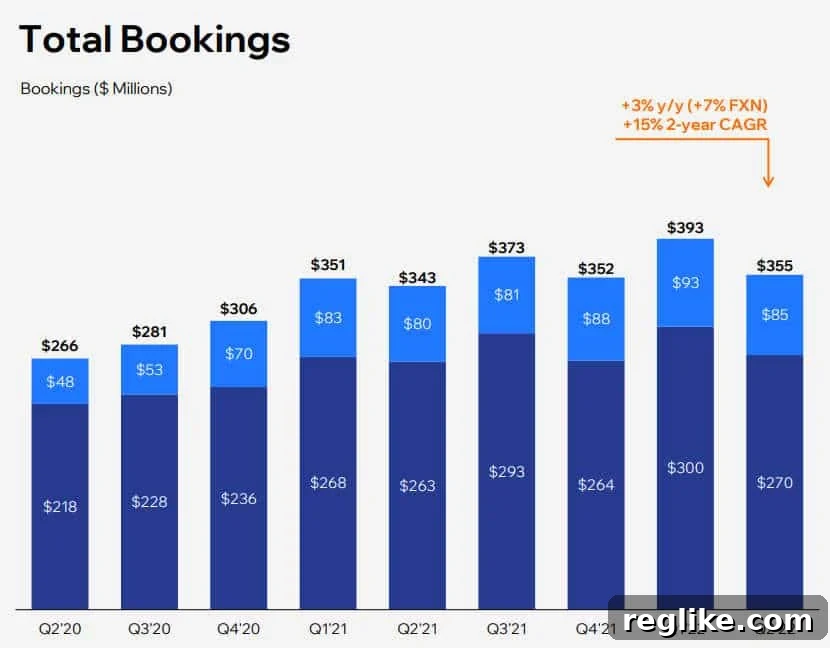
Revenue figures often lag behind bookings, which provide a more immediate indicator of customer acquisition and engagement. In this regard, bookings for Q2 saw a more modest 3% rise compared to the same quarter in 2021. Without the impact of currency exchange rates, this growth would have been closer to 7%. This tempered growth in bookings further reinforces the narrative of a market returning to a more sustainable, albeit slower, pace of expansion compared to the pandemic-fueled boom. The deceleration prompts a strategic re-evaluation, pushing companies like Wix to optimize operations and focus on core financial health rather than purely chasing rapid, unsustained growth.
Strategic Pivot: Prioritizing Profitability and Cash Flow
Recognizing the evolving market landscape, Wix is making a decisive strategic pivot. The company has explicitly stated its intention to shift focus from hyper-growth at all costs to enhancing profitability and strengthening its cash flow generation. This strategic realignment is a crucial response to investor expectations and broader market trends favoring sustainable business models over aggressive expansion. To achieve these ambitious financial objectives, Wix has initiated an aggressive cost reduction plan, targeting an impressive $150 million in annual expense savings.
To put this into perspective, the company’s operating expenses last year stood at $1.1 billion, a significant increase from $870 million reported in 2020. This substantial rise in operational costs reflects the investment made during the pandemic to scale up to meet surging demand. The current cost-cutting initiative aims to streamline operations, eliminate inefficiencies, and optimize resource allocation across the organization. This isn’t merely about cutting corners; it’s about fundamentally re-engineering the company’s cost structure to ensure long-term financial health and resilience in a more competitive and normalized digital economy.
Operational Efficiency and Workforce Adjustments
A notable component of this comprehensive cost reduction program will involve workforce adjustments, commonly referred to as layoffs. While precise figures were not fully detailed, Wix indicated that a significant portion—approximately 25%—of the targeted savings would originate from its customer care group. This suggests a strategic reassessment of how customer support is delivered and scaled, potentially leveraging technological advancements, self-service options, or more efficient routing systems to maintain service quality with a leaner team.
Such decisions are never taken lightly, reflecting a challenging but necessary step for companies adapting to new market realities. The move underscores a broader trend across the tech industry where companies that rapidly expanded their workforces during the pandemic are now recalibrating their staffing levels to match a more conservative growth outlook. The aim is to achieve greater operational efficiency and ensure that every dollar spent contributes directly to the company’s profitability and long-term value creation.
Meeting Financial Commitments and Boosting Investor Confidence
The implementation of this robust cost reduction strategy is designed to enable Wix to meet its ambitious three-year free cash flow (FCF) margin guidance, which it previously communicated to analysts in May. Free cash flow is a critical metric for investors, as it represents the cash a company generates after accounting for cash outflows to support operations and maintain its capital assets. A healthy and growing FCF is a strong indicator of a company’s financial stability and its ability to fund future growth, repay debt, or return capital to shareholders.
Investors reacted very positively to these strategic announcements, demonstrating strong confidence in Wix’s revised financial roadmap. Following the news, the company’s stock experienced a significant uplift, surging by over 10% in morning trading. This immediate positive market response highlights that while layoffs are sensitive, the market often rewards companies that demonstrate fiscal discipline and a clear path toward sustainable profitability, especially in an economic climate where growth at any cost is no longer the prevailing mantra.
The Broader Landscape: A Return to Equilibrium for Digital Infrastructure
The experiences of Wix, Tucows, and Verisign collectively paint a clear picture of a digital infrastructure market returning to a more balanced state. The initial panic-driven rush by businesses and individuals to establish or enhance their online presence during the pandemic created an unprecedented demand for website builders, domain registrations, and related services. This period of hyper-growth, however, was unsustainable over the long term.
Now, as economies reopen and consumer behavior normalizes, the urgency has lessened. While the fundamental importance of an online presence remains paramount for businesses of all sizes, the pace of new digital adoption has naturally slowed. This shift necessitates that platforms like Wix evolve their value proposition, focusing not just on attracting new users but also on enhancing the lifetime value of existing subscribers through superior tools, better support, and compelling new features. The competitive landscape, which includes formidable players like Squarespace, Shopify, and numerous open-source alternatives, further intensifies the need for efficiency and innovation.
Looking Ahead: Sustainable Growth and Innovation
Wix’s strategic pivot towards profitability and free cash flow generation marks a mature phase in its corporate development. It signifies an understanding that sustainable growth is built on strong financial fundamentals and operational excellence, not just market share expansion. This focus could empower Wix to invest more strategically in product innovation, enhance its core offerings for small businesses and enterprises, and solidify its position as a leading platform for creating, managing, and growing an online presence.
The company’s commitment to optimizing its cost structure while maintaining robust revenue growth positions it well to navigate future economic uncertainties and capitalize on the enduring need for digital solutions. By adapting proactively to the evolving market, Wix aims to deliver long-term value to its shareholders, employees, and the millions of users who rely on its platform to build their digital dreams.