
X.com’s Domain Fumble: Navigating the Perilous Path of Rebranding and Security
The digital landscape is constantly evolving, and few platforms exemplify this dynamic more than X, formerly known as Twitter. Under Elon Musk’s ownership, the platform has undergone a series of rapid and often controversial transformations, frequently characterized by a “move fast and break things” philosophy. While this approach can sometimes foster innovation, it also carries significant risks, particularly when it comes to the bedrock of online trust and security. A recent incident involving X.com’s domain transition starkly highlighted these vulnerabilities, creating a temporary but alarming window for potential phishing attacks and undermining user confidence.
This article delves into the specifics of X.com’s domain modification fumble, examining how a seemingly minor change could have catastrophic security implications. We’ll explore the immediate aftermath, the broader context of X’s rebranding efforts, and crucial lessons for both platform operators and everyday users in an increasingly complex digital world.
The X.com Domain Swap: A Risky Visual Deception
The core of the recent security scare originated from an unannounced and poorly executed change in how X handled links containing “twitter.com.” For a brief period, the platform began automatically modifying the visual display of any link that included “twitter.com” to read “x.com.” This alteration occurred even if “twitter.com” was merely a substring within a larger, unrelated domain name. Critically, while the visible text changed, the underlying URL — the actual destination a user would be directed to upon clicking — remained entirely unaltered.
Consider the profound implications of this mechanism. A link to fedetwitter.com, a hypothetical domain, would visually transform into fedex.com within the X interface. Similarly, goodrtwitter.com would misleadingly appear as goodrx.com. For an unsuspecting user quickly scrolling through their feed, these visual cues could be devastatingly deceptive. They would naturally assume they were clicking on a link to a legitimate, well-known brand, when in reality, they were being directed to an entirely different and potentially malicious website. This disconnect between what a user sees and where they actually go is a textbook example of a URL spoofing vulnerability, ripe for exploitation by malicious actors.
The issue was first brought to wider attention by security journalist Brian Krebs, who reported on the company’s latest fumble, underscoring the severity of the flaw and the immediate danger it posed to millions of users. Fortunately, X moved to fix the issue relatively quickly once it gained public attention, but the incident served as a potent reminder of the fragility of online security when major platform changes are rushed.
The Honeypot Incident and the Threat of Phishing
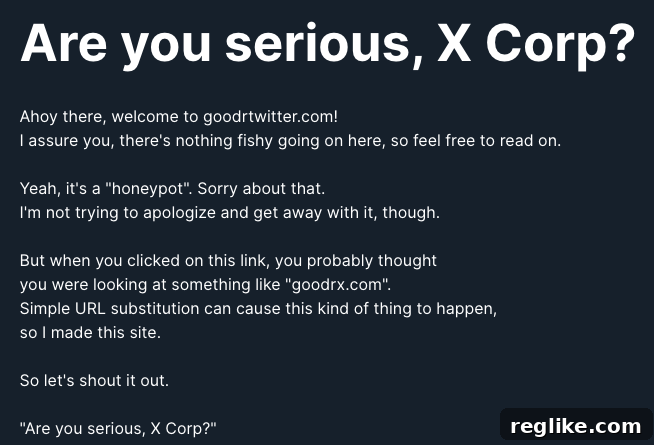
The potential for abuse was not lost on keen observers and ethical hackers. Many domains were quickly registered to either defensively protect well-known brand names or, in some cases, to highlight the vulnerability itself. One particularly illustrative example was the registrant of goodrtwitter.com, who, after the visual change made their domain appear as “GoodRx.com” on X, redirected it to a page designed as a “honeypot.” This page explicitly warned users about the deception:
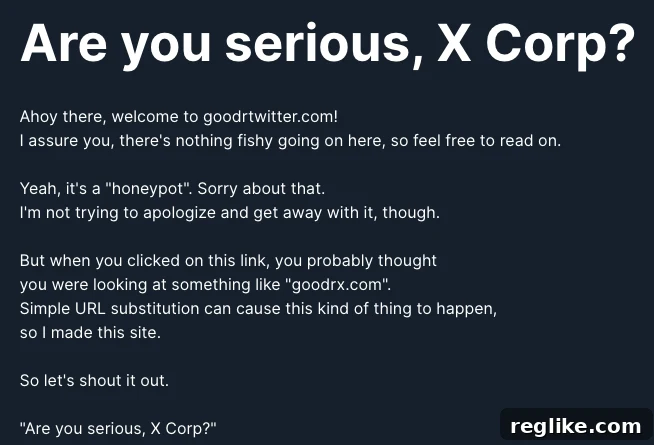
This “Are you serious, X Corp?” message perfectly encapsulated the frustration and concern within the cybersecurity community. It served as a clear, real-world demonstration of how easily users could be misled. Krebs noted that while some defensive registrations occurred, the potential for bad actors to leverage this brute-force domain change for malicious purposes was immense.
How This Became a Gift to Phishers
Phishing attacks rely heavily on deception, trust exploitation, and cognitive biases. The X.com domain fumble provided a perfect storm for such attacks:
- Trust Exploitation: Users inherently trust the platform they are on. If X visually changes a link to appear legitimate, users are less likely to scrutinize it.
- Cognitive Load Reduction: In a fast-paced environment like a social media feed, users rarely perform deep checks on every link. They rely on quick visual cues. The X.com change exploited this by providing a false visual cue.
- Brand Confusion: The ability to mimic well-known brand domains (like FedEx or GoodRx) is a potent weapon for phishers. They could craft messages urging users to click “official” links that, on X, would appear to lead to those trusted brands, but in reality, would direct them to credential-harvesting or malware-distributing sites.
- Social Engineering amplified: Malicious actors could combine this visual spoofing with compelling social engineering tactics – “Your account has been compromised, click here to verify,” or “Claim your prize now!” – making the bait even more irresistible.
The story quoting DomainTools’ VP of research and data underscored how readily bad actors could capitalize on this for sophisticated phishing campaigns, potentially leading to widespread account compromises, financial fraud, or malware infections.
X’s “Move Fast and Break Things” Mentality: A Double-Edged Sword
This incident is not an isolated event but rather fits into a pattern of changes made on X under Elon Musk’s leadership that have drawn criticism for being poorly conceived or inadequately tested. The “move fast and break things” adage, popularized in Silicon Valley, champions rapid development and iteration. However, for a global communication platform with hundreds of millions of users and profound geopolitical significance, such an approach carries immense responsibility and potential for severe unintended consequences.
Rebranding Twitter to X was an ambitious and complex undertaking, not just from a marketing perspective but from a deep technical standpoint. Changing domain structures, updating APIs, and ensuring seamless transitions while maintaining security and functionality is a monumental task. This recent domain fumble suggests that in the rush to complete the rebranding and implement new features, critical security testing and risk assessment protocols may have been overlooked or deprioritized.
User trust is a fragile commodity, especially on social media platforms. Incidents like these erode that trust, making users more wary and potentially pushing them towards alternative platforms. For X to succeed in its ambitious transformation, a meticulous and security-first approach is paramount, prioritizing stability and user safety over sheer speed of implementation.
Lessons Learned: Fortifying Digital Trust and Security
The X.com domain modification saga offers invaluable lessons for all stakeholders in the digital ecosystem:
For Platform Operators (Like X):
- Rigorous Testing is Non-Negotiable: Any change, especially one involving fundamental elements like URLs and domain handling, must undergo exhaustive security and functional testing across all user interfaces and environments.
- Security by Design: Integrating security considerations from the very outset of any new feature or change, rather than as an afterthought, is crucial. This includes threat modeling and comprehensive risk assessments.
- User Experience vs. Security: While improving user experience is important, it must never come at the cost of security. Simplification should not introduce vulnerabilities.
- Clear Communication: When significant changes are made, especially those that might affect how users perceive links or content, clear, proactive, and transparent communication is essential.
- Proactive Domain Management: Managing a brand’s digital presence, including defensive domain registrations and monitoring, is an ongoing responsibility to prevent malicious squatting and spoofing.
- Rapid Incident Response: While prevention is ideal, having a robust and rapid incident response plan, as X eventually demonstrated in fixing this issue, is vital for mitigating damage and restoring trust.
For Users: Navigating the Digital Minefield
- Always Verify the Full URL: Never rely solely on the visible text of a link. Hover over the link (on desktop) or long-press (on mobile) to inspect the actual destination URL before clicking.
- Be Skeptical of Unexpected Links: If a link seems too good to be true, or arrives in an unexpected context (e.g., a “security alert” for an account you weren’t expecting), exercise extreme caution.
- Look for HTTPS: Ensure the website you land on uses HTTPS (indicated by a padlock icon in the browser bar), especially when entering sensitive information.
- Use Multi-Factor Authentication (MFA): Enable MFA on all critical accounts, including X, email, and banking services. This provides an additional layer of security even if your password is compromised.
- Report Suspicious Activity: Most platforms offer ways to report phishing attempts or suspicious accounts. Doing so helps protect the wider community.
- Stay Informed: Keep abreast of common phishing tactics and security news. Knowledge is your best defense.
Conclusion: The Ongoing Battle for Digital Trust
The X.com domain fumble serves as a stark reminder of the continuous and evolving battle against cyber threats. In an era where social media platforms are central to global communication and commerce, the integrity and security of these platforms are paramount. While X’s rapid fix of the vulnerability was commendable, the incident itself underscored the dangers of unvetted changes and the critical importance of a security-first mindset.
For X, the path forward involves rebuilding and reinforcing user trust through transparent operations, meticulous security protocols, and a clear commitment to user safety. For users, it means cultivating a habit of healthy skepticism and vigilance, always prioritizing verification over assumption in their online interactions. In the complex digital landscape, ensuring security is a shared responsibility, requiring diligence from both the creators of platforms and those who use them.