
The Perils of .XXX Domains: Why Chasing Quick Profits Can Lead to Legal Disaster
In the vast and ever-evolving landscape of the internet, the allure of quick profits can often blind individuals to significant legal and financial risks. A particularly treacherous area where this phenomenon frequently manifests is in the speculative registration and resale of domain names, especially those tied to newer or controversial top-level domains (TLDs) like .XXX. What might appear as a clever arbitrage opportunity to some can quickly devolve into a costly legal nightmare, resulting in lawsuits, substantial fines, and the loss of any perceived investment.
This article delves into the inherent dangers of attempting to capitalize on .XXX domains by targeting established trademarks or selling dubious lists of “unclaimed” names. We will explore why such ventures are almost universally ill-advised, citing real-world examples and explaining the robust legal frameworks in place to protect intellectual property rights online. Our aim is to illuminate the perilous path that leads from a seemingly ingenious scheme to significant legal hot water, saving you from potentially wasting a substantial amount of money.
Understanding the .XXX Domain Landscape
The .XXX domain was introduced with considerable controversy and anticipation. Launched in 2011, it was specifically designated for websites related to adult entertainment. The intention was to create a distinct, identifiable space for such content, allowing for easier filtering and potentially better content control. However, its introduction also created a unique challenge for mainstream brands: the need to defensively register their trademarks under the .XXX TLD to prevent others from claiming them and potentially misrepresenting their brand or engaging in brand dilution.
This defensive registration period, and the general existence of the .XXX domain, opened a perceived window for opportunistic individuals. The logic, flawed as it may be, was that major corporations would pay a premium to acquire their brand names ending in .XXX, either to protect their reputation or to prevent competitors or malicious actors from using them. This perception has fueled various “get-rich-quick” schemes, each more legally precarious than the last.
The Risky Business of Selling “Unclaimed” .XXX Domain Lists
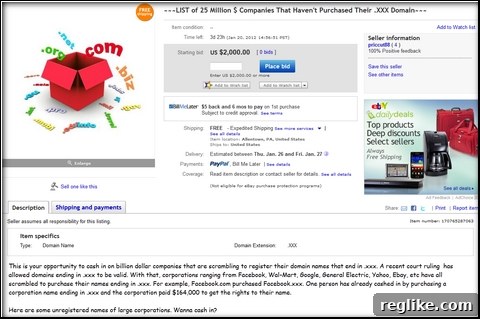
Consider the case of an eBay seller, identified as “priccut88,” who recently attempted to sell a list purporting to contain “25 Million Companies [that] Haven’t Purchased Their .XXX Domain.” This user sought a one-time payment of $2,000 for access to what they pitched as a golden opportunity to “cash in on billion dollar companies that are scrambling to register their domain names that end in .xxx.”
This is your opportunity to cash in on billion dollar companies that are scrambling to register their domain names that end in .xxx. A recent court ruling has allowed domains ending in .xxx to be valid. With that, corporations ranging from Facebook, Wal-Mart, Google, General Electric, Yahoo, Ebay, etc have all scrambled to purchase their names ending in .xxx. For example, Facebook.com purchased Facebook.xxx. One person has already cashed in by purchasing a corporation name ending in .xxx and the corporation paid $164,000 to get the rights to their name.
Such claims, while enticing, are fundamentally misleading and dangerous. The premise that a “recent court ruling” suddenly made .XXX domains “valid” for the purpose of speculative resale to major corporations is a gross misinterpretation of domain law. Furthermore, the idea that every company is “scrambling” to acquire their .XXX domain is an exaggeration designed to create urgency and panic among potential buyers of the list.
Why This “Opportunity” is a Trap:
- Trademark Protection is Paramount: Companies like Facebook, Google, and Wal-Mart possess incredibly strong trademarks. Their brand protection extends far beyond a specific domain extension. If someone registers “Facebook.xxx” with the intent to sell it back to Facebook or to profit from its brand, it constitutes clear trademark infringement and cybersquatting.
- Companies Don’t Need Every .XXX Domain: While many major brands defensively registered their primary trademarks during the initial .XXX sunrise period, they are highly selective. They do not need to own every permutation of their brand name under every TLD. Their legal teams are prepared to take action against infringers, not negotiate with them.
- The List Itself Carries Risks: Even if such a list were accurate (which is highly doubtful given the dynamic nature of domain registrations), purchasing and using it to register trademarked names for speculative purposes is a direct path to legal trouble. Those who act on such a list are essentially being advised to engage in illegal activity.
- Lack of Legitimate Intent: The primary legal defense for domain registration often hinges on legitimate intent. Registering a domain solely to sell it back to the trademark owner at an inflated price is the textbook definition of bad faith, which is a key element in cybersquatting cases.
The $2,000 spent on such a list is not an investment; it’s merely the first installment in what could become a cascade of legal fees and potential damages. Any alleged “success story” of a corporation paying six figures to reclaim a .XXX domain is either an extreme anomaly or a misrepresentation, often settled out of court to avoid protracted legal battles, but still under the clear threat of legal action against the registrant.
Cybersquatting and Trademark Infringement: A Costly Gamble
Beyond dubious lists, a more direct approach to “profiting” from .XXX domains involves registering a clear trademark belonging to another entity and then attempting to sell it at an exorbitant price. This practice is universally recognized as cybersquatting, a highly illegal and legally indefensible activity.
A prime example of this comes from a Connecticut man who registered “FoxStudios.xxx” in December and subsequently listed it on eBay for a staggering $1.975 million. When actions like this come to light, it’s a clear indicator that the individual likely has a profound lack of understanding about domain name law and intellectual property rights.
The Legal Framework Against Cybersquatting:
- UDRP (Uniform Domain-Name Dispute-Resolution Policy): This is the primary mechanism for resolving domain name disputes involving trademarks globally. A trademark owner can file a UDRP complaint if they can prove three elements:
- The domain name is identical or confusingly similar to a trademark in which the complainant has rights.
- The registrant has no rights or legitimate interests in respect of the domain name.
- The domain name has been registered and is being used in bad faith.
Registering a well-known trademark like “Fox Studios” under any TLD, with the sole intent to sell it for millions, is a textbook case of bad faith registration and use.
- ACPA (Anticybersquatting Consumer Protection Act): In the United States, the ACPA provides an additional layer of protection against cybersquatting. This federal law allows trademark owners to sue cybersquatters in court, potentially recovering statutory damages (up to $100,000 per domain name), actual damages, and attorneys’ fees.
In the case of “FoxStudios.xxx,” the registrant’s only likely “penalty” would be handing the domain over to the legitimate trademark owner, Fox Studios, without any compensation. In fact, they could face significant legal fees and potential financial penalties if the trademark owner decides to pursue an ACPA claim in court. The “investment” of the domain registration fee would be lost, and potentially much more.
The Real Cost: Beyond the Initial Investment
The advice to avoid these schemes cannot be overstated. The $2,000 spent on a dubious list, or the minimal fee to register a trademarked .XXX domain, is merely the tip of an iceberg of potential financial ruin. Once a trademark owner identifies an infringing registration, they will not hesitate to act. The costs involved in defending against a UDRP complaint or a federal lawsuit are astronomical:
- Legal Fees: Hiring an attorney specializing in intellectual property and domain law can easily cost tens of thousands of dollars, if not hundreds of thousands, depending on the complexity and duration of the case.
- Administrative Fees: UDRP proceedings, while generally less expensive than court litigation, still incur administrative fees.
- Potential Damages: Under ACPA, statutory damages can reach up to $100,000 per domain name. Imagine if you registered multiple infringing domains based on that “25 million companies” list.
- Loss of Domain: Even if you manage to avoid monetary penalties, you will almost certainly lose the domain name itself, rendering your initial investment worthless.
- Time and Stress: Legal battles are incredibly time-consuming and emotionally draining. They can divert attention and resources away from legitimate endeavors.
- Reputational Damage: Being identified as a cybersquatter can severely damage one’s reputation, potentially impacting future business opportunities or professional standing.
The promise of a quick and easy profit from .XXX domains, especially through infringing on established trademarks, is a mirage. It leads directly to a financial and legal quagmire, where the only guaranteed outcome is significant loss for the individual attempting the scheme.
Protecting Your Brand in the Digital Age: Legitimate Strategies
For legitimate businesses and trademark holders, protecting their brand online is a critical and ongoing task. This involves proactive measures and a clear understanding of domain law:
- Defensive Registrations: During the sunrise period for new TLDs, trademark owners often defensively register their primary trademarks to prevent cybersquatting. This is a strategic move to secure brand presence, not an open invitation for others to register and extort.
- Monitoring Services: Many companies utilize domain monitoring services to track new registrations that might infringe on their trademarks across various TLDs.
- UDRP and ACPA Actions: When infringement occurs, trademark owners are well-versed in initiating UDRP proceedings or pursuing legal action under ACPA to reclaim their intellectual property.
- Brand Enforcement: A comprehensive brand enforcement strategy involves not just domains but also social media handles, app store listings, and other digital assets.
For individuals seeking to engage in legitimate domain investment, the path is clear: focus on generic, descriptive, or creative domain names that do not infringe on existing trademarks. Develop original content or services associated with those domains. Understanding market trends, SEO, and legitimate business models is the key to success, not attempting to exploit the intellectual property of others.
Conclusion: Play It Safe, Stay Legal
The narrative surrounding .XXX domains, particularly the idea that they represent a fertile ground for speculative profit by targeting established brands, is fundamentally flawed and dangerously misleading. As demonstrated by the examples of the “25 million companies” list and the attempted sale of “FoxStudios.xxx,” such endeavors are not savvy investments but direct avenues to legal and financial peril. The robust legal frameworks of UDRP and ACPA are specifically designed to protect trademark owners from cybersquatting, ensuring that those who attempt to profit from another’s brand are met with swift and costly consequences.
Instead of seeking to exploit legal loopholes or engage in ethically dubious practices, individuals and businesses should focus on legitimate strategies for online success. Understanding and respecting intellectual property rights is not just a legal obligation; it’s a cornerstone of ethical online conduct and sustainable business practices. The promise of quick money from speculative .XXX domain registrations is a high-stakes gamble with overwhelming odds against the speculator. The safest and most prudent course of action is to avoid these schemes entirely and instead invest in practices that are both legal and genuinely value-adding.