
Unlocking Value: Navigating GoDaddy Auctions with Advanced SEO Metrics
In the dynamic world of domain investing, the value of a domain extends far beyond its name. Domains possessing inherent SEO strength, built over years through quality backlinks and content, have become incredibly valuable assets. Recognizing this shift, leading platforms serving the expired domain market have begun integrating sophisticated SEO metrics directly into their dashboards. While innovators like Namecheap pioneered this integration, the industry’s largest auction platform, GoDaddy Auctions, has now significantly enhanced its offerings, providing unprecedented insights to its users.
For many domain investors, the daily “firehose” of dropping domains from GoDaddy is often processed through third-party tools like ExpiredDomains.net. However, those exclusively relying on external platforms might have overlooked crucial recent updates to the metrics displayed on GoDaddy’s official auction marketplace. These additions are a game-changer for identifying high-potential domains and deserve a thorough understanding.
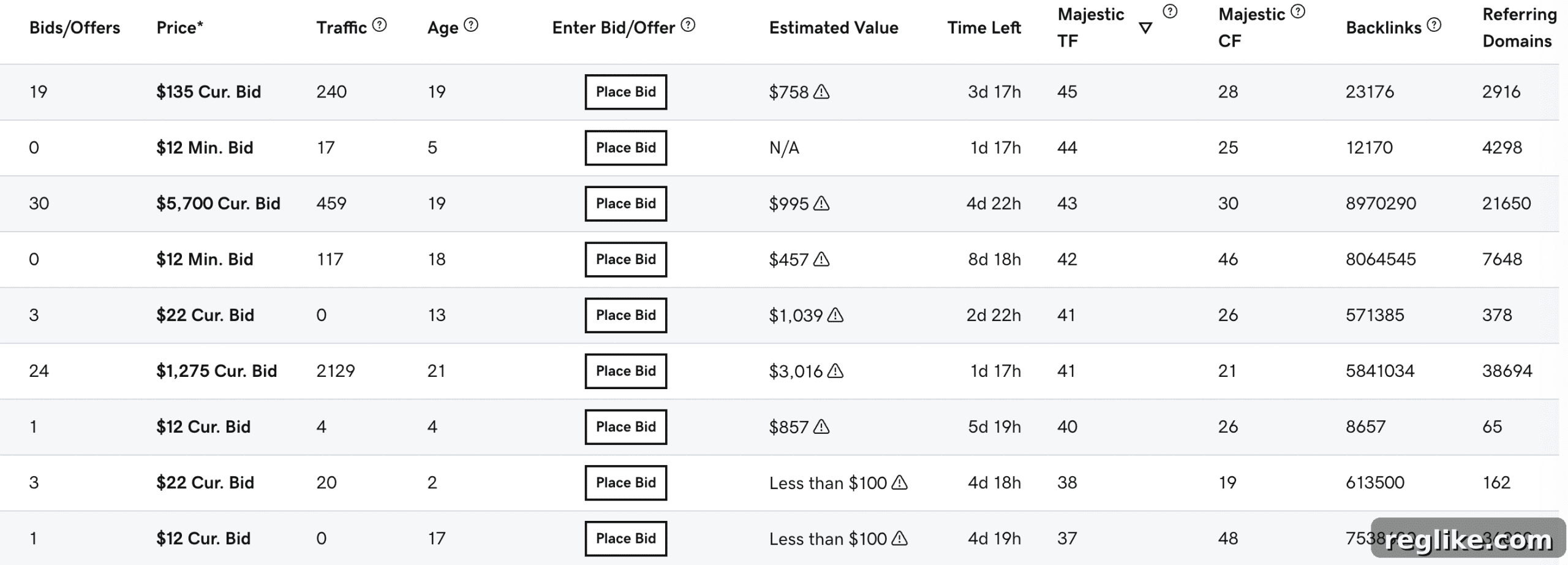
Here’s a glimpse at the updated interface:
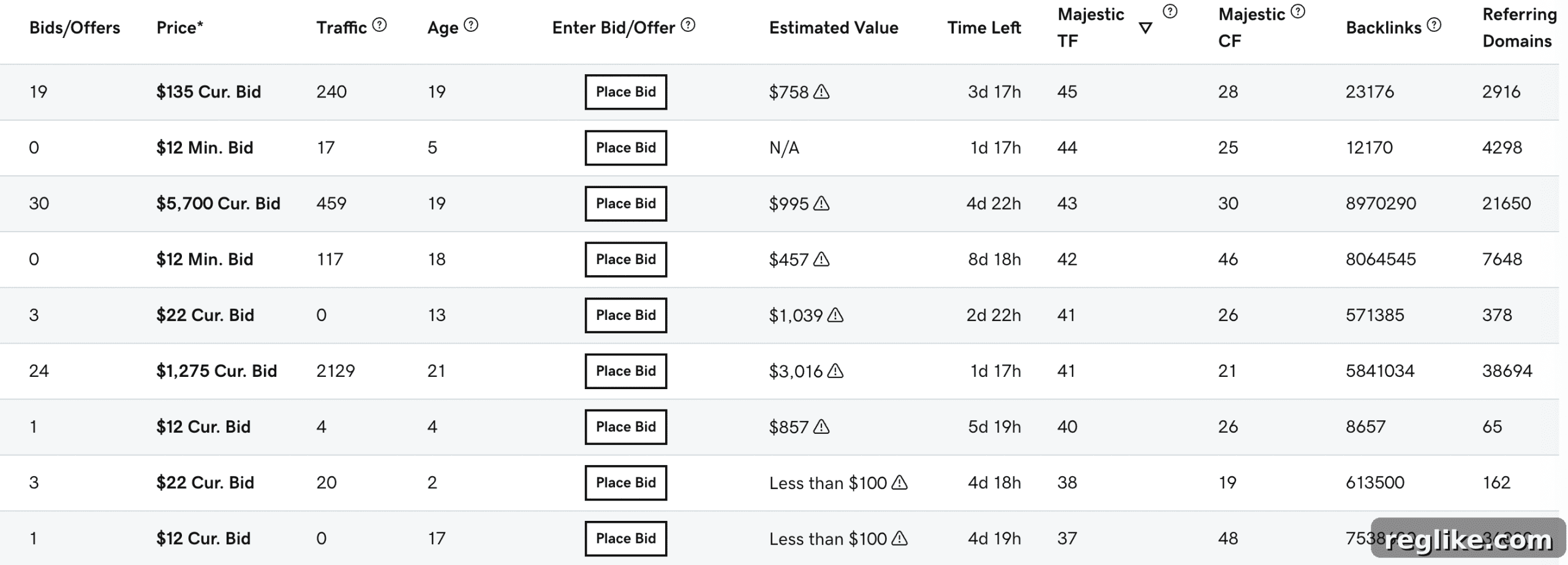
The recent integration of “Majestic TF” (Trust Flow), “Majestic CF” (Citation Flow), “Backlinks”, and “Referring Domains” represents a significant leap forward. These metrics, sourced from the renowned SEO analysis tool Majestic.com, offer domain investors a more granular view of a domain’s historical SEO performance and link profile quality. Understanding what each metric signifies and, more importantly, how to weigh them against each other, is crucial for making informed acquisition decisions.
Decoding Key SEO Metrics for Domain Investing
To effectively leverage GoDaddy’s enhanced auction platform, a clear understanding of each newly introduced metric is essential. While some may appear straightforward, their true value in the context of domain investing often lies in their interplay and the nuances of their calculation.
Understanding Majestic Trust Flow (TF)
Majestic TF, short for Trust Flow, is a proprietary metric developed by Majestic.com. As its name suggests, it is designed to measure the trustworthiness and quality of a domain’s backlink profile. Majestic defines Trust Flow as a score that “represents the quality of links that point to URLs and websites.” It evaluates the quality of inbound links by considering how close a site is to a trusted seed set of websites. In simpler terms, if a site receives links from highly authoritative and reputable sources, its Trust Flow score will be higher.
Trust Flow represents the quality of links that point to URLs and websites. A web page with higher Trust Flow than Citation Flow will usually have good-quality links.
A higher Trust Flow number indicates a stronger, more reputable backlink profile, signifying that the domain has historically attracted links from high-quality, trusted sources. For domain investors, a strong Trust Flow is a clear indicator of a valuable asset, as it suggests the domain carries significant SEO authority that can be leveraged for new projects or client work. It’s a measure of intrinsic quality that is much harder to manipulate than raw link counts, making it a reliable indicator of a domain’s inherent SEO power.
Exploring Majestic Citation Flow (CF)
In contrast to Trust Flow, Majestic CF, or Citation Flow, focuses purely on the quantity of links. Majestic defines Citation Flow as “a score which reflects the quantity of links that point to any given website.” This metric does not concern itself with the quality or trustworthiness of these links; it simply counts how many unique linking domains or pages point to the target domain.
Citation Flow is a score which reflects the quantity of links that point to any given website. Citation Flow does not care whether a link is of good-quality, or poor quality.
While a high Citation Flow might initially seem impressive, it’s crucial to understand its limitations. A domain can accumulate a vast number of links from low-quality, spammy, or even harmful sources, resulting in a high Citation Flow but a very low Trust Flow. Therefore, Citation Flow, when viewed in isolation, can be a misleading metric for assessing a domain’s true SEO potential. Its real value often emerges when evaluated in conjunction with Trust Flow, providing context on the balance between link quantity and quality.
Backlinks vs. Referring Domains: A Critical Distinction
The terms “backlinks” and “referring domains” are often used interchangeably, but they represent distinct concepts critical for accurate domain analysis. GoDaddy Auctions now provides both, making it imperative for investors to grasp their differences.
- Backlinks: A backlink (or inbound link) is a hyperlink from one website to another. The “number of backlinks” metric counts every individual link pointing to a domain, regardless of its source.
- Referring Domains: A referring domain is a unique website that provides one or more backlinks to your domain. The “number of referring domains” counts each distinct website linking to your domain only once, even if it provides multiple links.
Understanding this distinction is paramount. You can have one referring domain, but that single domain can generate hundreds or even thousands of individual backlinks. Consider this example:
Let’s say you operate a website selling high-quality toaster ovens, and a popular review site, ToasterReviews.net (a hypothetical website), publishes a review of your product. If ToasterReviews.net includes a single link to your product page within that specific review article, you would have 1 referring domain and 1 backlink.
Now, imagine ToasterReviews.net is a massive site with 200 different product review pages and blog posts. Instead of linking only in one article, they decide to place a prominent link to your site in their global sidebar or footer, which appears on all 200 pages. In this scenario, you would still have 1 referring domain, but now you would have 200 backlinks. The quantity of backlinks has increased dramatically, but the number of unique, independent sources (referring domains) remains the same. This illustrates why focusing solely on the raw number of backlinks can be misleading; a high count might just mean many links from a few sources, not broad authority from many distinct sites.
Strategic Application: Which Metrics Deserve Your Attention?
With these new metrics at your fingertips on GoDaddy Auctions, the challenge becomes discerning which ones truly matter for your domain investing strategy. Not all metrics are created equal, and some can even be deceptive if misinterpreted.
Prioritizing Quality Over Sheer Quantity
From a strategic SEO perspective, when evaluating domains for their intrinsic value, you should largely disregard the raw “number of backlinks” as a primary indicator. As the toaster example highlights, a domain could boast millions of backlinks from just a handful of referring domains. While these links might pass some value, the broader SEO signal of authority and natural growth comes from a diverse portfolio of unique referring domains. Many domain investors mistakenly prioritize a massive backlink count, often overlooking the far more significant metric of unique referring domains. A domain with 50 high-quality referring domains is almost always more valuable than one with 5,000 backlinks from only 5 referring domains.
Similarly, the Citation Flow metric, when used in isolation, can be a poor indicator of true SEO value. Because Citation Flow only measures quantity, it can be artificially inflated by low-quality, spammy links. Imagine a domain that has attracted 10,000 extremely poor, irrelevant, or even toxic links from shady sources. Its Trust Flow would likely be incredibly low, signaling a severely compromised link profile, yet its Citation Flow could be quite high due to the sheer volume of links. This scenario underscores the danger of relying solely on Citation Flow.
A Crucial Advisory for Domain Investors: Manipulation Risks
This is a critical public service announcement for all domain investors: It is possible to manipulate virtually all SEO metrics to appear higher than they genuinely should be. Black-hat SEO tactics, such as building extensive private blog networks (PBNs), link farms, or purchasing low-quality links, can artificially inflate metrics like Citation Flow and raw backlink counts. However, it is significantly more challenging to artificially boost Trust Flow effectively. Majestic’s algorithms are designed to filter out spammy and low-quality links when calculating Trust Flow, making it a more resilient indicator of genuine link profile quality, though not entirely immune to sophisticated manipulation.
The Golden Rule: Focus on Referring Domains and Trust Flow
When you’re sifting through GoDaddy Auctions in search of domains with substantial SEO value, your primary sorting and filtering criteria should be Referring Domains and Trust Flow. These two metrics, especially when considered together, provide the most reliable indicators of a domain’s inherent authority and the health of its backlink profile. A domain with a high number of unique referring domains and a strong Trust Flow score indicates a natural, authoritative link acquisition history, making it a prime candidate for investment.
A good rule of thumb is to look for a healthy Trust Flow to Citation Flow ratio. Ideally, the Trust Flow should be as close to or even higher than the Citation Flow. A TF:CF ratio where TF is significantly lower than CF (e.g., TF 10, CF 40) is a major red flag, often indicating a spammy or low-quality link profile. Conversely, a ratio where TF is close to or surpasses CF (e.g., TF 30, CF 35 or TF 35, CF 30) suggests a very high-quality and trustworthy link profile.
Beyond the Numbers: A Holistic Approach
While Trust Flow and Referring Domains are indispensable, remember that domain investing requires a holistic approach. These metrics are powerful tools, but they should be complemented by other due diligence steps:
- Domain Age and History: Older domains with a clean history often carry more authority. Tools like Archive.org can help you review past content.
- Brandability and Niche Relevance: Does the domain name itself have intrinsic value? Is it brandable? Is it relevant to a profitable niche?
- Traffic Potential: Does the domain still receive residual traffic, even if expired?
- Anchor Text Analysis: What kind of anchor text is used in its backlinks? Is it natural or overly optimized/spammy?
- Spam Check: Use various SEO tools to check for spammy link neighborhoods or penalties.
Don’t allow the other two metrics – raw backlink count and Citation Flow – to distract you from your core mission. While they certainly offer valuable data for experienced SEO professionals conducting deep, exhaustive research, their utility for domain investors focused on acquiring portfolio-worthy domain names is comparatively limited. Focus your energy on the metrics that truly reflect quality and long-term SEO potential.
In conclusion, GoDaddy Auctions’ integration of Majestic SEO metrics is a powerful enhancement for domain investors. By understanding and correctly prioritizing Trust Flow and Referring Domains, you can navigate the vast landscape of expired domains more effectively, identify truly valuable assets, and build a stronger, more profitable domain portfolio. Educating yourself on these key indicators is not just an advantage; it’s a necessity for success in today’s competitive domain market.