
Unveiling China’s Web Navigation Landscape: A Deep Dive into Direct Traffic and Domain Demand
Kassey Lee explores the most recent data on web navigation trends in China, revealing critical insights for businesses and domain investors.

As we navigate further into 2020, understanding the dynamics of web traffic in one of the world’s largest digital markets, China, becomes increasingly vital. This updated time-series analysis delves into the latest web traffic data from China, examining its profound impact on the demand for premium domain names. For any entity looking to establish or expand its online presence in this unique landscape, grasping how users arrive at websites is paramount.
The Foundational Insight: Direct Visits Driving China’s Digital Highway
My previous article, “Direct visits driving demand for domains in China,” published in October last year, laid the groundwork for this analysis. Utilizing years of meticulously collected data from Baidu, China’s dominant search engine, the research aimed to dissect the various pathways users take to reach a website. The most striking discovery was unequivocally that “direct visit accounts for the largest share of web traffic in China.” This initial finding underscored a fundamental difference in user behavior within the Chinese digital ecosystem compared to many Western markets, where search engines often serve as the primary gateway for initial site discovery and even subsequent visits.
The prominence of direct visits suggests that Chinese internet users frequently remember and manually type domain names into their browser, or access them through bookmarks and direct links from offline sources. This behavior is a strong indicator of brand recognition and user loyalty, highlighting the intrinsic value of a memorable and intuitive domain name as a direct portal to a brand’s online presence. For businesses, this means that investing in a strong, easy-to-recall domain is not merely a branding exercise but a direct strategy for acquiring and retaining user traffic.
Navigating the Evolving Data Landscape: Challenges in Updating the Analysis
To provide the most current perspective, this analysis integrates the latest available data from 2019. However, the process of updating the time-series analysis was met with certain methodological challenges, primarily due to changes in Baidu’s data reporting format. These adjustments necessitated a revised approach to ensure comparability and accuracy.
Baidu’s Data Evolution: From Yearly Summaries to Monthly Snapshots
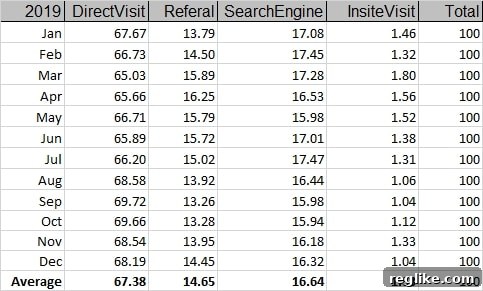
One significant alteration by Baidu pertains to the granularity of their data. Historically, yearly aggregate numbers for web traffic categories were readily available, simplifying year-over-year comparisons. Unfortunately, Baidu has shifted its reporting, now providing only monthly figures. To overcome this hurdle and maintain the integrity of a yearly comparative analysis, I adopted a methodological solution: averaging the monthly figures to derive the annual numbers. While this approach provides a reasonable approximation for trend identification, it’s important to acknowledge that it differs from directly reported annual sums, potentially introducing minor variances in the absolute values compared to previous years’ direct reporting.
Evolving Traffic Classification: A New Category Emerges
Another challenge stemmed from the evolution of Baidu’s traffic classification system. In previous reports, web traffic was categorized into distinct types: Direct Visit, Referral, Search Engine, Directory, and Social Media. This framework provided a clear understanding of the diverse sources driving online activity. However, the updated data reflects a streamlined classification where only Direct Visit, Referral, and Search Engine categories are retained. The categories of “Directory” and “Social Media” are no longer explicitly listed as standalone traffic sources. This change could imply that traffic previously classified under these headings is now aggregated into “Referral” or “Search Engine” categories, or that their individual significance for direct tracking has diminished from Baidu’s perspective.
Accompanying this streamlining is the introduction of a new category, identified by the Chinese term 站内来源. Translating this accurately into English posed a semantic challenge. My interpretation led to “Insite Visit,” which, based on its description, measures visitors who become active again after a period of inactivity exceeding 30 minutes. This new category introduces an interesting dimension to user engagement, potentially highlighting re-engagement from long-idle sessions rather than completely new visits. Its inclusion suggests Baidu’s enhanced focus on understanding sustained user interaction and session management, distinguishing it from an entirely fresh direct visit. Understanding the nuances of “Insite Visit” is crucial for a comprehensive understanding of user behavior and engagement metrics within the Chinese digital landscape.
The Enduring Power of Direct Navigation in China: Interpreting the Latest Data
Despite the changes in data format and classification, the updated analysis of web traffic in China reinforces a consistent and critical trend. Below is the updated version of web traffic in China, which, while not directly comparable in absolute terms to previous years, clearly illustrates the relative dominance of different traffic sources.

The data unequivocally demonstrates that direct visit remains the predominant method by which visitors access websites in China. This finding carries significant weight for any individual or organization operating or planning to enter the Chinese market. It implies a distinctive user behavior: Chinese consumers actively remember and consciously specify domain names in their browser to navigate to desired websites. This isn’t merely a preference; it’s a deeply ingrained digital habit that contrasts sharply with the search-engine-first approach often observed in Western internet usage.
Implications for Brand Strategy and Domain Investment
The sustained dominance of direct navigation profoundly impacts brand strategy and domain investment in China:
- Unparalleled Importance of Memorable Domains: For businesses, this means that a short, memorable, and easily pronounceable domain name is an invaluable asset. It functions as a digital address that users are willing and able to recall and type. Brand names that translate well into concise Pinyin or numeric domains often gain a significant advantage.
- Enhanced Brand Recall and Loyalty: When users directly navigate to a site, it signifies a higher level of brand recognition and intent. This behavior is indicative of strong brand building efforts, where the domain name itself becomes synonymous with the brand. It suggests that once a user is familiar with a brand, they bypass intermediary search engines or referrals for subsequent visits.
- Reduced Reliance on Paid Search for Established Brands: While search engine optimization (SEO) and paid advertising remain crucial for initial discovery, the high rate of direct visits suggests that for established brands, user retention and repeat traffic are heavily driven by direct access. This can potentially lead to more cost-effective long-term marketing strategies focused on brand building and direct communication channels.
- Strategic Domain Portfolio Management: Given the propensity for direct navigation, securing not just a primary .com domain but also relevant country-code top-level domains like .cn, as well as common alternative spellings or Pinyin variations, becomes a critical protective and offensive strategy. This ensures that users reaching for a specific brand are not inadvertently diverted to competitors or squatters.
The secondary, yet still important, roles of Search Engines and Referrals should not be overlooked. While direct visits dominate repeat traffic, search engines likely play a crucial role in initial discovery, especially for new brands or specific product searches. Referrals, meanwhile, could encompass traffic from partnerships, affiliate sites, or even increasingly, from within the vast ecosystem of Chinese super-apps. The “Insite Visit” category, while still needing further clarification on its exact operational definition, suggests a focus on re-engagement and session longevity, indicating that once a user is on a platform, Baidu tracks their continued interaction and return within certain timeframes. This could be relevant for content platforms or service providers aiming for sustained user activity.
Forecasting Domain Demand: The Future is Direct
The consistent pattern observed in Baidu’s web traffic data solidifies the notion that demand for easy-to-remember and brandable domain names will continue to surge in China. As the digital economy expands and more businesses vie for online visibility, the intrinsic value of a domain name that facilitates direct navigation will only grow. This insight is not just a statistical observation; it’s a strategic imperative for anyone serious about success in the Chinese digital market.
The unique blend of cultural factors, technological infrastructure, and user habits in China has fostered an environment where the domain name acts as a powerful, direct gateway. Investors and businesses should view premium domains not as mere web addresses, but as prime digital real estate that guarantees direct access to a highly engaged and intentional user base. The future of web traffic in China, according to the latest data, continues to point towards a path paved by direct visits, underscoring the enduring power and increasing demand for impactful domain names.
You can access the comprehensive Baidu web traffic data here for further exploration.